CLINICAL MEMORY
Longitudinal Diagnostic Memory
Carry IPSS trajectories, PVR trends, and dated medication trials from visit to visit. Find BPH prompt packs at Access Specialty Prompts at templates.scribing.io to generate notes in 5 seconds.
Specialty Clinical Playbook
Capture IPSS scores, PVR volumes, and dated BPH medication trials in distinct E/M sections. Book your audit at https://cal.com/merryai/demo.
 Dr. Sarah Chen, MD
Specialty Architecture
Engineered to mirror the pacing, diagnostic frameworks, and documentation requirements of Urology, from IPSS review to same-day cystoscopy.
CLINICAL MEMORY
Carry IPSS trajectories, PVR trends, and dated medication trials from visit to visit. Find BPH prompt packs at Access Specialty Prompts at templates.scribing.io to generate notes in 5 seconds.
CONTEXT RETRIEVAL
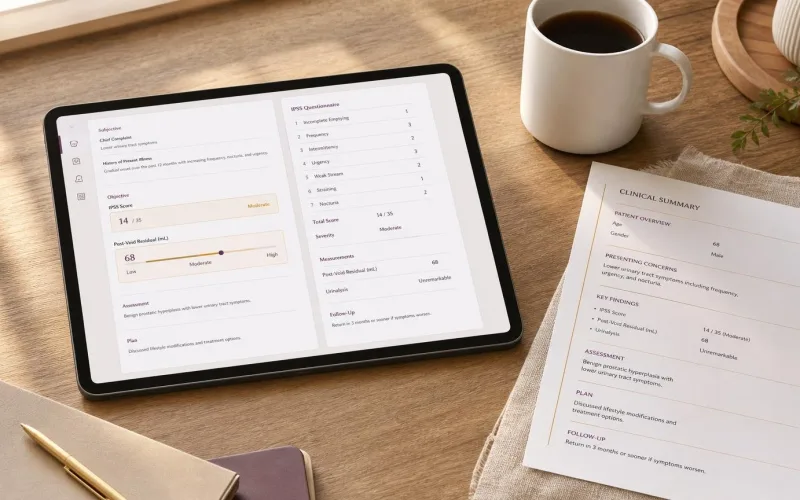
Retrieve prior IPSS totals, bladder-scan residuals, uroflow Qmax, and PSA trends without tab bouncing between questionnaire, vitals, and medication panels.
COMPLEXITY CAPTURE
Capture G2211 where longitudinal BPH care qualifies, and suppress it when a non-preventive E/M carries Modifier 25. Schedule a 15-Minute Specialty Workflow Audit today.
SPEAKER ROUTING
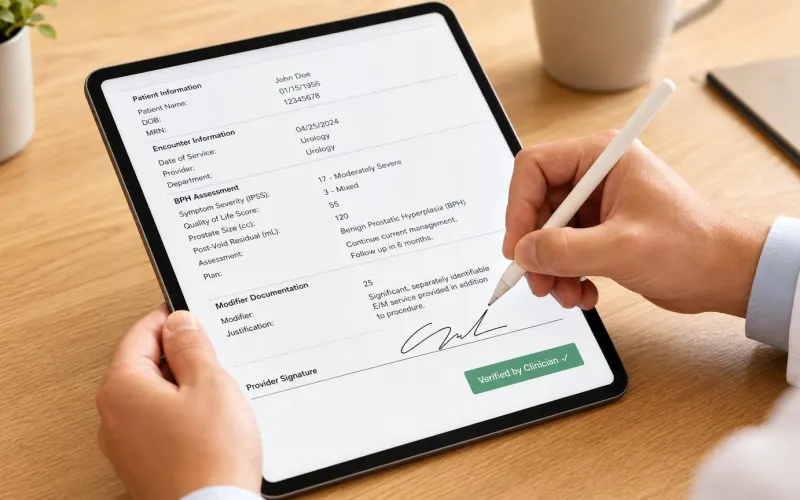
Diarize patient, caregiver, and clinician dialogue and map findings directly into the E/M history, assessment, and procedure sections your urology template expects.
Point-of-Care Flow
Zero IT friction, zero complex API setup, and human-verified attestation on every note.
A follow-up visit for benign prostatic hyperplasia looks simple on the schedule and rarely is. In fifteen minutes the urologist reviews a symptom questionnaire, reads a bladder scan, reconciles a medication history that may span three years and two drug classes, examines the prostate, and decides whether medical therapy has run its course. Each of those steps carries documentation weight, and each is easy to lose when the note is assembled from memory at the end of the day.
Auditors reviewing BPH escalation claims look for the same handful of facts every time: a numeric symptom score, a measured residual, and evidence that conservative management was tried and failed. When those facts live only in a questionnaire tab or a scanned bladder-scan printout, the narrative that justifies cystoscopy, urodynamics, or referral for a prostatic procedure reads as thin. Merry listens to the encounter and writes those facts into the assessment where reviewers expect to find them.
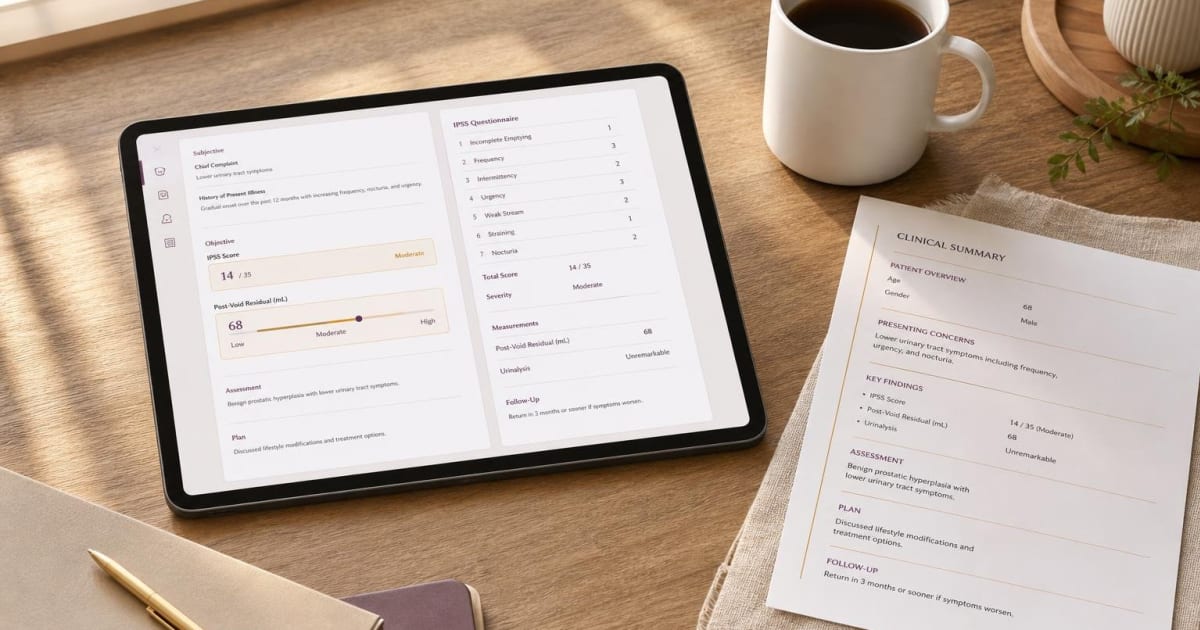
The International Prostate Symptom Score asks seven questions covering incomplete emptying, frequency, intermittency, urgency, weak stream, straining, and nocturia, each scored zero to five, plus a separate quality-of-life item. Totals of 0 to 7 are mild, 8 to 19 moderate, and 20 to 35 severe. Merry reads the completed questionnaire when it is present, mirrors the total and dominant symptoms in the narrative, and records the prior score so that change over time is visible in a single sentence rather than across five archived notes.
Post-void residual must be documented in mL with its method, whether bladder scan or catheterization, because a scanner estimate and a catheterized volume carry different weight. Alongside it, Merry records each failed trial with drug, dose, start and stop dates, and the reason it ended: tamsulosin 0.4 mg daily from March to June with persistent nocturia, or finasteride 5 mg stopped after six months for sexual side effects. Dated entries are what distinguish a considered escalation from a hurried one.
The matrix below summarizes how each urology metric translates into a documentation requirement and the billing evidence it supports. Merry uses it as a checklist during drafting and flags any row that remains empty before the note is signed.
| Specialty Diagnostic Metric | Required Clinical Data Points | Billing Evidence |
|---|---|---|
| IPSS / AUA Symptom Score | Total 0-35, severity band, QoL item, prior score and date | Supports MDM problem complexity and escalation rationale |
| Post-Void Residual (PVR) | Volume in mL, method, trend across visits | Supports medical necessity for 51798 and further workup |
| Failed Medical Therapy | Drug, dose, start and stop dates, reason for discontinuation | Supports MDM risk and procedural necessity |
| Uroflowmetry | Qmax in mL/s, voided volume, curve pattern | Supports 51741 and obstruction assessment |
| Prostate Volume | DRE estimate or TRUS volume | Guides therapy selection and diagnostic reasoning |
| Red-Flag Findings | Hematuria, retention episodes, recurrent UTI, PSA trend | Supports a separately identifiable E/M with Modifier 25 |
Each row reflects a fact a reviewer can verify without inference. When the matrix is complete, the assessment rests on measured values rather than adjectives.
Urology clinics routinely pair an office visit with a minor procedure on the same date: cystoscopy, a bladder scan, uroflowmetry, or a catheter change. Under NCCI policy, Modifier 25 is appropriate only when the evaluation and management service is significant and separately identifiable from the usual pre- and post-procedure work. The diagnoses may overlap; the documented work may not.
Merry enforces that separation physically in the chart. Symptom review, IPSS discussion, medication reconciliation, and the decision-making conversation are routed into the visit or assessment pane, while scope findings, anesthesia, and technique go into the procedure pane. Questionnaire data is never written into the procedure note, so the E/M service reads as its own body of work when a reviewer opens the encounter.
HCPCS G2211 recognizes the longitudinal relationship a urologist holds with a patient whose BPH, retention, or stone disease requires ongoing management. It is reported only with office and outpatient codes 99202 through 99215 or eligible home visit codes. Medicare does not pay G2211 when the base visit carries Modifier 25, with one exception: since January 1, 2025, it may be payable when the same-day service is an annual wellness visit, initial preventive physical exam, vaccine administration, or another Part B preventive service.
For nearly every urology encounter that includes cystoscopy or another minor procedure, that exception does not apply. Merry therefore suppresses G2211 by default whenever a non-preventive E/M carries Modifier 25, and explains the reason in a short note to the coder. Payer or state overlays, reviewed by your own compliance staff, can sit on top of the national logic.
Open the web EHR encounter as you normally would, then enable Merry from the Chrome toolbar. On first use, map the E/M note section and the procedure section by clicking into each field once; Merry remembers those targets for your EHR and template. No API connection or IT ticket is required.
Specialty prompt packs for BPH, hematuria, and stone follow-up are available at https://templates.scribing.io. Each pack includes the IPSS, PVR, and dated-trial fields described above. For current code descriptors and guideline language, keep the https://www.ama-assn.org/practice-management/cpt reference close at hand.
Every note remains a draft until the urologist reviews and signs it. Merry assembles the evidence; the clinician attests to it.
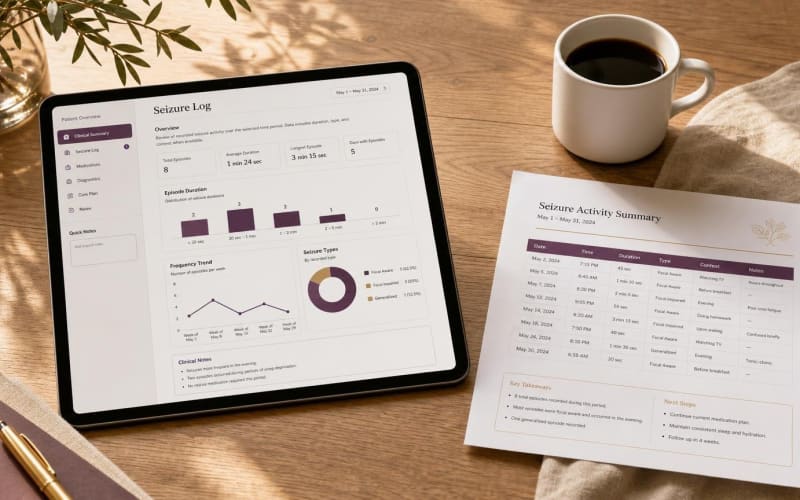
Seizure frequency, semiology, and mg/kg dosing captured at the point of care. Book your audit at https://cal.com/merryai/demo.

Seizure counts, mg/kg dosing, and EEG dates structured into every plan. Book your audit at https://cal.com/merryai/demo.

Separate BPH E/M work from cystoscopy and track IPSS, PVR, and PSA velocity per year. Book your audit at https://cal.com/merryai/demo.