CLINICAL MEMORY
Longitudinal Diagnostic Memory
Carry prior IPSS totals, PVR values, and serial PSA results forward visit to visit. Access Specialty Prompts at templates.scribing.io for BPH and hematuria structures.
Specialty Clinical Playbook
Separate BPH E/M work from cystoscopy and track IPSS, PVR, and PSA velocity per year. Book your audit at https://cal.com/merryai/demo.
 Dr. Sarah Chen, MD
Specialty Architecture
Engineered to mirror the pacing, diagnostic frameworks, and documentation requirements of Urology.
CLINICAL MEMORY
Carry prior IPSS totals, PVR values, and serial PSA results forward visit to visit. Access Specialty Prompts at templates.scribing.io for BPH and hematuria structures.
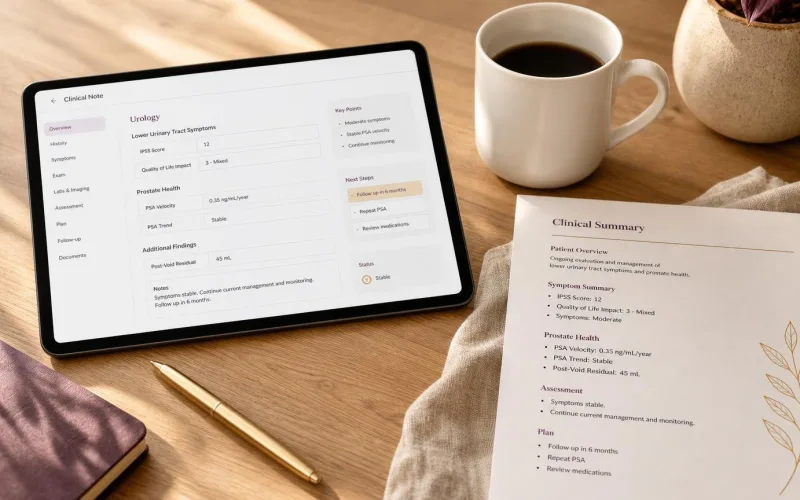
CONTEXT RETRIEVAL
Retrieve PSA trajectories, prior residuals, and 5-alpha-reductase inhibitor history without tab bouncing.
COMPLEXITY CAPTURE
Surface G2211 on E/M-only BPH follow-ups and withhold it on Modifier 25 cystoscopy days. Schedule a 15-Minute Specialty Workflow Audit today.
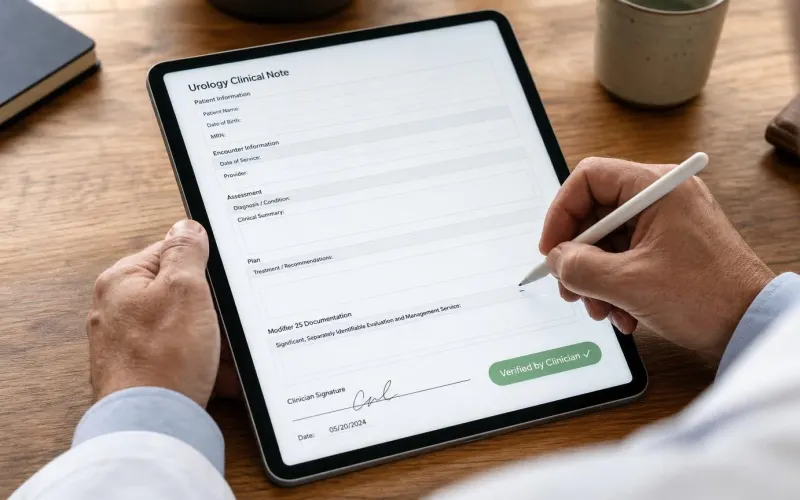
SPEAKER ROUTING
Diarize patient, spouse, and clinician dialogue and map findings into Problem 1 E/M and Problem 2 procedure sections.
Point-of-Care Flow
Zero IT friction, zero complex API setup, and human-verified attestation on every note.

A typical urology follow-up rarely holds a single service. A man returns for benign prostatic hyperplasia management, his tamsulosin dose needs reconsideration, his PSA has moved since spring, and before he leaves the room a flexible cystoscopy is performed for microscopic hematuria. Each of those threads is legitimate clinical work. On paper, however, they often collapse into one narrative, and a blended narrative is precisely what a payer reviewer reads as a procedure with ordinary pre-service evaluation attached.
Modifier 25 exists for this situation, but it rewards architecture rather than volume. CPT defines it as a significant, separately identifiable E/M service on the same day as a procedure, and NCCI principles expect the E/M work to extend beyond the usual pre- and post-procedure care bundled into a code such as 52000. The AMA's guidance at https://www.ama-assn.org/practice-management/cpt is worth rereading with your coders before any template is finalized.
Merry drafts the encounter as two distinct problems from the first word. Problem 1 carries BPH management: symptom burden, objective emptying, medication decisions, and laboratory trend. Problem 2 carries the cystoscopy indication, consent, findings, and post-procedure plan. The clinician changes nothing in the room; the structure appears only in the draft awaiting review.
Longitudinal prostate care depends on values that can be compared across visits. Adjectives such as 'improved' or 'stable' cannot be trended, cannot be audited, and cannot justify a medication change. Merry listens for the numeric anchors urologists already speak aloud and places them in fixed positions within Problem 1, so that next year's reviewer, or next year's you, finds them in the same place.
The International Prostate Symptom Score totals seven items from 0 to 35, banded as mild (0–7), moderate (8–19), and severe (20–35). Merry records the total, the band, and the separate quality-of-life item scored 0 to 6, because a moderate score with a bother score of 5 tells a very different story than the same total with a bother score of 1. When the patient reports individual items, storage and voiding subscores are preserved rather than summed away.
Post-void residual belongs in millilitres, with the method noted, whether bladder scanner or catheterization. 'Empties well' is not a finding. Merry captures the value, compares it with the prior documented residual, and notes when the clinician has voiced concern about retention, so that the medical decision making behind an alpha-blocker adjustment or a urodynamics referral is visible in the note itself.
PSA velocity should be expressed in ng/mL per year, with the dates and values used for the calculation listed alongside it. Velocity drawn from two closely spaced values is noisy; many urologists prefer at least three measurements spanning roughly 18 months. Merry documents the values the clinician cites, notes whether finasteride or dutasteride is in use, since these agents roughly halve measured PSA, and records the clinician's interpretation rather than generating one.
This matrix reflects how Merry sorts spoken findings into billing-relevant evidence. It is a documentation aid, not a coding determination; final code selection rests with the clinician and the practice's coding staff.
| Specialty Diagnostic Metric | Required Clinical Data Points | Billing Evidence |
|---|---|---|
| IPSS total and bother score | Total 0–35, severity band, QoL item 0–6, prior score and date | Chronic illness management in E/M MDM; Problem 1 |
| Post-void residual (PVR) | Value in mL, method (scanner or catheter), prior PVR | Objective data reviewed; supports medication or referral decisions |
| PSA velocity | Serial PSA values with dates, ng/mL per year, 5-ARI status | Data review and risk assessment within E/M |
| Cystoscopy indication | Hematuria, tumor surveillance, or refractory LUTS; consent; findings; post-procedure plan | Procedure note for CPT 52000; Problem 2, separate from E/M |
| Same-day E/M plus procedure | Work beyond usual pre- and post-procedure care | Modifier 25 on E/M; G2211 withheld |
| E/M-only longitudinal visit | Continuing focal-point relationship, medication titration, comorbidities | G2211 eligible with office/outpatient E/M |
One rule deserves emphasis here. CMS edits deny G2211 when the office E/M is billed with Modifier 25 on the same day as a separately payable procedure. Merry therefore withholds the G2211 suggestion on cystoscopy days and surfaces it on E/M-only BPH follow-ups where longitudinal management is documented. The narrow preventive-service exception, effective 2025, is flagged for coder review rather than applied automatically.
Open the Tebra encounter first, before the patient conversation begins, so the note shell exists in the active browser tab. Then launch the Merry Chrome Extension from the toolbar. No API credentials, interface engine, or IT ticket is required; the extension reads the visible chart sections the way you do.
Record the visit as usual. Merry separates clinician, patient, and any accompanying family member, so a spouse's account of nocturia or a weakening stream stays attributed to the person who said it.
Review each drafted problem separately. Problem 1 is inserted into the Assessment and Plan section for the E/M service; Problem 2 is inserted into the procedure documentation tied to the cystoscopy. You confirm IPSS, PVR, and PSA velocity values, edit freely, and attest before anything is signed. Nothing is written into locked or system-generated coding fields.
Prompt packs for urology live at https://templates.scribing.io, including BPH follow-up, hematuria evaluation, and stent-check structures. Audio is processed in memory and discarded at session close under an executed BAA, leaving only the note you approved.

Seizure counts, mg/kg dosing, and EEG dates structured into every plan. Book your audit at https://cal.com/merryai/demo.

Structure tissue stages, sub-millimeter margin clearing, defect reconstruction, and distinct procedural defense.

Document separate E/M decision-making, fluoroscopy logs, and facet injection intervals to survive Medicare audits.