CLINICAL MEMORY
Longitudinal Seizure Memory
Carry seizure frequency per type, last-event dates, and dose history across visits. Find seizure log prompt packs at Access Specialty Prompts at templates.scribing.io to generate notes in 5 seconds.
Specialty Clinical Playbook
Seizure frequency, semiology, and mg/kg dosing captured at the point of care. Book your audit at https://cal.com/merryai/demo.
 Dr. Sarah Chen, MD
Specialty Architecture
Engineered to mirror the pacing, diagnostic frameworks, and documentation requirements of Pediatric Neurology.
CLINICAL MEMORY
Carry seizure frequency per type, last-event dates, and dose history across visits. Find seizure log prompt packs at Access Specialty Prompts at templates.scribing.io to generate notes in 5 seconds.
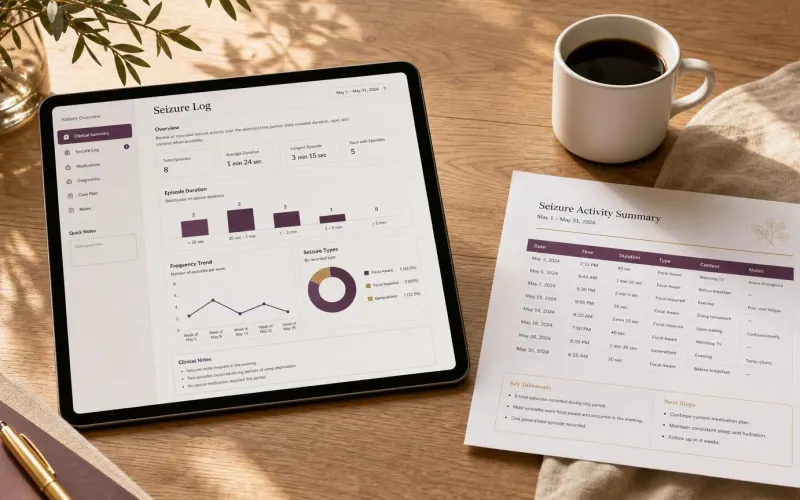
CONTEXT RETRIEVAL
Retrieve weight z-score trends, prior mg/kg dosing, EEG findings, and milestone trajectories without tab bouncing.
COMPLEXITY CAPTURE
Document the continuing epilepsy care relationship that supports longitudinal complexity add-on revenue. Schedule a 15-Minute Specialty Workflow Audit today.
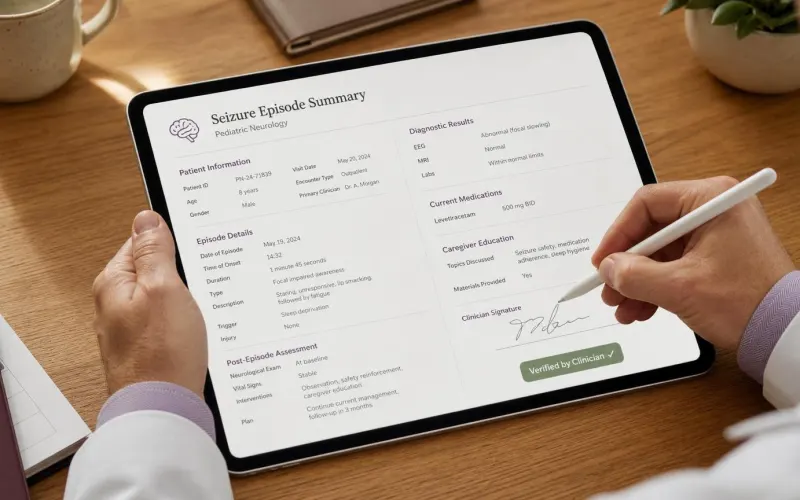
SPEAKER ROUTING
Diarize parent, child, and interpreter dialogue and map witnessed semiology, auras, and side effects into specialty-approved note sections.
Point-of-Care Flow
Zero IT friction, zero complex API setup, and human-verified attestation on every note.

Every pediatric epilepsy follow-up visit begins with the same quiet question: what has changed since we last met? The answer rarely arrives in order. A parent reaches for a phone calendar of events, a grandparent recalls a cluster during a fever, and an adolescent mentions a morning of jerks before breakfast. The seizure log is where these fragments become a clinical instrument.
AAN epilepsy quality measures ask for seizure type, frequency for each type, and time since last seizure at every visit. Child neurology measures add appropriately dosed rescue therapy for prolonged convulsive seizures, neurodevelopmental and behavioral screening, safety counseling, and transition planning. None of this is easy to type while also watching a child's gait, affect, and attention across the room.
Merry listens to the encounter and drafts the log in the structure the measures already expect. It separates caregiver history from the patient's own account, so a mother's description of a focal impaired awareness event is not blended with her son's report of an aura. The clinician remains the author; Merry keeps the ledger.
Four data points anchor every pediatric seizure note: monthly seizure frequency, semiology, mg/kg antiseizure dose, and weight z-score. When these sit as discrete, consistently labeled elements rather than scattered narrative, they can be trended, audited, and queried by registries. Published work on pediatric epilepsy common data elements, available through https://www.ncbi.nlm.nih.gov/pmc/, makes the same argument for learning healthcare systems.
Frequency is logged per seizure type, not as a single blended count. Merry records focal aware, focal impaired awareness, generalized tonic-clonic, absence, myoclonic, and epileptic spasms separately, with the date of the last event and any clusters requiring rescue medication. Semiology follows ILAE language: onset, awareness, motor or non-motor features, duration, and postictal state, including Todd paresis or confusion.
When a caregiver describes behavior that may be non-epileptic, such as staring with preserved responsiveness or paroxysmal sleep events, Merry drafts the description verbatim and flags it for clinician review rather than assigning a classification. Diagnostic judgment stays with the neurologist.
Children grow out of doses quietly. A levetiracetam regimen at 30 mg/kg/day in spring may drift toward 22 mg/kg/day by autumn after a growth spurt. Merry takes the stated weight from the encounter, calculates current mg/kg/day for each antiseizure medication, and records the WHO or CDC weight z-score alongside it. Rescue therapy, whether intranasal midazolam or rectal diazepam, is documented with its weight-based dose and the seizure action plan.
A falling weight z-score paired with topiramate or a ketogenic diet trial becomes visible in the note itself, prompting the conversation about appetite or metabolic monitoring that might otherwise wait.
The workflow is deliberately simple. Open the web EHR encounter, activate Merry from the Chrome Extension, and conduct the visit as usual. After review, Merry maps the seizure log and caregiver observations into the HPI field, and medication changes, rescue plan, EEG orders, and counseling into the Plan field. Insertion uses standard input events, so autosave and audit trails behave normally. Nothing is written after signature.
The matrix below connects each diagnostic metric to the data points the note must contain and the billing evidence it supports.
| Specialty Diagnostic Metric | Required Clinical Data Points | Billing Evidence |
|---|---|---|
| Monthly seizure frequency | Count per ILAE type, date of last seizure, cluster events | Chronic illness with progression; supports MDM level |
| Seizure semiology | Onset, awareness, motor or non-motor features, duration, postictal state | Independent historian and diagnostic reasoning |
| mg/kg antiseizure dose | Current weight, total daily dose, mg/kg/day, titration change | Prescription drug management risk element |
| Weight z-score | WHO/CDC z-score, trend since prior visit | Longitudinal monitoring supporting G2211 |
| Rescue therapy plan | Agent, weight-based dose, five-minute threshold, caregiver education | AAN child neurology measure capture |
| Behavioral and developmental screen | Vanderbilt, PHQ-A, school performance, milestones | Comorbidity complexity documentation |
Prompt packs for each row are available at https://templates.scribing.io, including seizure diary templates for infantile spasms, absence epilepsy, and Dravet syndrome follow-up.
G2211 recognizes the continuing relationship that pediatric epilepsy care already is. Its language describes ongoing care for a single serious or complex condition, and a well-kept seizure log, with frequency trends, dose recalculations, and growth monitoring across visits, is the plainest evidence of that relationship. Payer policies for children vary, so confirm coverage with your coding team.
Same-day procedures require clear separation. When a routine EEG or a botulinum toxin session for spasticity falls on the day of the epilepsy visit, the note must show a significant, separately identifiable E/M service for modifier 25, or a distinct procedural service for modifier 59. Merry keeps the epilepsy narrative apart from procedural documentation so the boundary is legible to an auditor.
Protected health information is handled with zero retention: audio and transcripts are processed in memory and discarded once the note is finalized, under an executed Business Associate Agreement. Merry produces a draft, the clinician reviews and edits, and only an explicit action commits the note to the chart.
The quiet aim is time. Fewer evenings reconstructing a seizure history from memory, and more attention left for the child and family in the room.
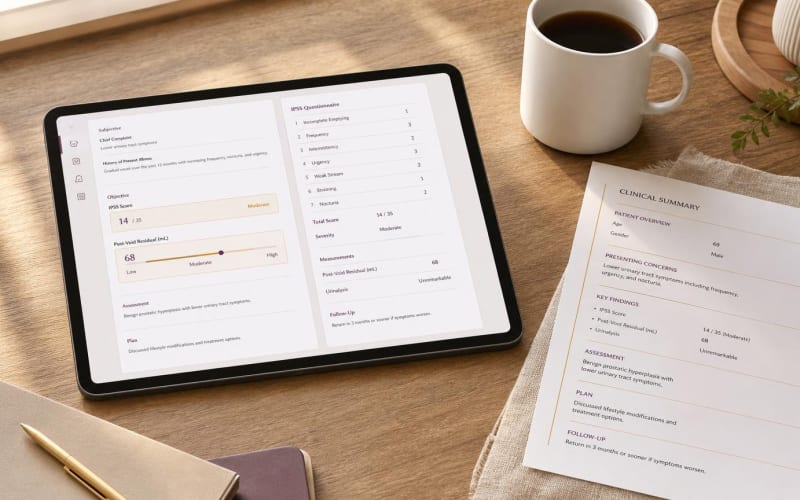
Capture IPSS scores, PVR volumes, and dated BPH medication trials in distinct E/M sections. Book your audit at https://cal.com/merryai/demo.

Seizure counts, mg/kg dosing, and EEG dates structured into every plan. Book your audit at https://cal.com/merryai/demo.

Separate BPH E/M work from cystoscopy and track IPSS, PVR, and PSA velocity per year. Book your audit at https://cal.com/merryai/demo.