
CLINICAL MEMORY
Longitudinal Recovery Memory
Find 40+ prompt packs at templates.scribing.io to generate BIRP/DAP notes in 5 seconds and surface unresolved relapse-risk questions.
Specialty Clinical Playbook
Turn one 3-hour group session into individualized, 42 CFR Part 2-compliant progress notes per client. Book your audit at https://cal.com/merryai/demo.
 Dr. Sarah Chen, MD
Specialty Architecture
Engineered to mirror the pacing, diagnostic frameworks, and documentation requirements of Addiction Treatment & Intensive Outpatient Clinics.
CLINICAL MEMORY
Find 40+ prompt packs at templates.scribing.io to generate BIRP/DAP notes in 5 seconds and surface unresolved relapse-risk questions.
CONTEXT RETRIEVAL
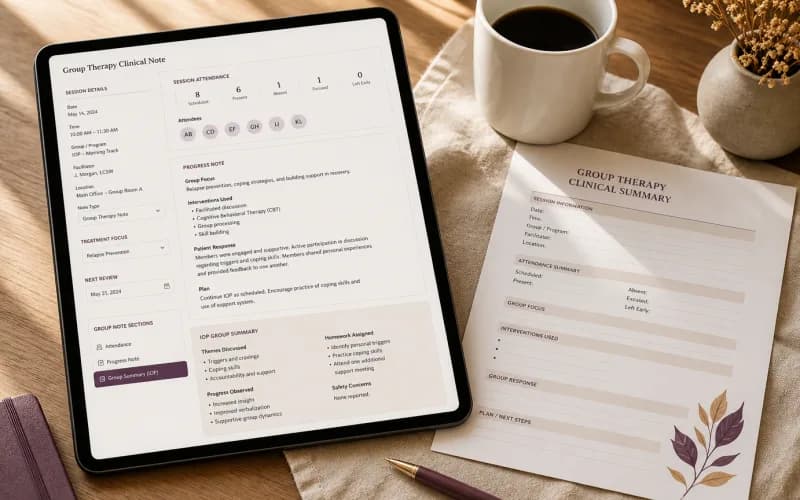
Retrieve prior ASAM dimensions, UDS trends, and continued-stay criteria in one structured draft without tab bouncing.
WORKFLOW INTELLIGENCE
Capture utilization-review evidence and auto-draft level-of-care justification. Claim your 15-Minute Workflow Audit today.
SPECIALTY-AWARE REASONING
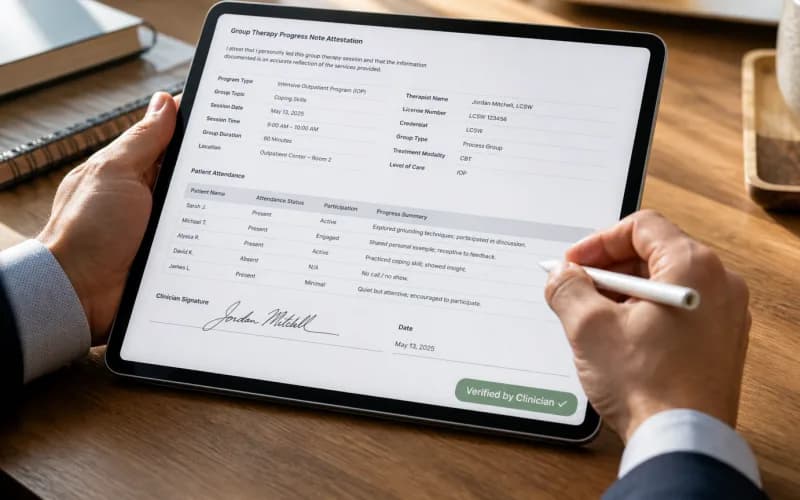
Diarize 10+ voice group sessions and map each client's participation into individualized, Part 2-safe note sections.
Point-of-Care Flow
Zero IT friction, zero complex API setup, and human-verified attestation on every individualized note.
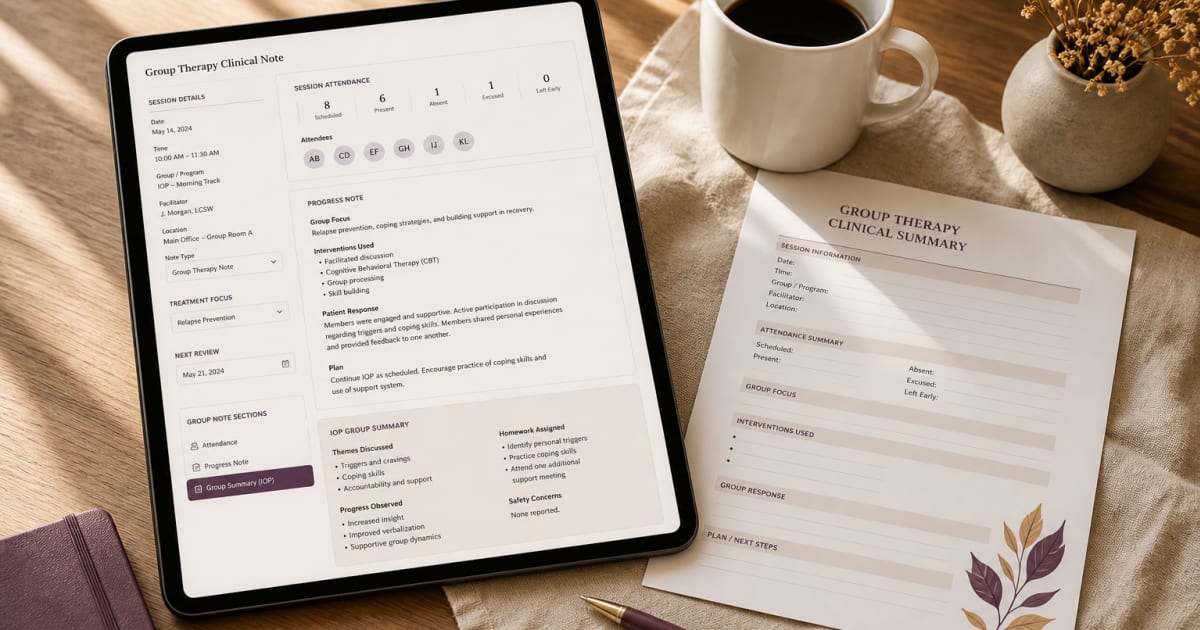
Clinical documentation in addiction treatment is fundamentally a problem of one-to-many transformation. A single three-hour group session with ten or more participants is not one clinical event but ten distinct, legally separable episodes of care. Each participant requires an individualized progress note that ties the shared session content to that client's own diagnosis, treatment-plan goals, documented response, and next steps. Shared or copy-pasted group notes are a leading source of noncompliance and privacy exposure in IOP and PHP settings.
Merry AI approaches this challenge by treating the acoustic stream as a routable data source rather than a single transcript. Diarization separates concurrent voices, attributes each utterance to the correct speaker, and then decomposes the session into participant-specific narratives. The result is a distinct note per client that preserves the golden thread while carefully excluding the identities and disclosures of other group members, a mandatory requirement under 42 CFR Part 2 substance-use confidentiality rules.
The following clinical logic matrix maps the specialty diagnostic frameworks used in addiction medicine against the structured data points each note must capture and the billing evidence that defends the claim during utilization review or post-payment audit.
| Clinical Diagnostic Framework | Required Clinical Data Points | Billing & Audit Evidence |
|---|---|---|
| ASAM Level of Care (Dimensions 1-6) | Withdrawal risk, biomedical status, emotional/behavioral conditions, readiness to change, relapse potential, recovery environment | Continued-stay and step-down justification; medical necessity for IOP Rev Code 0905 |
| DSM-5-TR SUD Severity | Number of criteria met, specifiers, remission status, co-occurring diagnoses | Diagnosis-to-service linkage supporting E/M and G2211 complexity |
| BIRP / DAP Group Note | Behavior, Intervention, Response, Plan per participant; individualized engagement | Per-client service date, duration, location, signature, timestamp |
| UDS / Lab Trend | Substance panel results, longitudinal trajectory, MAT adherence markers | Objective evidence for OTP bundled-payment services under Medicare Chapter 17 |
Utilization review in addiction programs lives or dies on the golden thread: the traceable line connecting the intake assessment, the ASAM placement decision, each treatment-plan objective, every progress note, and the eventual discharge or step-down. When a reviewer cannot follow that thread, medical necessity collapses and reimbursement is denied. Merry AI is engineered to retrieve prior ASAM dimensions and treatment-plan goals into every new draft so the continuity is visible in each note rather than reconstructed after the fact.
Level-of-care specificity matters most acutely at transition points. Moving a client from PHP to IOP, or defending a continued stay at a higher intensity, requires documentation that explicitly references the ASAM criteria driving the decision. The system prompts clinicians toward the specific dimension language reviewers expect, converting vague session summaries into defensible placement rationale.
Group therapy documentation must be individualized even though the therapeutic event is shared. California DHCS guidance and comparable state timelines require that each note document the specific client's participation and response while prohibiting the naming of other participants. Merry AI's speaker routing enforces this structurally: each generated note contains only the attributed client's contributions, with cross-references to other members stripped before the draft ever reaches the chart.
Complexity add-on capture is often overlooked in behavioral health. Per CMS FAQ guidance, HCPCS G2211 may be reported alongside office/outpatient E/M codes 99202-99215 when the clinician serves as the continuing focal point for a patient's serious or complex condition, a description that fits ongoing SUD management well. For IOP services in FQHC and RHC settings, CMS MM13264 mandates certification and plan-of-care documentation under Revenue Code 0905. Merry AI surfaces this evidence during drafting so the billing packet is complete before signature.
Substance-use records carry heightened confidentiality obligations beyond baseline HIPAA. The 2024 revisions to 42 CFR Part 2, analyzed in peer-reviewed work available through the National Library of Medicine, have eased certain integration pathways into electronic health records while preserving strict controls over redisclosure. Any AI documentation vendor touching this data must operate under an executed Business Associate Agreement and honor the additional consent requirements Part 2 imposes.
Consent and disclosure workflows should state plainly that sessions may be recorded, transcribed, and AI-assisted, identify who processes the audio, explain retention, and allow clients to decline where applicable. Merry AI's zero-retention design supports this by shredding audio and interim transcripts from volatile memory once notes are finalized, leaving only the clinician-signed record in the EHR.
Every note that Merry AI drafts preserves a versioned record of what the model generated, what the clinician edited, and who applied the final signature. This audit trail is essential for QA and post-payment audit defense, where reviewers increasingly ask how AI-assisted documentation was verified. The treating clinician remains the record owner and the final signatory; the system never signs on their behalf.
Behavioral-health EHRs are notoriously closed environments. Rather than wait months for an HL7 or FHIR interface, Merry AI's Chrome Extension injects structured notes directly into the active Kipu or ZenCharts browser window through DOM insertion. There is no API queue lag, no IT provisioning, and no complex integration project. Clinicians access 40+ tuned prompt packs to accelerate drafting; you can Access Specialty Prompts at templates.scribing.io to align output with your program's templates.
The practical outcome for a ten-participant, three-hour group is transformative: one recording becomes ten compliant, individualized, golden-thread progress notes with medical-necessity evidence and Part 2-safe redaction, ready for single-click delivery into the chart. To see this workflow run against your own session structure, Schedule a 15-Minute Specialty Workflow Audit with our clinical team.
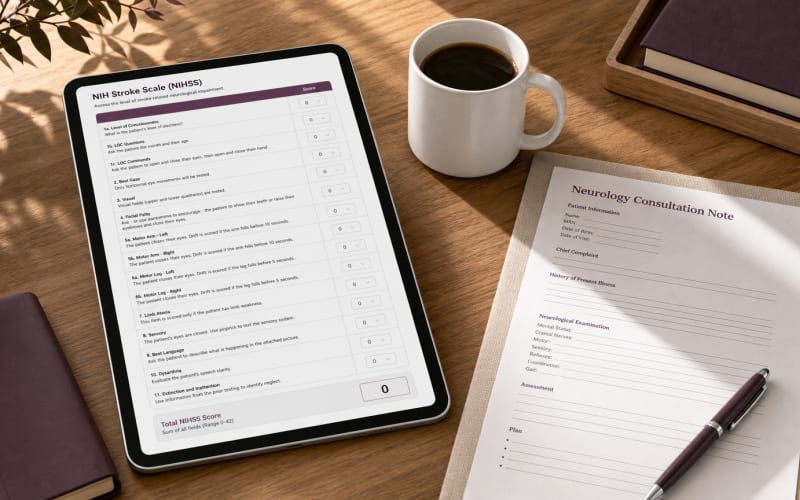
Convert the spoken neurological exam into discrete NIHSS and MMSE item scores with verifiable attestation. Book your audit at https://cal.com/merryai/demo.
Ambient reasoning that captures GDMT titration, LVEF trends, and CPT G2211 complexity without a single voice command. Book your audit at https://cal.com/merryai/demo.
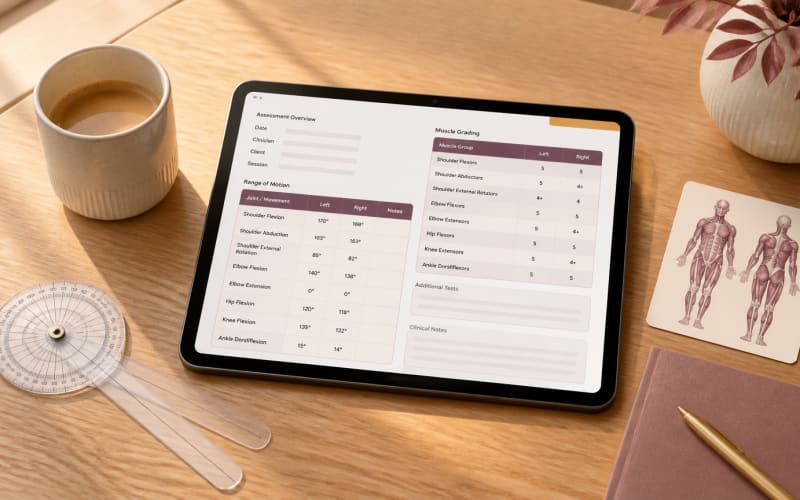
Convert spoken MSK exams into discrete ROM degrees and 0–5 strength grades that satisfy payer medical-necessity checklists. Book your audit at https://cal.com/merryai/demo.