
CLINICAL MEMORY
Longitudinal Patient Memory
Find 40+ prompt packs at templates.scribing.io to generate cardiology and internal medicine notes in 5 seconds and surface unresolved GDMT titration questions.
Specialty Clinical Playbook
Ambient reasoning that captures GDMT titration, LVEF trends, and CPT G2211 complexity without a single voice command. Book your audit at https://cal.com/merryai/demo.
 Dr. Sarah Chen, MD
Specialty Architecture
Engineered to mirror the pacing, diagnostic frameworks, and documentation requirements of multimorbid chronic disease management and structural heart care.
CLINICAL MEMORY
Find 40+ prompt packs at templates.scribing.io to generate cardiology and internal medicine notes in 5 seconds and surface unresolved GDMT titration questions.

CONTEXT RETRIEVAL
Retrieve prior LVEF trajectories, BNP trends, lipid panels, and CHA2DS2-VASc scores in one structured draft without tab bouncing.
WORKFLOW INTELLIGENCE
Autonomously detect longitudinal continuous care patterns and auto-draft the G2211 complexity add-on rationale. Claim your 15-Minute Workflow Audit today.
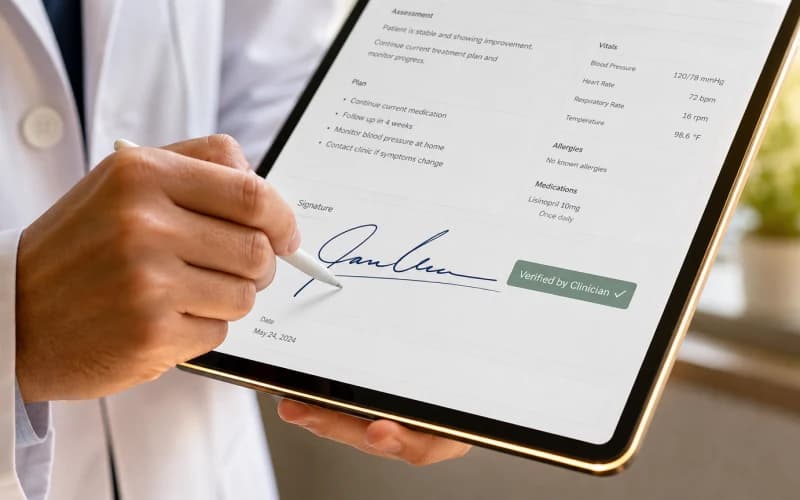
SPECIALTY-AWARE REASONING
Diarize multi-party cardiology dialogues and map NYHA class, edema grading, and titration decisions directly into specialty-approved assessment sections.
Point-of-Care Flow
Zero IT friction, zero complex API setup, and human-verified attestation on every note.

Clinical documentation in Internal Medicine and Cardiology carries a cognitive weight that few specialties rival, because the encounter is rarely about a single complaint. A follow-up visit routinely braids together heart failure with reduced ejection fraction, atrial fibrillation, chronic kidney disease, type 2 diabetes, and hypertension into one continuous management narrative. The clinician must simultaneously reconcile subjective symptom burden against objective data, adjust guideline-directed medical therapy, and stratify longitudinal risk. Legacy documentation tools force this reasoning into a manual command-and-review loop that fractures attention at the exact moment it should be on the patient.
Merry AI approaches this problem through ambient reasoning rather than voice-command dependence. Instead of waiting for the clinician to dictate a section or trigger a coding module, the platform continuously models the encounter, infers clinical intent, and maps observed findings into specialty-approved structures. This is the decisive architectural difference from command-centric scribes: the coding and complexity layer is co-located with the conversation itself, so the internist or cardiologist is freed from carrying a parallel mental ledger of what needs to be documented for reimbursement integrity.
Longitudinal memory anchors the entire workflow. Because chronic disease management is defined by trajectory, Merry AI retrieves prior LVEF percentages, BNP and NT-proBNP trends, serial creatinine and potassium values during GDMT titration, and historical CHA2DS2-VASc scores, then presents them inline in the drafted assessment. The clinician sees the arc of the disease without tab-bouncing across the chart, which is the difference between a static snapshot and a genuinely longitudinal record.
Documentation defensibility depends on the tight coupling between the diagnostic framework a clinician reasons through, the discrete data points that framework demands, and the billing evidence that survives an audit. The matrix below maps that coupling for the highest-volume Internal Medicine and Cardiology scenarios, illustrating how ambient reasoning converts spoken clinical judgment into structured, defensible documentation.
| Specialty Diagnostic Framework | Required Clinical Data Points | Billing Evidence Captured |
|---|---|---|
| NYHA Functional Classification | Symptom burden at rest vs exertion, orthopnea, PND, ejection fraction category | E/M complexity level, G2211 longitudinal care rationale |
| GDMT Titration (HFrEF) | ARNI/ACE dose, beta-blocker uptitration, MRA, SGLT2i initiation, K+ and eGFR trend | MDM moderate-to-high, chronic illness with progression |
| CHA2DS2-VASc Stroke Risk | Age, sex, CHF, HTN, diabetes, prior stroke/TIA, vascular disease | Anticoagulation decision, risk stratification documentation |
| LVEF Structural Assessment | Echo-derived EF %, diastolic parameters, valvular morphology | Data review element, independent interpretation credit |
| Modifier 25 Logic Bridge | Significant separately identifiable E/M on same day as procedure | Distinct service documentation defending unbundled billing |
Each row demonstrates the same principle: the diagnostic framework is not merely clinical shorthand but the scaffolding for compliant revenue capture. When a cardiologist verbalizes an uptitration of sacubitril-valsartan while noting a stable potassium of 4.6 and an eGFR that tolerates the change, Merry AI recognizes both the clinical reasoning and the moderate-to-high Medical Decision Making complexity that reasoning substantiates.
The CPT G2211 add-on code exists to compensate the cognitive labor of longitudinal, continuous, and comprehensive care, as codified in CMS Change Request 13473 and clarified through AMA guidance available at https://www.ama-assn.org/practice-management/cpt. The code is not driven by raw problem count; it reflects an established relationship in which the physician serves as the continuing focal point for a patient's care. Command-based scribes leave this recognition entirely to the clinician, and the result is chronic under-utilization across busy internal medicine panels.
Merry AI closes that gap by ambiently detecting the linguistic and clinical signatures of longitudinal care: references to prior visits, ongoing management of the same conditions across encounters, and the risk-stratification cognition that extends beyond the presenting complaint. It drafts the supporting rationale so the clinician can attest with confidence rather than reconstruct justification after the fact.
Guideline-directed medical therapy titration is among the most documentation-sensitive activities in cardiology, because each dose change must be tethered to the laboratory and hemodynamic data that made it safe. Merry AI captures the four pillars of HFrEF therapy discretely, recording the specific agent, the dose adjustment, and the surveillance values that justified it. This produces an assessment and plan that reads as a coherent titration ladder rather than a loose collection of medication changes.
Structural findings receive equal rigor. When an echocardiogram result is discussed, the platform extracts the LVEF percentage, diastolic function grading, and valvular morphology into the structured assessment, preserving the independent-interpretation and data-review elements that support the encounter's Medical Decision Making level.
Cardiology and internal medicine encounters are frequently multi-party affairs. A spouse describes the patient's nocturnal breathlessness, an adult child reports medication non-adherence, and the patient offers a more optimistic self-assessment. Collapsing these voices into a single undifferentiated history destroys the diagnostic tension that a skilled clinician deliberately preserves. Merry AI applies acoustic diarization to attribute each statement to its true source, keeping caregiver-reported history and patient self-report as independent evidentiary threads.
This separation matters clinically and medicolegally. When objective volume status contradicts a patient's minimized symptom report but corroborates a caregiver's account, the attributed transcript defends the clinician's decision to escalate diuresis. The note reflects reality rather than an averaged fiction.
Enterprise scribe deployments have historically demanded multi-phase integration projects: authentication token exchange, encounter context APIs, SDK selection, audio streaming infrastructure, and EHR write-back mapping. For a solo internist or a mid-size cardiology group, that timeline is a barrier to adoption that outlasts clinical patience.
Merry AI eliminates that entire burden through a Chrome Extension that performs DOM injection directly into the active EHR browser window. There is no interface engine, no API queue latency, and no vendor integration cycle. The clinician records the ambient encounter, reviews the specialty draft with full attestation over GDMT decisions and G2211 rationale, and delivers the finalized note into the open chart with a single click. To explore specialty-specific prompt packs, clinicians can Access Specialty Prompts at templates.scribing.io, and to see the workflow against their own EHR they can Schedule a 15-Minute Specialty Workflow Audit.

Separate prenatal flowsheet data from problem E/M and route each into athenaOne OB fields. Book your audit at https://cal.com/merryai/demo.
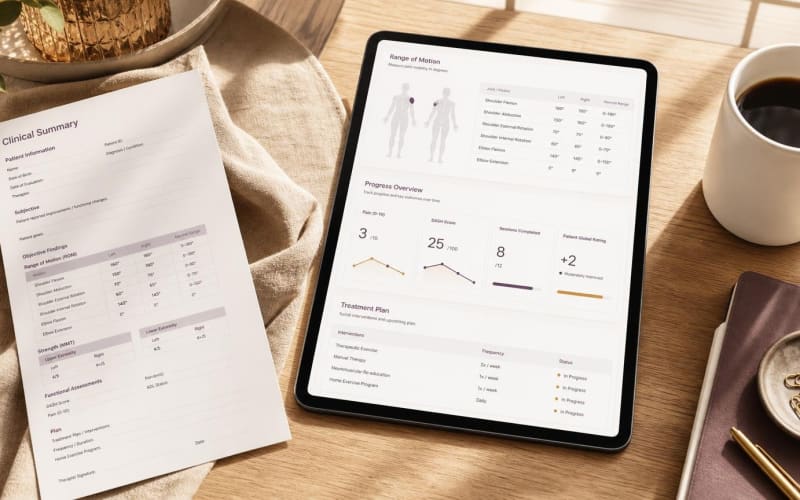
Spoken ROM degrees, failed PT, and NSAID trials mapped into NextGen exam fields. Book your audit at https://cal.com/merryai/demo.
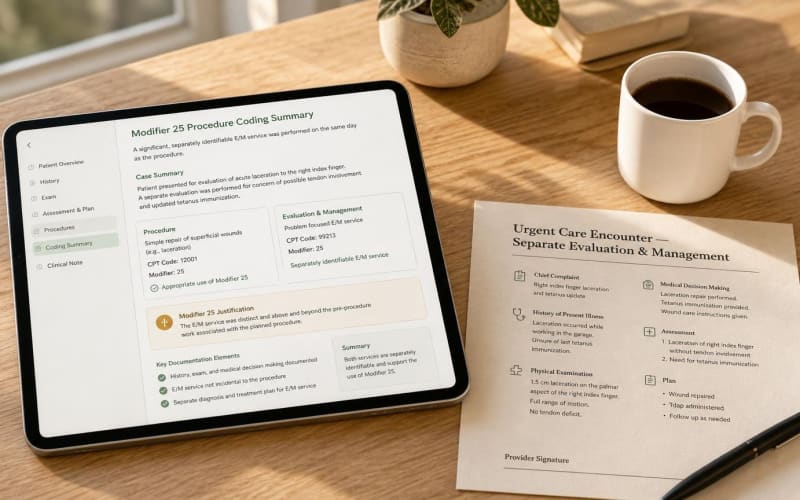
Separate cellulitis E/M reasoning from I&D procedure logs, field by field. Book your audit at https://cal.com/merryai/demo.