Why Same-Day Procedures Draw Scrutiny
Urgent care encounters rarely stay single-threaded. A patient arrives with a warm, erythematous right calf. Within twenty minutes, the clinician has evaluated spreading cellulitis, identified a fluctuant collection, and performed an incision and drainage. CPT 10060 carries a 10-day global period. Under the Medicare NCCI Procedure-to-Procedure framework, the decision to drain and the usual pre-procedure assessment are already bundled into the procedure payment.
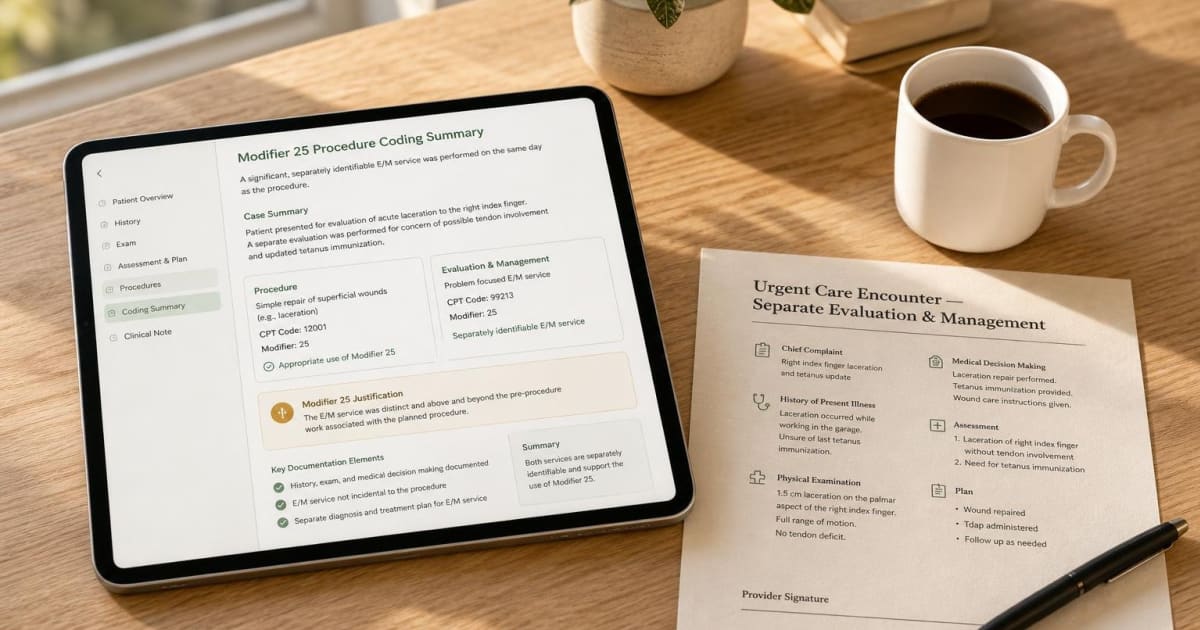
The E/M service survives only when the chart shows work that exceeds that inherent evaluation. Modifier 25 asserts that a significant, separately identifiable evaluation occurred. Modifier 59, or the more precise XS and XE subsets, asserts that two procedures were distinct by site, lesion, or session. Payers test both assertions against the record, not the claim form. Most records fail because the reasoning lives in one undifferentiated paragraph.
Isolating Cellulitis Logic from the Procedure
Our first clinical directive is separation at the level of reasoning, not formatting. Merry listens to the ambient encounter and sorts each statement into one of two lanes. The first lane is evaluation of the acute cellulitis syndrome. The second is preparation for and performance of the drainage. Fever history, diabetic status, and prior MRSA exposure belong to the E/M lane. Consent, anesthetic volume, and packing belong to the procedure lane.
Documenting the Separately Identifiable E/M
A defensible Modifier 25 note documents cellulitis as its own problem. That means measured erythema margins, marked borders with a time stamp, and any lymphangitic streaking. It means vital signs screened against sepsis criteria and a differential that addresses deep venous thrombosis, necrotizing infection, and septic bursitis. It also means independent decisions: whether to order a duplex ultrasound, which oral antibiotic covers streptococcal and MRSA risk, and when to escalate to IV therapy.
Diagnosis pairing deserves equal care. The E/M line may carry L03.115 for cellulitis of the right lower limb, while the procedure line carries the abscess diagnosis, such as L02.415. Verify current descriptors at https://www.cms.gov/medicare/coding-billing/icd-10-codes. Different diagnoses are not required for Modifier 25. However, when the clinical picture genuinely contains two problems, the record should say so plainly.
Keeping the Procedure Log Procedural
The procedure note should read like an operative log and nothing more. Merry drafts the indication, consent, anatomic site with laterality, and lesion size in centimeters. It records the anesthetic agent and volume, incision length, purulence, cultures sent, irrigation, packing, dressing, complications, and tolerance. Diagnostic reasoning stays out of this field, because duplicating it blurs the exact boundary an auditor is looking for.
When two procedures occur, each receives its own log with distinct site descriptors. A drained left thigh abscess and a separate right forearm laceration repair are one example. Merry flags where XS may describe the relationship more precisely than 59. The final modifier choice stays with the clinician and coder.
The Urgent Care Clinical Logic Matrix
The matrix below shows how Merry maps each diagnostic indicator to the evidence a payer expects to find.
| Specialty Diagnostic Metric | Required Clinical Data Points | Billing Evidence |
|---|
| Cellulitis extent (L03.115) | Erythema dimensions in cm, marked border time, streaking, warmth | E/M problem addressed, supports Modifier 25 |
| Abscess fluctuance (L02.415) | Size, induration, ultrasound findings if performed | Indication for CPT 10060 |
| Sepsis screen | Temperature, heart rate, respiratory rate, blood pressure, mentation | Risk element in MDM, escalation rationale |
| MRSA risk stratification | Prior MRSA, household contacts, athletics, injection drug use | Prescription drug management |
| Comorbidity burden | Glucose or A1c, immunosuppression, peripheral arterial disease | Complexity supporting E/M level |
| Procedure specifics | Consent, lidocaine volume, incision length, packing, culture | Procedure log kept apart from E/M |
| Second-site procedure | Distinct anatomic site, laterality, separate indication | XS or 59 support |
Every row maps to a destination field, which is where the second directive begins.
Injecting Distinct Records into Active EHR Fields
Web-based urgent care platforms rarely store the visit note and the procedure record in the same place. Procedures commonly render in a separate tab, drawer, or iframe. Merry's Chrome Extension recognizes these zones through mapped DOM selectors. It holds the procedure log until the procedure pane is open. It writes the E/M assessment into the provider note under a labeled Modifier 25 rationale heading.
No API contract is required. The extension works inside the browser session the clinician already has open, so implementation means field mapping rather than an interface project. Paired prompt packs for abscess, laceration, and foreign body workflows are available at https://templates.scribing.io.
Governance, Attestation, and Clinician Authorship
Nothing is inserted without an explicit click. The clinician reviews both drafts, edits freely, and attests before signing. Merry never assigns final codes or appends modifiers on its own. It surfaces the evidence and the gaps. If the E/M lane contains only the pre-procedure evaluation, the draft says so, and the clinician decides whether a separate service truly occurred.
On G2211, restraint is appropriate. CMS generally does not pay the add-on when the base E/M carries Modifier 25, outside narrow exceptions such as same-day preventive services and vaccine administration. Episodic urgent care visits rarely meet the longitudinal relationship standard. Merry's drafts reflect that reality rather than suggesting revenue the record cannot support.