Head-to-Head Architecture Comparison
When orthopedic surgeons evaluate documentation tools, the cost that matters is rarely the subscription line. It is the minute spent separating a knee injection narrative from the E/M assessment that justified it, and the audit exposure created when those two narratives blur together. We reviewed Merry AI and Nabla on that basis: dollars, clicks, and coding defensibility on Practice Fusion.
Nabla is a capable general-purpose ambient scribe with a clean interface and broad specialty coverage. Its standard individual workflow generates a note inside Nabla's own interface, which the clinician then transfers into the EHR unless an enterprise integration has been negotiated. Merry writes directly into Practice Fusion's chart fields from a Chrome extension.
| Feature | Merry AI | Nabla |
|---|---|---|
| Real Pricing | $54/mo Pro Annual ($648/yr) | $119/mo Pro list ($1,428/yr); enterprise quoted privately |
| DOM Injection Speed | Under 1 second per field after review | Copy-paste per section, or enterprise integration |
| Practice Fusion E/M vs Procedure Fields | Separate mapped DOM nodes | Single composite note |
| Group Note-Splitting | Diarized, one note per participant | Not a documented feature |
| CPT G2211 Capture | Rule-aware; excludes modifier 25 procedure days | No documented G2211 logic |
| Attestation Logging | Clinical Logic Bridge attestation block per note | In-app edit history; no per-element attestation |
| Data Retention | Audio shredded from RAM at 0 days; record lives in EHR | States audio is not stored; verify terms in your BAA |
Pricing figures above use published list rates. Nabla enterprise contracts are quoted privately and may differ, so verify against your own quote before modeling.
Same-Day E/M and Procedure Documentation
Why Merged Notes Fail Audits
Modifier 25 asks a narrow question: was the E/M service significant and separately identifiable from the procedure performed that day? A single composite note answering both the clinical reasoning and the injection technique makes that distinction hard to see. Auditors read structure as evidence. When the decision to inject and the act of injecting share one text block, the E/M portion looks like pre-procedure work already bundled into the procedure's global payment.
Merry handles this by generating two encounter-specific narratives from the same visit. The E/M narrative carries the history, measured examination, differential, and decision-making. The procedure narrative carries site, laterality, approach, guidance method, agent, volume, lot number, and immediate response. Prior visit text is never reused: each Assessment and Plan is drafted from today's conversation, and pulled-forward template phrases above a similarity threshold are suppressed before anything is written.
Practice Fusion Field Mapping in Chrome
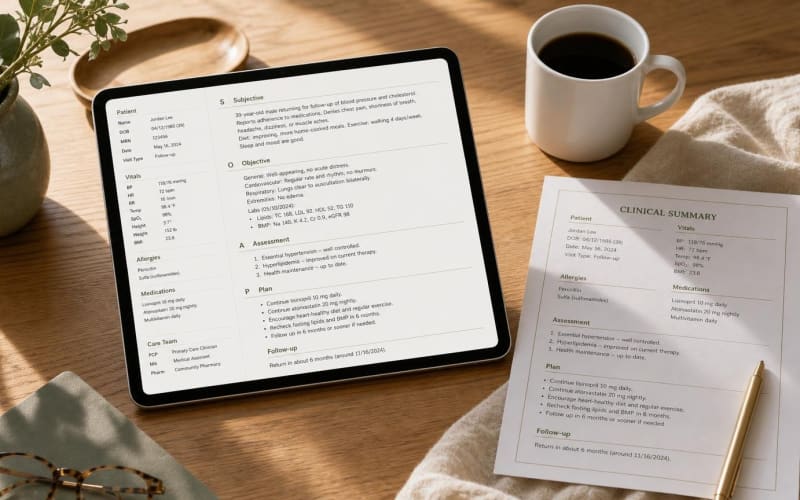
Practice Fusion stores encounters with either a SOAP note, holding separate Subjective, Objective, Assessment, and Plan fields, or a Simple note with one free-text body. Merry's extension binds each output to a distinct DOM node: E/M content into the SOAP fields, procedure content into the procedure documentation area tied to CPT selection. Content cannot spill across sections because the mapping is keyed to the field, not to cursor position. ROM degrees, manual muscle testing grades, and special tests such as Lachman, McMurray, or Hawkins land in Objective, where a reviewer expects to find them.
G2211, Modifiers, and Real Recovery Math
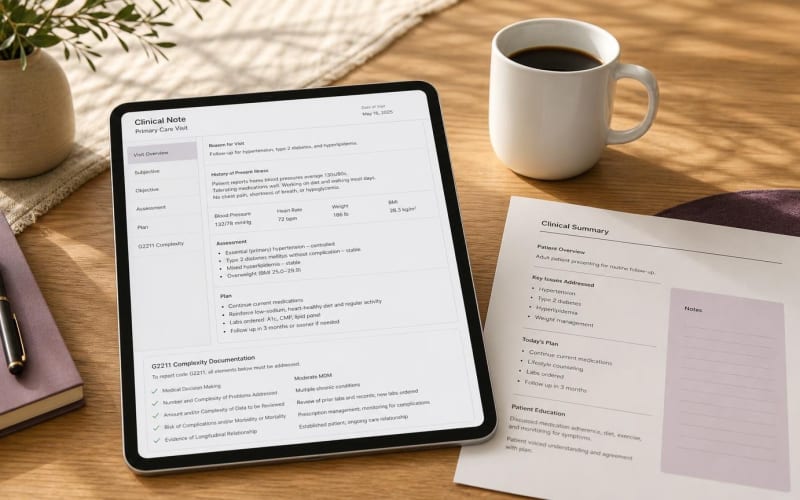
The G2211 rules deserve careful reading before anyone models revenue. CMS does not pay G2211 when the associated E/M is reported with modifier 25, except when the same-day service is an annual wellness visit, vaccine administration, or a listed Part B preventive service. A same-day joint injection billed with modifier 25 therefore does not qualify. Merry flags G2211 only on E/M visits without a procedure-driven modifier 25, and documents the longitudinal relationship for conditions such as progressive osteoarthritis or recurrent rotator cuff pathology.
The recovery figure is plain arithmetic. At roughly $16 per claim, about 975 qualifying follow-up visits per year, near 20 per week across 48 weeks, yields approximately $15,600. Your panel mix and locality will move that number, so we recommend running it against your own Medicare volume. Code definitions are maintained by the AMA at https://www.ama-assn.org/practice-management/cpt.
Modifier 59 for Distinct Sites
Multi-site procedures carry a separate risk under NCCI procedure-to-procedure edits. When a patient receives injections in two distinct joints, Merry writes a separate procedure narrative per anatomic site, with independent indication and laterality, which supports modifier 59 or the more specific XS where documentation warrants it. The coder still decides; the note simply gives them something defensible to decide with.
Cost, Retention, and Next Steps
On annual software overhead, the gap is measurable. Merry Pro Annual at $54 per month totals $648 per clinician per year. Nabla Pro at its $119 monthly list rate totals $1,428. The difference, $780 per clinician, is roughly 55% lower overhead, before counting the minutes recovered from copy-paste and manual field separation. For a five-surgeon group, that is $3,900 a year.
On retention, both products take privacy seriously. Nabla states it does not store encounter audio; Merry shreds audio from RAM at zero days and keeps the legal record only in Practice Fusion, under the practice's control. The more meaningful difference is attestation: Merry's Clinical Logic Bridge writes an attestation block linking each billed element to its documented finding, giving the practice a review trail during payer audits.
If you want to test this against your own charts, Schedule a 15-Minute Workflow Audit. We will open a de-identified orthopedic encounter, map your Practice Fusion fields, and compare the output side by side, the way a colleague would walk through a chart with you.