Head-to-Head Architecture Comparison
When clinicians evaluate documentation systems, the bottleneck is rarely the prose of the note. It is the distance between a finished draft and a signed chart. Suki AI closes that distance through formal, bidirectional EHR integrations and a partner SDK. Merry AI closes it with a Chrome extension that writes into note fields you map once. Both are defensible engineering choices, and each carries a different cost and coverage profile for an independent primary care group.
Suki's integration model is strong where it exists. Public materials describe live context pulls (problems, vitals, medications) and structured pushes into Epic, Oracle Health, athenahealth, MEDITECH, and embedded partners such as Sevocity. Independent reviews, however, report no native integration for eClinicalWorks, AdvancedMD, Veradigm, or DrChrono, all common in small practices. In those environments the workflow falls back to copy-paste.
| Feature | Merry AI | Suki AI |
|---|---|---|
| Real pricing | $54/mo Pro Annual ($648/yr), flat | ~$399/mo per provider reported (~$4,788/yr); enterprise quotes vary |
| DOM injection speed | Sub-second write into mapped textareas | No DOM injection; API push where integrated, copy-paste elsewhere |
| EHR coverage | Any browser-rendered EHR after one-time field mapping | Epic, Oracle Health, athenahealth, MEDITECH, partners |
| Group note-splitting | Diarized per-participant notes from one session | Not publicly documented |
| CPT G2211 capture | Attestation tied to a dated longitudinal plan per chronic problem | Coding support inside integrated workflows |
| Attestation logging | Timestamped Clinical Logic Bridge block per claim | Not uniformly published |
| Data retention | Audio processed in RAM, 0-day retention | Contract-dependent; not uniformly published |
Cost Mathematics for Independent Practices
A five-physician practice paying list for Suki at roughly $399 per provider per month spends about $23,940 per year. The same group on Merry AI Pro Annual spends $3,240. The difference, $20,700, is about 86 percent of the software line. For market context, Freed lists at $99/mo and Nuance DAX is typically sold as an enterprise contract near $8,000 per clinician per year, so Suki sits in the middle of the market.
Flat pricing matters for forecasting because a practice can budget documentation the way it budgets rent. There is no per-encounter metering, so a heavy flu season does not change the invoice.
Time Recovered Per Clinician
Our internal benchmark across outpatient panels shows roughly 2.1 hours saved per physician per day, mostly from removing after-clinic charting. The larger share of that gain comes from eliminating the copy-paste and reformatting step, not from faster transcription. Readers who want to examine the broader evidence on ambient documentation and burnout can search the peer-reviewed literature at https://www.ncbi.nlm.nih.gov/pmc/.
G2211 Attestation and Audit Posture
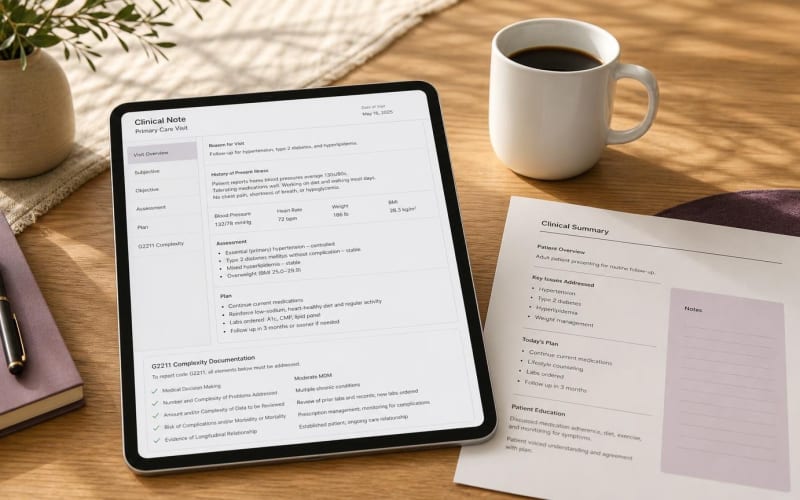
CMS describes G2211 as complexity inherent to visits where the practitioner is the continuing focal point for care, or manages a single serious or complex condition over time. CMS also states the code is not appropriate when the practitioner has not assumed, or does not plan to assume, that ongoing responsibility. That second clause is where template-driven tools get into trouble.
Dated Longitudinal Plans, Not Boilerplate
Merry AI ties every chronic problem to a dated longitudinal plan before it proposes G2211 language. A note for hypertension and stage 3a CKD, for example, carries the prior visit date, the current eGFR trend, the medication adjustment, and the next scheduled reassessment. If a plan element is missing, no attestation is drafted, and the clinician sees why.
At the 2025 national rate of approximately $16 per claim, $15,600 in annual recovery corresponds to about 975 qualifying visits, or roughly four per clinic day across 245 days. That is a conservative figure for an internist carrying a multimorbid Medicare panel.
Attestation Logging for Payer Review
Each proposed G2211 attestation is written into a timestamped Clinical Logic Bridge block recording which problems, dates, and plan elements supported it, and which clinician signed. During a payer audit, the practice produces that reasoning per claim rather than reconstructing it months later. Modifier 25 documentation follows the same rule: separately identifiable E/M work must be stated, not implied.
Deployment, Risk, and Next Steps
The fair criticism of DOM injection is fragility. EHR interface updates can move fields, and iframes or tabbed charts can route text to the wrong place. Merry AI addresses this by asking you to install the Chrome extension and map your EHR note textareas once, then verifying the target field, active tab, and patient context before every write. If the mapping no longer matches, the write is blocked and the clinician is prompted to remap.
Structured fields remain a limitation. Merry AI writes narrative sections; diagnoses, orders, and problem list entries stay under clinician control in the EHR. For practices fully on Epic with an active Suki contract, that integrated structured push is a real advantage worth weighing.
For practices on eClinicalWorks, DrChrono, or similar platforms, the comparison is simpler: Merry AI works today at a fraction of the cost, with retention and attestation behavior you can inspect. If you would like us to review your note fields, panel mix, and G2211 eligibility with you, Schedule a 15-Minute Workflow Audit.