Head-to-Head Architecture Comparison
When orthopedic surgeons evaluate documentation tools, the bottleneck is rarely prose quality. It is whether a knee flexion of 115 degrees lands in the discrete ROM field a payer reviewer will read, or sits buried in a narrative paragraph. Nabla produces strong narrative notes and exports them through Nabla Connect, a Chrome extension, or an embedded iframe, after which the host EHR or its integration script decides which fields to fill. Merry AI writes structured values directly into mapped DOM fields from a browser overlay.
The table below summarizes what we verified from public documentation and our own benchmark charts. Pricing reflects published list rates at the time of writing, so confirm current quotes before you budget.
| Dimension | Merry AI | Nabla |
|---|---|---|
| Real pricing | Pro Annual $54/mo ($648/yr), flat, unlimited encounters | Free tier with capped monthly encounters; Pro ~$119/mo ($1,428/yr); Enterprise custom-quoted |
| DOM injection speed | Direct overlay writes to mapped inputs, under 1 second per template in internal testing | Export event or copy step; placement depends on EHR-side build |
| Group note-splitting | Diarization attributes patient, family, interpreter, and trainer speech | Single-encounter note; no published multi-party splitting |
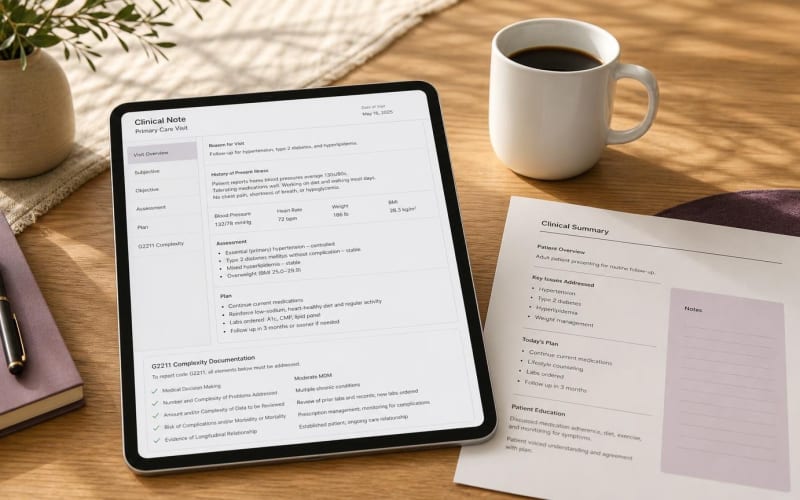
| CPT G2211 capture | Longitudinal flag, suppressed when modifier 25 is present | E/M tab limited to Family, General, Internal Medicine, Pediatrics |
| Modifier 25/59 evidence | Sign-off held until ROM degrees, wound dimensions, or lesion counts exist | No published discrete-field enforcement |
| Attestation logging | Clinical Logic Bridge links value, source sentence, timestamp, and attestation | EHR audit trail; SOC 2 Type II, ISO 27001, TX-RAMP Level 2 documented |
| Data retention | Audio held in RAM only, shredded after note generation | States no audio storage; confirm note retention in BAA |
Neither product makes coding decisions on your behalf, and neither should. Nabla's E/M suggestion asks the clinician to copy the code into the EHR, and nothing submits automatically. Merry follows the same principle: it flags, it never assigns.
Discrete Field Injection for Orthopedic Templates
Orthopedic charts are field-dense by design. A single post-injection follow-up may touch a contenteditable exam body, numeric ROM inputs, a laterality picklist, a KOOS total, and a serial flowsheet row. Narrative-only output forces the surgeon or medical assistant to re-key those values, which is where transcription errors and the daily documentation burden accumulate.
Mapping Procedure Fields to Overlay Selectors
Merry maps each specialty template field to a stable selector before go-live. A knee injection template binds joint and side to the laterality select, pre- and post-procedure flexion degrees to numeric inputs such as data-field-id=knee-flexion, and drug, volume, lot number, and guidance modality to procedure-tab fields. Writes dispatch native change events so EHR validation still fires, and every write is idempotent: regenerating a note replaces prior Merry text rather than duplicating it.
Before any write, the overlay confirms the active MRN matches the encounter, verifies the note is unsigned, and checks which tab is open, so exam values reach the exam and implant details reach the op note. Iframe-hosted editors are handled with all-frames content scripts.
Modifier and G2211 Logic Under NCCI
Modifier 25 and 59 claims fail audits most often for lack of objective, separately identifiable evidence. Merry therefore applies a hard rule: when a note supports modifier 25 or 59, sign-off is held until the relevant discrete values exist, meaning ROM in degrees, wound length and width in centimeters, or a lesion and anatomic site count.
The Modifier 25 Exclusion
CMS guidance is explicit here. G2211 generally is not payable when modifier 25 is appended to the same E/M, except when the separate service is a Part B preventive service, immunization, or annual wellness visit. Most orthopedic modifier 25 visits involve a same-day injection or fracture care, so Merry suppresses the G2211 flag there and surfaces it only for longitudinal visits, such as ongoing management of severe osteoarthritis without a same-day procedure. Verify code definitions at https://www.ama-assn.org/practice-management/cpt.
Recovering G2211 Without Overreach
The arithmetic is deliberately conservative. G2211 pays roughly $16 nationally under the Medicare fee schedule. A practice documenting about 975 qualifying longitudinal visits a year, roughly four per clinic day across 245 days, recovers about $15,600. Merry surfaces ROM trends, PRO scores, and imaging review that make those visits defensible, while the clinician still chooses the code.
Cost, Compliance, and Audit Posture
On list pricing alone, Merry Pro Annual at $648 per clinician per year compares with roughly $1,428 for Nabla Pro billed monthly, a difference of about $780, or 55 percent. For a six-surgeon group, that is near $4,680 annually before counting staff re-keying time. Enterprise contracts at either vendor are negotiated, so request a written quote.
Nabla's security documentation is substantial, including SOC 2 Type II, ISO 27001, HIPAA, and a TX-RAMP Level 2 certificate, and we credit it fully. Merry's distinction is narrower: audio lives only in RAM, never on disk or IndexedDB, and is shredded once the note generates. The Clinical Logic Bridge attaches an attestation block linking each injected value to its source sentence.
California's AB 3030 requires disclaimers on AI-generated patient communications, so Merry appends disclosure and human-contact instructions when writing to after-visit summaries or portal messages. Consistent with SB 1120, Merry never judges medical necessity. Texas deployments use the same conservative defaults.
To see your own templates mapped field by field, Schedule a 15-Minute Workflow Audit.