Head-to-Head Architecture Comparison
When dermatologists evaluate documentation systems, the bottleneck is rarely prose quality. It is whether a lesion described aloud arrives in the chart as a discrete, codable object. Freed AI produces a clean narrative SOAP note and pushes it into browser-based EHR note fields. Merry AI parses the same dialogue into lesion-level records and writes them into the procedure field that the coding engine actually reads. That distinction drives everything below.
| Capability | Merry AI | Freed AI |
|---|---|---|
| Real pricing | Pro Annual $54/mo ($648/yr), flat rate | $99/mo ($1,188/yr). Coding Assistant is limited to Premier and Groups tiers |
| DOM injection speed | Sub-second write into targeted procedure and exam fields | One-click EHR Push to note fields. Copy-paste on unsupported EHRs |
| Structured lesion block (CPT 17000) | Count, site map, diameter in mm, and prior topicals per lesion | Lesion findings captured as narrative text |
| Group note-splitting | Diarized split into separate notes per patient | One note per recorded visit |
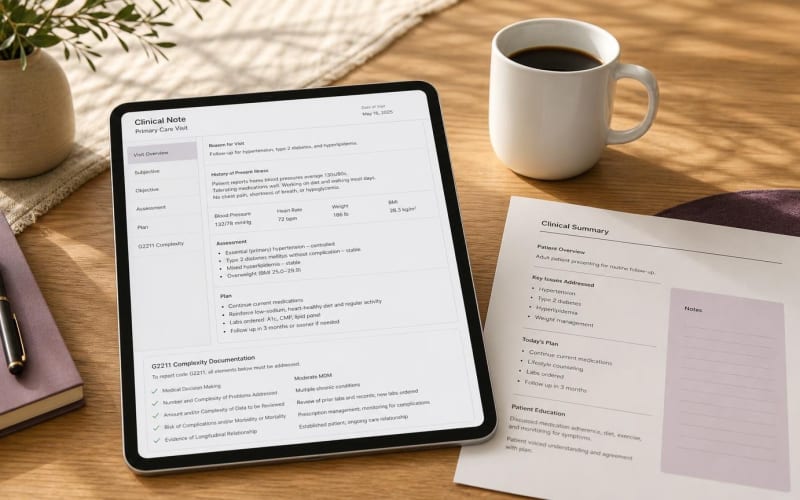
| CPT G2211 capture | Flags eligibility and suppresses it when Modifier 25 is appended | Coding suggestions on higher tiers |
| Attestation logging | Timestamped clinician attestation per injected field | Clinician review and edit before push |
| Data retention | Audio purged after note finalization. Note retention is configurable under BAA | Governed by Freed's published security policy. Confirm terms in your BAA |
In plain terms, Freed is a well-built generalist scribe. Its Chrome extension supports Athenahealth, Practice Fusion, Tebra, SimplePractice, Elation, Jane App, DrChrono, and OfficeAlly. Its help center also documents eClinicalWorks push. An independent dermatology review notes that Freed does not offer structured lesion morphology capture, body site mapping, or procedure-specific templates. For a lesion-heavy clinic, that gap shows up as manual re-entry.
Pinning the Extension to the Dermatology Tab
Merry's Chrome extension pins to the dermatology tab of the EHR rather than floating over the general note. When you open the Procedures tab in EMA or a comparable dermatology flowsheet, the extension resolves the specific field selectors, including those inside embedded iframes. It then injects the lesion map directly into the procedure field. The exam narrative goes to the exam section, and the procedure record goes to the procedure grid. Nothing passes through the clipboard, so there is no copy-paste lag and no risk of pasting the wrong patient's text.
The practical consequence is downstream: auto-coding logic for ICD-10 diagnoses, CPT procedures, and pathology requisitions keeps working, because it receives the discrete rows it was designed to read.
Lesion-Level Capture for CPT 17000
Destruction of premalignant lesions is where narrative notes cost the most. CPT 17000 covers the first lesion. CPT 17003 covers each additional lesion from the second through the fourteenth. CPT 17004 replaces both when fifteen or more lesions are treated. Unit counts therefore depend on an exact lesion count, and an auditor will want to match each unit to a documented site.
Merry builds one row per lesion as you speak. Consider the sentence 'three AKs on the left dorsal hand, two to four millimeters, one on the right temple at five millimeters.' Merry turns it into four rows, each with anatomic site, diameter in mm, morphology, and destruction method. The total count populates the unit field, so 17000 plus 17003 × 3 is reconciled against the map before you sign. Freed would render the same sentence accurately as prose, but the clinician or coder still has to count, transcribe, and assign units by hand.
Prior Topical Therapy as Medical Necessity
Payers increasingly ask why destruction was chosen over field therapy. Merry captures prior topical regimens, such as 5-fluorouracil or imiquimod, with approximate dates and response. It attaches them to the lesion block. That one line often separates a clean claim from a records request.
The Cost Math, Line by Line
Freed's month-to-month price is $99 per clinician, or $1,188 per year. Merry Pro Annual is $54 per month, or $648 per year. The difference is $540 per clinician annually, a 45.5% reduction, before counting the coder time that structured lesion rows remove. For a five-dermatologist group, that is $2,700 per year in software alone. For context, enterprise contracts such as Nuance DAX run near $8,000 per clinician per year. Both tools sit well below that tier, so the real question is which one returns more per dollar.
Freed reserves its Coding Assistant for Premier and Groups subscribers. That raises the effective comparison price for practices that want coding support. Merry includes G2211 flagging and lesion-unit reconciliation in the flat rate, with no per-encounter metering.
Audit Defense: G2211, Modifier 25, and Modifier 59
G2211 pays roughly $16 nationally at the 2026 conversion factor of 33.4009, with local variation. Consider a dermatologist following chronic conditions such as psoriasis, hidradenitis, or melanoma surveillance. That clinician may see about 975 eligible non-procedure follow-ups per year, and 975 × $16 ≈ $15,600. CMS edits deny G2211 when the E/M carries Modifier 25 on the same day, outside the listed preventive exceptions. Merry therefore suppresses the flag automatically on procedure days rather than inviting a denial.
Modifier 25 requires a significant, separately identifiable E/M service. Because Merry writes the evaluation and the procedure into different fields, the separation exists in the chart structure, not only in formatting. Modifier 59 depends on distinct lesions or sites, which the per-lesion map documents directly. Confirm coding definitions against the source at https://www.ama-assn.org/practice-management/cpt.
Attestation and the Clinical Logic Bridge
Every injected field carries an attestation entry that records the clinician, the timestamp, the source utterance, and the code the data supports. We call this the Clinical Logic Bridge. During a payer audit, you can show precisely why a unit was billed and who confirmed it.
If you want to test this against your own charts, Schedule a 15-Minute Workflow Audit. Bring three recent destruction visits, and we will review them together, line by line.