Statutory Scope of Texas HB 149 in Multispecialty Practice
Texas HB 149, the Texas Responsible Artificial Intelligence Governance Act (TRAIGA), took effect January 1, 2026. It adds Chapters 551 through 554 to the Texas Business and Commerce Code. For health care, the operative provision is Section 552.051(f). When an artificial intelligence system is used in relation to a health care service or treatment, the provider must disclose that use to the patient or the patient's personal representative no later than the date the service is first provided. In an emergency, the disclosure is due as soon as reasonably possible.
Multispecialty groups carry a compounded exposure profile. A single organization may route cardiology, behavioral health, orthopedic, and pediatric encounters through one ambient documentation pipeline, while each department keeps its own intake script. Section 552.051(d) requires the disclosure to be clear, conspicuous, written in plain language, and free of dark patterns. A notice buried in portal terms of use, or delivered inconsistently across departments, is difficult to defend.
Enforcement rests exclusively with the Texas Attorney General. After written notice, a provider has 60 days to cure. Uncured violations carry civil penalties of $10,000 to $12,000 per curable violation, $80,000 to $200,000 per uncurable violation, and $2,000 to $40,000 per day for continuing violations. Disclosure therefore needs to be reproducible at the encounter level. A policy-level statement is not enough.
Pre-Capture Disclosure and Note Header Injection
Merry AI separates the disclosure event from the evidence of disclosure. The statute governs what the patient is told. The chart proves that it happened. Both records must exist, and they must share one timestamp.
P1: Timestamped Acknowledgment Before Ambient Capture
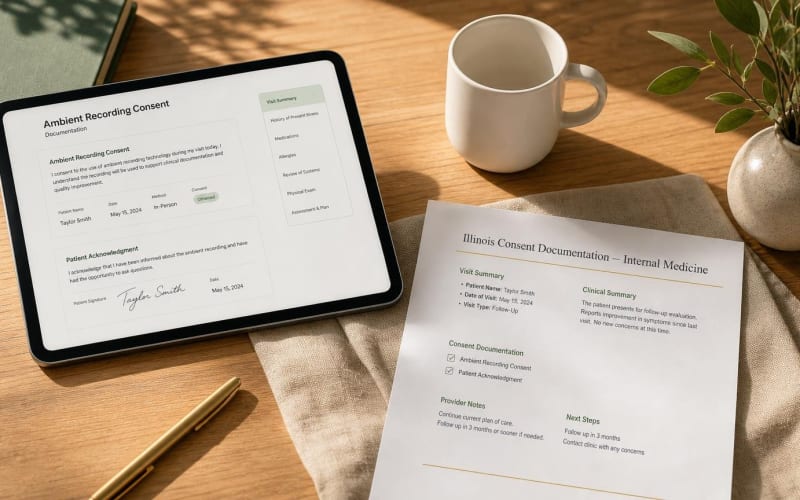
The microphone remains hard-locked until the clinician confirms that the patient or a personal representative has received the plain-language disclosure. The overlay presents a visible notice in the exam room or telehealth interface and pairs it with a standardized verbal script. It then records the patient's affirmative acknowledgment with an ISO 8601 timestamp. Ambient capture cannot begin until that acknowledgment exists. Audio is processed in volatile memory only and shredded from RAM after transcription. Retention is zero-day, and audio is never reused for model training.
Emergency encounters follow a deferred pathway consistent with the statutory exception. The overlay logs a deferred-disclosure flag, prompts completion as soon as reasonably possible, and preserves both timestamps.
P7: Disclosure Line Injected Into the Note Header DOM Field
Before the first dictated word, the overlay writes a labeled header block as the first node of the active progress note. It binds only to the foreground editor, whether that editor is a contenteditable region, a textarea, or an iframe-nested editor. It also verifies the patient and encounter identifiers before any write. The node carries a data-ai-disclosure attribute and a machine-readable timestamp, so auditors can query disclosure coverage across every department.
The header text is plain and fixed: AI-assisted documentation disclosed to patient and acknowledged at [timestamp]; drafted with AI assistance, reviewed and finalized by the signing clinician. The header renders in print, PDF, and portal exports. It sits outside the clinical narrative and never functions as medical decision-making content.
Statutory Comparison of Documentation Architectures
| Compliance Dimension | Manual Charting | Standard Generic AI Scribes | Merry AI Compliance Architecture |
|---|---|---|---|
| §552.051(f) disclosure timing | Not triggered absent AI use | Global consent or app icon; timing undocumented | Timestamped acknowledgment required before capture unlocks |
| Encounter-level evidence | Not applicable | Vendor dashboard outside the legal record | Header DOM node inside the signed note |
| §552.051(d) plain language | Not applicable | Variable; often embedded in terms of service | Standardized script and fixed header text |
| Audio retention | None | Frequently retained for QA or training | RAM-only; shredded after transcription |
| Wrong-chart write risk | Low | Active-field typing across open tabs | Patient and encounter ID match before any write |
| Coding influence | Clinician-driven | Boilerplate may imply complexity | No code or modifier suggestions |
Specialty Criteria Under Clinician Attestation
Disclosure compliance does not excuse weak clinical documentation. In behavioral health, the overlay preserves PHQ-9, GAD-7, and PCL-5 results as discrete scores and requires confirmation of each DSM-5-TR symptom cluster. In cardiology, NYHA class and LVEF are captured with the study date and source. In orthopedics, entries require numeric range-of-motion degrees and strength grades on the 0 to 5 scale. Pediatric templates follow Bright Futures periodicity and never mark a screening as performed without clinician confirmation.
Audit Readiness and Coding Integrity
CMS reports a 10.3 percent improper payment rate for E/M services in the 2024 reporting period. Incorrect coding and insufficient documentation drive most of those denials. A disclosure-compliant note that overstates complexity still fails review.
Coding Separation for G2211, Modifier 25, and Modifier 59
The overlay never suggests codes. Longitudinal complexity language for G2211 appears only when the clinician explicitly selects it. Same-day E/M and procedure documentation is structured into distinct sections. This structure supports a significant, separately identifiable service under modifier 25 but does not presume one. The overlay also never proposes modifier 59. The disclosure header stays excluded from any complexity narrative.
Governance logs record when AI was active, which fields it touched, and when each disclosure was inserted. For peer-reviewed literature on ambient documentation accuracy, consult https://www.ncbi.nlm.nih.gov/pmc/.
Clinics preparing for Attorney General inquiries should test disclosure coverage department by department before any notice arrives. Schedule a 15-Minute Workflow Audit to map your note fields, consent scripts, and header injection against Section 552.051.