Statutory Mandate: 720 ILCS 5/14-2 in Internal Medicine
Illinois treats the exam room as a site of private conversation. Under 720 ILCS 5/14-2(a)(1), a person commits eavesdropping when they knowingly and surreptitiously use an eavesdropping device to overhear, transmit, or record all or any part of a private conversation without the consent of all parties. Section 14-1(d) defines a private conversation as oral communication between two or more persons where at least one party intends it to be private under circumstances reasonably justifying that expectation. Physician-patient dialogue, shielded by privilege and conducted behind a closed door, sits within that definition.
The exposure is not theoretical. A first offense is a Class 4 felony under Section 14-4, and Section 14-6 grants aggrieved parties civil remedies, including actual and punitive damages and injunctive relief. Internal Medicine visits raise the stakes further: discussions of HIV status, substance use, cognitive decline, and advance directives carry a strong expectation of privacy. An ambient microphone left active without clear disclosure is precisely the surreptitious conduct the statute targets.
Who Counts as a Party in the Exam Room
Every voice captured is a party. The attending, resident, medical student, rooming nurse, interpreter, patient, and caregiver each hold an independent consent right. A daughter who joins a geriatric follow-up halfway through, or a telephonic interpreter added for medication reconciliation, has not consented simply because the patient did at check-in. Consent obtained at intake does not travel forward to new participants; a defensible workflow treats each arrival as a fresh consent event.
Consent Attestation and Ephemeral Audio Architecture
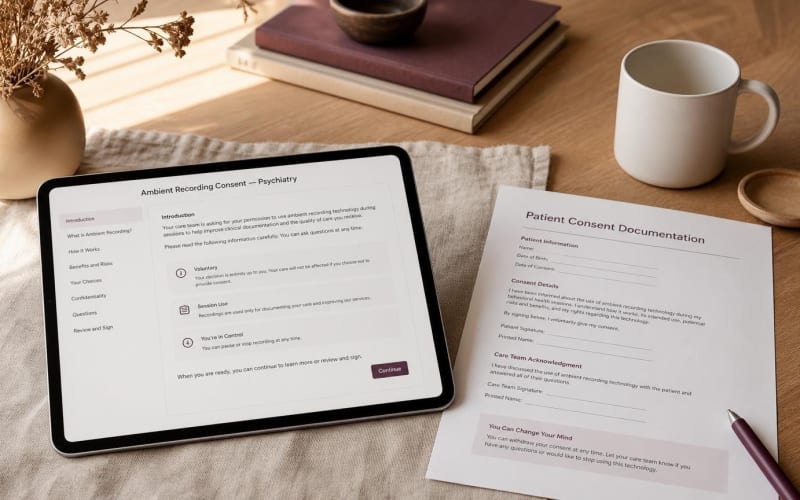
Directive P1 is the foundation: confirm and document consent from all parties before any audio is processed. Merry records a consent attestation per participant and injects it into the active encounter note through the DOM of the browser-based EHR. The attestation is time-stamped, lists each participant by role, and states that verbal consent was obtained for ambient documentation. Because it lives in the legal medical record rather than a vendor dashboard, the chart alone demonstrates that capture was disclosed and consensual.
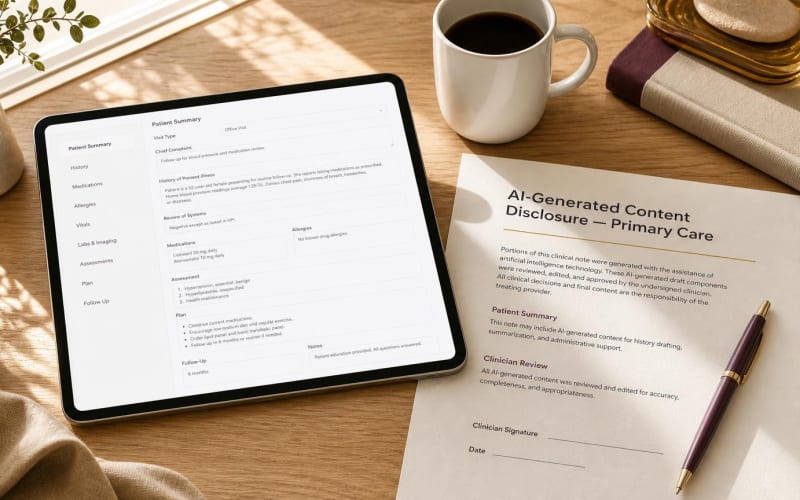
Audio is processed in RAM only, with 0-day shredding once the draft note is generated and accepted. No audio file or raw transcript persists on vendor infrastructure, leaving no recording to subpoena. The discoverable artifact remains the signed encounter note, which exists regardless of any documentation tool. This removes the parallel evidentiary corpus that opposing counsel could mine for alleged discrepancies.
Activating the Illinois Consent Workflow (P7)
Before launching the encounter, activate the Illinois consent workflow in the Merry Chrome extension. Once enabled, capture does not begin until every listed participant is confirmed, and the workflow prompts for re-attestation when a participant is added. Encounter-ID matching guards bind the session to the correct patient context across iframes and multi-tab charting, and signed or addendum-locked notes are never modified. These guards prevent consent language or clinical content from landing in the wrong chart.
Statutory Comparison: Liability by Documentation Model
| Compliance Dimension | Manual Charting | Standard Generic AI Scribes | Merry AI Compliance Architecture |
|---|---|---|---|
| 720 ILCS 5/14-2 recording exposure | None; no device used | Persistent audio triggers all-party consent duty | Consent attested per participant before capture |
| Consent evidence location | Not applicable | Vendor dashboard or app log | Time-stamped attestation in the EHR note |
| Audio retention | None | Cloud storage for QA or training windows | RAM-only, 0-day shredding |
| Vendor subpoena surface | None | Recordings and transcripts discoverable | No stored recording to subpoena |
| Mid-visit participant changes | Not applicable | Often unmodeled | Re-attestation prompt for each new party |
| EHR insertion path | Typed by clinician | Generated externally, then pushed | Direct DOM injection into active note |
| Staging fidelity | Clinician-dependent | Risk of summarizing away NYHA, GOLD, KDIGO | Preserves staging and numeric values |
Manual charting avoids eavesdropping exposure at the cost of documentation burden and incomplete complexity capture. Generic scribes reduce typing while creating a second data set outside the chart. Merry retains the efficiency without the retained recording.
2026 CMS Reimbursement Alignment for Internal Medicine
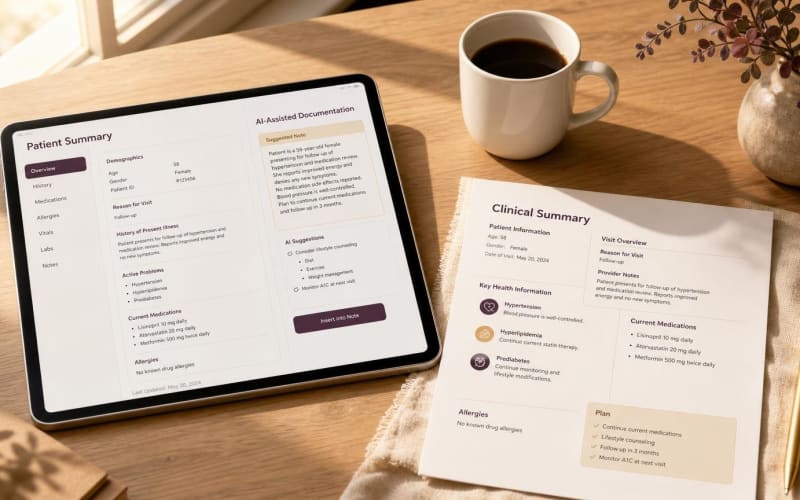
Statutory compliance and reimbursement integrity share one dependency: a precise, problem-oriented note. Internal Medicine encounters involve multimorbidity, polypharmacy, and guideline-driven staging such as NYHA class with LVEF, GOLD stage with CAT score, KDIGO G/A category with eGFR and UACR, ADA glycemic thresholds, and PHQ-9 scores. Merry preserves these values verbatim within a separate Assessment and Plan for each active problem.
G2211, Modifier 25, and NCCI Modifier 59
HCPCS G2211 reflects longitudinal complexity and is reported with office/outpatient E/M codes 99202-99205 and 99211-99215, or home/residence codes 99341, 99342, 99344, 99345, and 99347-99350, when the practitioner serves as the continuing focal point of care. CMS denies G2211 when the base E/M carries modifier 25 on the same date, except when the E/M accompanies an annual wellness visit, vaccine administration, or other Part B preventive service; beginning January 1, 2026, that exception extends to home or residence visits.
Modifier 25 demands a separable record. The E/M must be significant and separately identifiable from same-day procedure work, with its own history, examination, and medical decision-making. Modifier 59 and the X-modifiers (XE, XS, XP, XU) override NCCI procedure-to-procedure edits only when services are genuinely distinct by session, site, or lesion. Merry structures notes so these distinctions are explicit. Peer-reviewed literature on ambient documentation accuracy is indexed at https://www.ncbi.nlm.nih.gov/pmc/.
Compliance teams reviewing Illinois deployments should verify attestation placement, confirm the absence of retained audio, and test encounter-matching guards against multi-tab workflows. Schedule a 15-Minute Workflow Audit to review each control against your EHR configuration.