Statutory Compliance Architecture for Texas HB 149
Texas HB 149, the Texas Responsible Artificial Intelligence Governance Act (TRAIGA), took effect January 1, 2026, and adds Chapter 552 to the Texas Business and Commerce Code. For health care, Section 552.051(f) requires the provider of a service or treatment to disclose that an artificial intelligence system is used in relation to that care. The disclosure must occur no later than the date the service is first provided, or as soon as reasonably possible in an emergency.
The disclosure standard is procedural, not decorative. Section 552.051(d) requires the disclosure to be clear and conspicuous, written in plain language, and free of dark patterns. A consent paragraph buried in an intake packet signed months earlier is a weak evidentiary position when an ambient system is recording today's cardiology follow-up.
Multispecialty groups carry compounded exposure. A single Texas group may run behavioral health, cardiology, orthopedics, and pediatrics through the same EHR instance. Each specialty generates distinct documentation, but the statutory trigger is identical: AI involvement in care requires disclosure before that involvement begins.
Pre-Capture Disclosure Sequencing (P1)
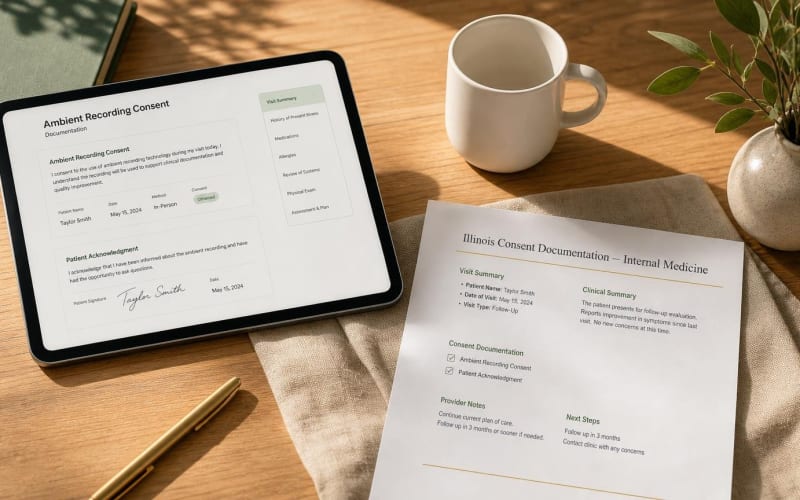
Merry AI enforces a hard interlock. When the browser extension detects a Texas facility identifier and an active encounter note, it presents a patient-facing disclosure. It then records a timestamped acknowledgment in ISO 8601 format with the local time zone, including America/Denver for El Paso sites, before the microphone stream opens. No acknowledgment, no audio. The streaming session cannot initialize until the acknowledgment event is committed.
Emergency encounters follow the statutory exception. The clinician may flag the encounter as emergent, and capture proceeds. The system queues the disclosure for delivery as soon as reasonably possible and logs both the emergency flag and the deferred acknowledgment time.
EHR Note Header Injection via Chrome (P7)
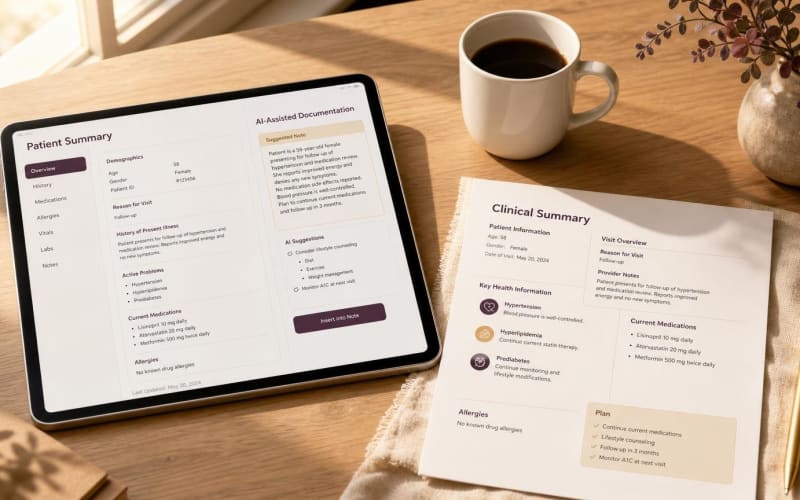
The Chrome extension writes the disclosure banner directly into the note header. It uses the editor's native input pathway rather than raw DOM mutation, which preserves EHR change tracking in Epic, Oracle Health, athenaOne, eClinicalWorks, and NextGen. The extension traverses nested iframes and locates editors through ARIA labels rather than brittle element IDs. If the banner is deleted before signature, the extension re-inserts it. A representative header reads: "AI ambient documentation assistance was used for this encounter. Patient disclosure acknowledged [timestamp, timezone]."
Multi-tab charting does not fragment the record. The banner anchors to the narrative note for the visit ID, not to orders or flowsheets, and it follows the encounter across the HPI, exam, and assessment tabs. When an encounter produces separate procedure and consult notes, each AI-assisted note receives its own header.
Voiceprint and Biometric Retention Controls
HB 149 also amended Section 503.001 of the Business and Commerce Code, the Texas biometric identifier statute that covers voiceprints. Retaining clinical audio creates an unnecessary biometric data inventory. Merry AI buffers audio in RAM only and never writes it to disk. The buffer is shredded once text generation completes. This is 0-day retention, with no training reuse and no backup copies. Intermediate transcripts are purged at clinician signature.
Comparative Liability Across Documentation Models
The table below contrasts three documentation approaches against the HB 149 obligations most likely to surface in an Attorney General civil investigative demand.
| Compliance Dimension | Manual Charting | Standard Generic AI Scribes | Merry AI Compliance Architecture |
|---|---|---|---|
| § 552.051(f) disclosure timing | Not triggered | Often at intake, not per encounter | Timestamped acknowledgment before capture |
| § 552.051(d) conspicuousness | Not applicable | Policy document or verbal mention | Plain-language banner in note header |
| Audio retention | None | Often stored for QA or training | RAM-only, 0-day retention |
| § 503.001 voiceprint exposure | None | Persistent audio inventory | No stored audio |
| Audit evidence | Clinician recollection | Vendor logs outside the chart | Disclosure persisted in signed note |
Specialty Documentation and Reimbursement Integrity
Disclosure compliance and billing integrity share one failure mode: undocumented facts. CMS reported a 10.3% improper payment rate for E/M services in the 2024 reporting period. Incorrect coding accounted for 49.1% of those improper payments, and insufficient documentation accounted for 34.1%. Merry AI structures each specialty note against its own clinical standard:
- Behavioral health notes against DSM-5-TR criteria and risk assessment.
- Cardiology notes against NYHA class and a dated LVEF.
- Orthopedic notes against measured ROM in degrees and 0–5 strength grading.
- Pediatric well visits against Bright Futures periodicity.
Coding prompts remain advisory and clinician-controlled. G2211 is suggested only when the narrative documents a continuing focal-point relationship or ongoing care for a single serious or complex condition. Modifier 25 prompts require a separately identifiable E/M section with its own medical necessity. Modifier 59 prompts require explicit anatomic or session distinctness.
Enforcement Posture and Audit Readiness
The Texas Attorney General holds exclusive enforcement authority under Chapter 552. After written notice, Section 552.104 provides a 60-day cure period. Section 552.105 sets three tiers of civil penalties:
- $10,000 to $12,000 per curable violation.
- $80,000 to $200,000 per uncurable violation.
- $2,000 to $40,000 per day for continuing violations.
HB 149 creates no private right of action.
Clinician attestation remains the final safeguard. Every Merry AI note requires clinician review and signature, and the disclosure header is locked into the signed record. A cure-period response can therefore rely on chart-level evidence rather than vendor attestations. Peer-reviewed literature on ambient documentation accuracy is indexed at https://www.ncbi.nlm.nih.gov/pmc/.
Compliance officers preparing for audit should sample Texas visits across each specialty and verify disclosure timestamps against encounter start times. To review that sequence against your own EHR configuration, Schedule a 15-Minute Workflow Audit.