Statutory Compliance Architecture for Pennsylvania Wiretap Act
Documenting behavioral health encounters under the Pennsylvania Wiretapping and Electronic Surveillance Control Act (WESCA), 18 Pa.C.S. §§ 5701–5782, begins with one fact. Pennsylvania is an all-party consent jurisdiction. Section 5703 makes intentional interception, disclosure, or use of a wire, electronic, or oral communication a felony of the third degree unless a statutory exception applies. The only exception relevant to an ambient scribe is § 5704(4). It requires that all parties to the communication have given prior consent.
Therapy sessions sit squarely within the definition of 'oral communication' in § 5702. Patients speak with a justified expectation that their words are not subject to interception, and that expectation is arguably stronger in a psychotherapy room than anywhere else in medicine. Civil exposure under § 5725 adds actual damages and liquidated damages of at least $100 per day of violation or $1,000, whichever is higher. Punitive damages and attorney's fees may also be awarded.
HIPAA overlays rather than replaces WESCA. Session audio is protected health information under 45 CFR § 160.103. The Mental Health Procedures Act, 50 P.S. § 7111, adds confidentiality duties for treatment records. Documentation is the only evidence that all three regimes were satisfied.
Interception Occurs at Capture, Not Storage
A common vendor argument holds that streaming audio without saving a file is not 'recording.' WESCA does not support that reading. Interception occurs at acquisition, so in-memory processing still intercepts. Merry AI relies on the § 5704(4) consent exception and pairs it with 0-day RAM shredding. Audio exists only in volatile memory and is never written to disk or browser storage. It is destroyed once the draft note is generated.
Consent Line Injection in SimplePractice
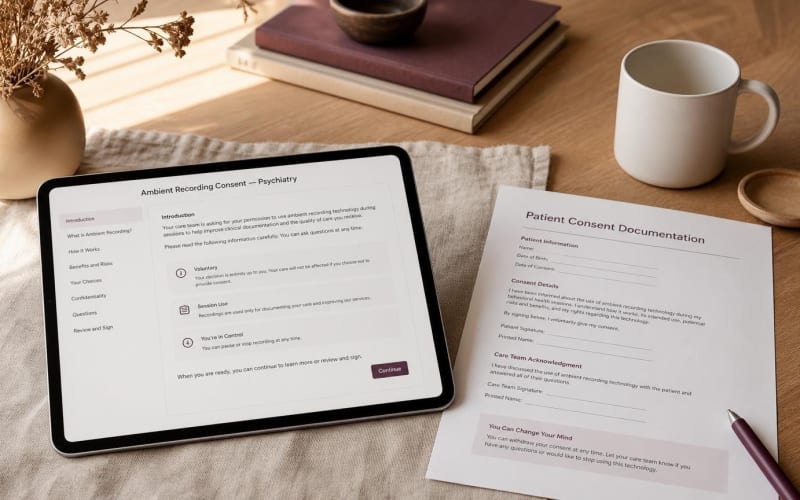
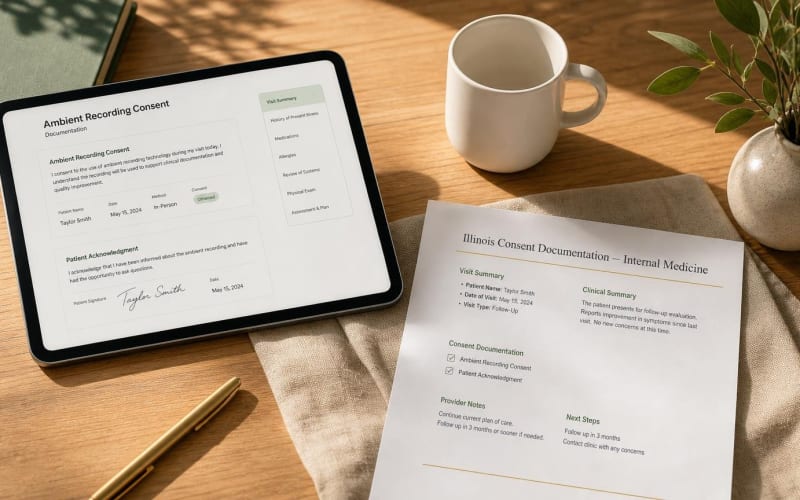
Directive P1 requires that every note open with documented all-party recording consent and a timestamp. Directive P7 specifies the mechanism. The Merry AI Chrome extension injects the consent line at the top of the SimplePractice progress note body before any clinical narrative is written. Because the line lives in the legal medical record, it travels with the note through supervision, payer review, and litigation hold.
The injected consent line reads: 'WESCA CONSENT (18 Pa.C.S. § 5704(4)): Prior verbal consent to audio processing obtained from all parties present [patient; guardian; co-therapist] at 14:02:11 EDT, before capture began. Modality: telehealth. Audio processed in volatile memory only; destroyed after note generation.' The clinician confirms each participant before the microphone activates. If any party declines, capture remains disabled for the session.
Minimum Consent Log Elements
A defensible Pennsylvania consent log captures four elements:
- The consent timestamp relative to session start.
- The name and role of every participant.
- The modality and device.
- The audio-handling statement.
Each additional voice requires consent. Family sessions, couples therapy, and group work multiply the parties, and every participant must give prior consent. Late arrivals trigger a pause. Capture stops until the new participant consents, and the log is amended with a second timestamp.
DOM Targeting and Field Integrity
SimplePractice exposes no open API for third-party note writers. The extension instead identifies exact DOM input selectors for the progress note body and its subsections. It then writes text as automated keystrokes under the clinician's authenticated session. The extension tracks the active tab and never writes into messaging, billing, or portal iframes. If a selector changes after an EMR update, injection halts and alerts the clinician rather than failing silently.
Statutory Comparison: Manual Charting vs Generic Scribes vs Merry AI
| Compliance Dimension | Manual Charting | Standard Generic AI Scribes | Merry AI Compliance Architecture |
|---|---|---|---|
| § 5704(4) prior all-party consent | Not triggered; no interception | Often clinician-only or buried in intake forms | Per-session, per-participant consent obtained before capture |
| Consent location | Not applicable | Separate vendor dashboard | Timestamped line atop the SimplePractice note |
| Audio retention | None | Cloud persistence; model training common | Volatile memory only; 0-day RAM shredding |
| § 5725 civil exposure | Minimal | Elevated by durable audio artifacts | Minimized; no retrievable audio |
| Mid-session participant change | Not applicable | Rarely detected | Capture pauses pending amended consent |
Manual charting avoids WESCA entirely, but it transfers the cost to clinician time. Generic scribes reduce typing, yet they frequently store audio in the cloud. Those durable artifacts extend both wiretap and breach exposure for highly sensitive behavioral health dialogue.
Reimbursement Integrity and Audit Readiness
Consent documentation and billing documentation share a single record, so the same note must support medical necessity. CMS's Medicaid behavioral health fact sheet requires records that 'fully disclose the extent of the services.' Merry AI structures notes around DSM-5-TR criteria:
- Symptom count and duration.
- Functional impairment.
- Exclusions.
- Risk assessment covering ideation, plan, means, intent, and protective factors.
For psychiatric prescribers billing E/M, G2211 requires a longitudinal relationship evidenced by diagnoses, assessment, and plan of care. Per CMS Transmittal 12461, G2211 is not payable when the base E/M carries modifier 25, except for specified preventive services. Notes therefore separate E/M content from any same-day procedure. Modifier 59 is never appended to E/M lines, consistent with NCCI policy.
Peer-reviewed literature on documentation burden and ambient capture is indexed at https://www.ncbi.nlm.nih.gov/pmc/ for teams building internal policy. Clinician attestation remains mandatory. The treating clinician reviews, edits, and signs every draft, and that signature attests to both the clinical content and the consent line.
Practices preparing for payer or board review can Schedule a 15-Minute Workflow Audit to map consent capture, DOM targeting, and coding logic against current Pennsylvania requirements. This page is informational and does not constitute legal advice. Confirm your deployment with Pennsylvania counsel.