The Statutory Reach of 720 ILCS 5/14-2 in the Exam Room
Under Illinois 720 ILCS 5/14-2, the eavesdropping statute prohibits the knowing use of an eavesdropping device to record or transcribe, in whole or in part, a private conversation without the consent of all parties to that conversation. The provision is deceptively short, but its application to modern outpatient documentation is expansive. When a clinician sits with a patient in an exam room and speaks quietly about symptoms, medications, and prognosis, the law treats that exchange as a private conversation carrying a reasonable expectation of privacy. Any ambient tool that captures the acoustic content of that exchange is, for statutory purposes, an eavesdropping device unless every party has consented.
The practical consequence for Illinois health systems is that the deployment of an ambient AI scribe is not merely a procurement decision; it is a consent-architecture decision. A tool that begins listening the moment the clinician enters the room, without disclosure, recreates exactly the surreptitious-recording scenario the legislature intended to prohibit. The statute does not carve out an exception for clinical benefit, documentation efficiency, or physician burnout relief, however genuine those motivations are. Consent is the operative requirement, and it must precede capture.
Because the statute attaches to every party, the analysis cannot stop with the patient. Exam rooms routinely contain caregivers, adult children, spouses, medical interpreters, chaperones, and trainees. Each participant who speaks or is spoken to is a party to the private conversation, and each must consent before ambient capture is lawful. This multi-party reality is where most generic scribing deployments fail, because they were built around a single-speaker mental model that does not match the messy, populated Illinois exam room. For the underlying statutory text and related eavesdropping jurisprudence, the peer-reviewed and government literature indexed at https://www.ncbi.nlm.nih.gov/pmc/ provides useful context on privacy expectations in clinical settings.
Building a Defensible Consent Workflow
A defensible outpatient workflow under this statute rests on four sequential controls: pre-visit disclosure, in-room affirmative consent, contemporaneous charting, and an immediate stop path. Each control exists to answer a specific question an auditor or opposing counsel will eventually ask, and each must produce evidence, not merely intention.
Pre-visit disclosure sets the baseline expectation that the encounter may be documented with the assistance of an ambient tool. This disclosure can appear in intake materials, on signage, or in the check-in conversation, but it does not substitute for in-room consent. Its function is to remove surprise, not to satisfy the statute on its own. Disclosure that a visit may be recorded is not consent that this specific conversation is being recorded.
The In-Room Affirmative Consent Step
Immediately before capture begins, the clinician must obtain affirmative agreement from every party present. The critical design principle is that silence is never treated as consent. A properly constructed prompt names the tool, states plainly that the conversation will be transcribed to assist with documentation, identifies who is in the room, and asks each party to agree. If a caregiver or interpreter is present, that person is addressed directly. This is the step where the all-party requirement is either satisfied or quietly violated, and it is worth rehearsing with clinical staff until it becomes reflexive.
Contemporaneous Charting of the Consent Event
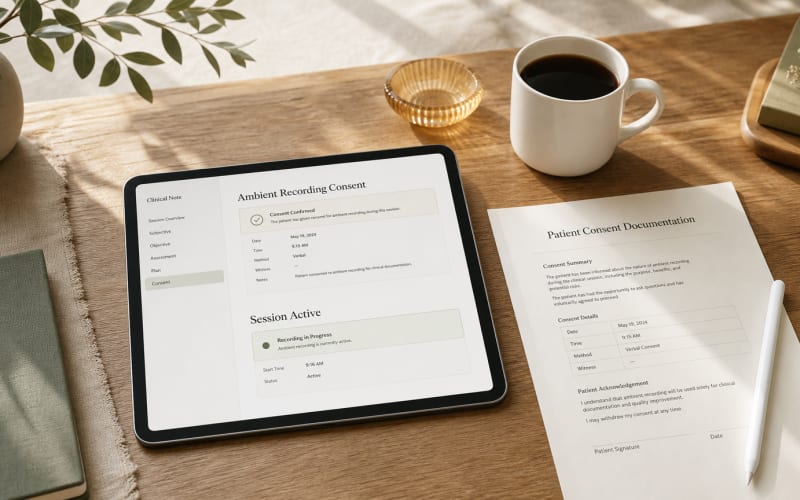
Once consent has been obtained, the fact of consent must be memorialized in the encounter note at the time it occurred. Vendor and legal guidance in Illinois consistently favors contemporaneous documentation because it converts a fleeting verbal exchange into durable evidence. The chart entry should record the date, the time, the roles of the participants present, and the fact that all parties agreed before recording began. A note that simply says "AI scribe used" is insufficient; the entry must demonstrate that consent preceded capture. You can validate your consent-language phrasing against the reviewed prompts in the Scribing Template Directory before rolling it into production.
Comparing Documentation Architectures
When Illinois practices evaluate their options, the differences between manual charting, a generic ambient scribe, and a compliance-oriented architecture become concrete rather than abstract. The table below contrasts the three approaches against the specific obligations that 720 ILCS 5/14-2 imposes.
| Compliance Dimension | Manual Charting | Generic AI Scribe | Merry AI Compliance Architecture |
|---|---|---|---|
| All-party consent capture | Not applicable; no recording occurs | Often absent or single-speaker only | Enforced multi-party disclosure prompt before capture |
| Consent timestamp evidence | Depends on clinician memory | Rarely logged | Discrete, immutable consent event in encounter metadata |
| Raw audio retention | None | Frequently stored on disk | In-memory processing with RAM session shredding |
| Physician attestation trail | Implicit in authorship | Blended with generated text | Separate, timestamped attestation event |
| Mid-encounter withdrawal | Simply stop writing | No defined path | Hard-stop control with logged withdrawal time |
| G2211 complexity capture | Manual and often omitted | Inconsistent | Structured continuity-of-care narrative surfaced for review |
What the comparison makes visible is that the statutory risk does not come from ambient documentation as a category; it comes from the absence of the consent, retention, and attestation controls that surround it. A generic scribe that stores raw audio and never logs consent is more exposed under Illinois law than a clinician writing notes by hand, precisely because it creates a recording of a private conversation without evidence that the recording was authorized.
Data Retention, RAM Shredding, and Discovery Exposure
The retention posture of an ambient tool determines how much protected health information survives the encounter and, correspondingly, how much can be breached or discovered. Under the compliance architecture we recommend, ambient audio is processed in volatile memory and never committed to persistent storage. When the draft note is returned to the clinician, the acoustic buffer and intermediate transcript fragments are overwritten and released, consistent with the technical safeguards standard at HIPAA 45 CFR §164.312.
This zero-retention design has a direct statutory benefit under 720 ILCS 5/14-2. The immutable artifacts that remain are the consent event and the finalized, attested note, not a retained recording of the private conversation. If the raw audio no longer exists, there is no surreptitious recording to be produced, and the discovery surface shrinks accordingly. Practices should insist on verifying this behavior during vendor due diligence rather than accepting a marketing assertion, because a tool that silently retains audio reintroduces the exact exposure the statute targets.
Physician Attestation and Continuity-of-Care Coding
Attestation is the control that keeps the physician as the legal author of the record. An ambient scribe generates a proposed note; it does not practice medicine and it does not sign the chart. The treating clinician must review the draft, correct any misattribution or fabrication, and affirmatively adopt the content. Recording this attestation as a distinct, timestamped event lets an auditor separate machine-generated text from clinician-adopted text, which is decisive in any medico-legal review.
This discipline also protects legitimate coding, particularly CPT G2211, the office and outpatient visit complexity add-on code that reflects the cognitive work of serving as the continuing focal point for a patient's care. Accurate capture of that continuity narrative depends on the clinician's own medical decision-making, and CMS guidance on G2211 assumes the treating practitioner authors the record. A compliance-oriented scribe should surface the continuity-of-care elements for physician confirmation rather than manufacture them, preserving both coding integrity and statutory defensibility. If you want to see how these controls behave in a live Illinois exam-room scenario, Book a 15-Minute Workflow Audit and we will walk through your specific consent, retention, and attestation posture together.