Reading O.C.G.A. 16-11-62 as a Recording Statute, Not a Telehealth Rule
Georgia O.C.G.A. § 16-11-62 is fundamentally a wiretapping and eavesdropping statute. It addresses the recording or observation of private communications and the activities of individuals in private places without the consent that the law demands. It is easy, and increasingly common, for vendors to overstate its reach and to claim that it imposes granular technical mandates on telehealth transport, such as automatic re-consent prompts triggered by a WebRTC track change from video to audio. The statutory text supports no such reading. For Georgia physician groups building defensible documentation workflows, precision here is not academic; it determines which controls are legally required and which are prudent risk management dressed up as statute.
When you separate the statute from the telehealth consent framework, the compliance picture clarifies. Telehealth consent is a distinct obligation. Georgia Medicaid guidance expects written consent from the member before telehealth services are rendered, and that consent should live in the medical record. That is a consent-and-documentation duty. Section 16-11-62, by contrast, is concerned with whether a recording exists and whether it was made with the consent posture the law requires. A physician group that conflates the two ends up either over-engineering its platform or, worse, relying on an imagined statutory trigger that does not exist while neglecting the written-consent duty that plainly does.
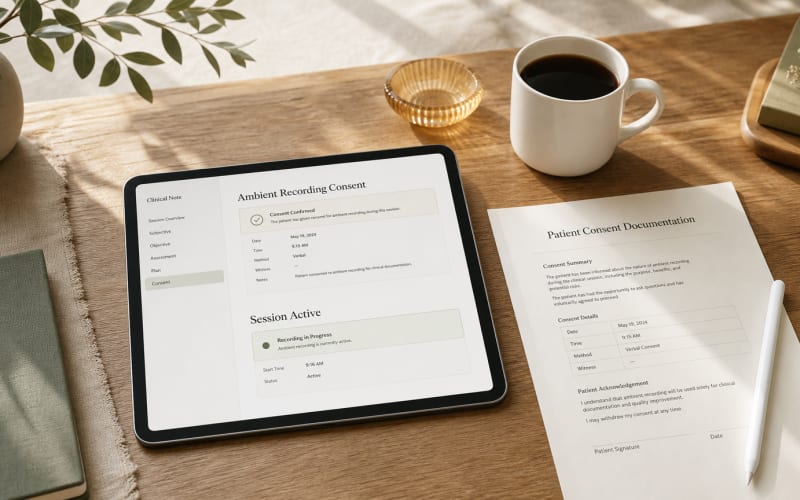
A defensible program therefore rests on four load-bearing concepts: consent, disclosure, documentation, and auditability. Consent must be captured before the encounter and tied to the chart. Disclosure means the patient is informed if any recording, transcription, or ambient scribing occurs. Documentation means the encounter modality and any consent artifacts are recorded contemporaneously. Auditability means the system can show, later and under scrutiny, when consent was obtained and when the modality changed. These are the pillars we hold our own architecture against, and they are the ones we recommend Georgia physician groups adopt regardless of which vendor they select.
The Modality-Change Problem: Video, Audio-Only, and Mixed Encounters
A recurring operational question involves what happens when a telehealth session degrades from two-way audiovisual to audio-only mid-encounter. The honest legal answer is that § 16-11-62 does not create an immediate re-consent requirement pinned to that transport event. There is no Georgia statutory language mandating a track-switch consent prompt. But the absence of a statutory command is not license to ignore the change. If the original consent artifact was framed around an audiovisual encounter and the session narrows to audio-only, the scope of what the patient agreed to has shifted, and a careful record should reflect that shift.
We advise treating a modality change as a workflow event that warrants patient notice and re-documentation. Practically, this means the platform should log session modality changes with timestamps, surface an updated-notice or re-affirmation prompt when the mode changes, and preserve that event in the audit trail. This is a risk-control posture, not a statutory citation, and it should be labeled as such internally so that your compliance officers understand the basis for the control. Overstating the legal basis for a control undermines credibility during audit; understating the prudence of the control invites avoidable exposure.
Sequencing Consent Before Capture
The single most important sequencing discipline is that consent state must precede capture. A scribe or recorder should not begin operating unless a confirmed consent condition tied to the chart is present. This ordering is what keeps the § 16-11-62 concern from ever attaching, because the statute's exposure grows from recordings made without the required consent. When consent is a hard precondition, the system is architecturally incapable of producing an out-of-consent recording. Merry AI keys its capture state to that confirmed consent flag by design.
The County Board of Health Edge Case
One narrow but instructive exception exists in Georgia law: a county board of health facility carries an explicit restriction against recording patient activities without the consent of all patients observed in that setting. Physician groups operating within, or adjacent to, public health facilities should treat all-party consent as the operating default there rather than assuming a single-participant consent posture suffices. This is a good reminder that consent posture is context-dependent, and that a mature platform lets you configure consent requirements per site and per modality rather than hard-coding a single national assumption.
Architecture Comparison: Manual, Generic Scribe, and Merry AI
The differences between charting approaches become concrete when you place them side by side. Manual charting is auditable but slow and error-prone under cognitive load. Generic AI scribes accelerate drafting but frequently retain audio in vendor systems and rely on implicit rather than gated consent, which widens § 16-11-62 and HIPAA exposure. A compliance-first architecture treats consent as a precondition and retention as an enemy.
| Control Dimension | Manual Charting | Standard Generic AI Scribe | Merry AI Compliance Architecture |
|---|---|---|---|
| Consent sequencing | Clinician-dependent, often verbal | Frequently implicit, ungated | Hard gate: capture blocked without chart-tied consent flag |
| Audio retention | No audio; note only | Persistent audio in vendor store | RAM session shredding; no persistent audio artifact |
| Modality-change logging | Manual, easily omitted | Rarely captured | Timestamped modality events in audit log |
| Physician attestation | Signature on final note | Often auto-filed as draft | Mandatory review-and-sign gate before EHR filing |
| Audit evidence | Fragmented across systems | Vendor-held, limited access | Consent and signature events retained with the note |
| G2211 complexity capture | Manual, inconsistent | Not modeled | Structured prompts surface longitudinal complexity |
Read across that table and the design philosophy is legible: eliminate persistent recordings, gate capture on consent, and make the physician the affirmative author of record. Each choice narrows a specific statutory or regulatory surface rather than adding generic features.
Attestation, Retention, and the Liability Chain
Physician attestation is the mechanism that converts a machine-drafted proposal into an authoritative medical record. The attesting physician certifies accuracy, adopts the content, and thereby keeps the liability chain unbroken. Merry AI enforces this as a hard gate: a draft cannot be filed to the EHR until the clinician reviews, corrects where necessary, and signs, with the signature event recorded in the audit log. This mirrors the long-standing standard applied to human transcriptionist output, where the dictating physician remains responsible for the final text.
Retention discipline complements attestation by removing the artifact that most directly implicates § 16-11-62. Under a HIPAA § 164.312 aligned posture, audio lives only in volatile memory for the duration of the transcription pass and is then released and overwritten. The only surviving objects are the physician-attested note inside the covered entity's own EHR and the metadata audit log. Cross-referencing the statutory text through the National Library of Medicine's PMC index at https://www.ncbi.nlm.nih.gov/pmc/ is a useful step when assembling your legal appendix and citation trail.
Validating Prompts and Templates Before Deployment
Before any of this reaches production, the scribe prompts and modality-notice templates should be validated against the Georgia written-consent requirement and against your own consent artifacts. We maintain a vetted set of starting points in the Scribing Template Directory, which physician groups can adapt to their site-specific consent posture and to the G2211 complexity-capture language relevant to their longitudinal patients. Do not deploy a generic template without confirming it reflects Georgia's documentation expectations.
Building the Georgia Telehealth Compliance Checklist
Pulling the analysis into an operational checklist gives physician groups something actionable. Obtain and store written telehealth consent before the encounter; document whether the encounter is video, audio-only, or mixed at the start; if any recording, transcription, or scribing is used, document that the patient was informed and that required consent was captured; preserve the consent artifact in the chart and keep it available at originating and distant sites where required; and treat a video-to-audio shift as a workflow change requiring notice and re-documentation. None of these steps requires an imagined statutory trigger, and all of them survive audit scrutiny.
If your group is uncertain whether its current platform gates capture on consent, shreds audio after processing, and enforces attestation before filing, that uncertainty is itself a finding. We would rather show you the mechanics than describe them abstractly. Book a 15-Minute Workflow Audit and we will walk through your consent sequencing, your modality-change logging, and your retention posture against the O.C.G.A. § 16-11-62 and Georgia Medicaid framework, and identify where your documented controls diverge from your actual system behavior.