Statutory Compliance Architecture for Florida Security of Communications Act
Florida's Security of Communications Act, codified at Chapter 934, Florida Statutes, governs the interception of wire, oral, and electronic communications. Section 934.03(1) makes it unlawful to intentionally intercept an oral communication. Section 934.02(2) defines that communication by the speaker's reasonable expectation that it is not subject to interception. A gastroenterology consultation about rectal bleeding, biologic failure, or fistula drainage meets that expectation without argument.
The operative exception is narrow. Section 934.03(2)(d) permits interception only when all parties to the communication have given prior consent. Florida is therefore an all-party jurisdiction for ambient documentation. The exposure is concrete: § 934.03(4) attaches criminal penalties, and § 934.10 authorizes civil actions for actual damages, statutory liquidated damages, punitive damages, and attorney's fees.
All-Party Consent Mechanics in the GI Exam Room
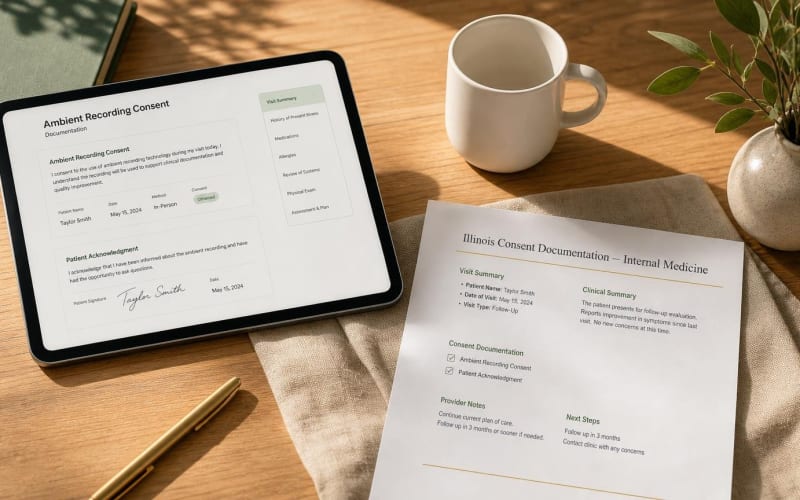
Every voice in the room counts as a party. In IBD clinics, that routinely includes a spouse, an adult child managing infusion schedules, a medical interpreter, or a fellow. Merry AI requires the clinician to confirm verbal consent from each present speaker before the microphone activates. The capture session cannot begin while the consent field is empty.
Consent is captured as structured text, not inferred from silence. The attestation names the technology, its purpose, the parties present, and the time of agreement. If a new participant enters mid-visit, capture pauses until consent is extended. This sequence satisfies the prior-consent language of § 934.03(2)(d) rather than relying on retroactive acknowledgment.
Ephemeral Audio Handling and Chapter 934 Exposure
Volatile memory does not remove the consent obligation. Acquisition of the oral communication is itself the interception, regardless of storage. What a RAM-only pipeline changes is the size of the downstream record. Merry AI buffers audio in process memory, transcribes in near real time, and overwrites each buffer after transcription. No audio reaches disk, object storage, or a training queue.
The only persistent artifact is the clinician-reviewed note. That limits breach surface, discovery scope, and retention ambiguity. The comparison below summarizes how each documentation model distributes Chapter 934 and billing risk.
| Compliance Dimension | Manual Charting | Standard Generic AI Scribes | Merry AI Compliance Architecture |
|---|---|---|---|
| § 934.03(2)(d) consent | No interception occurs | Often a one-time account checkbox | Per-encounter, per-party attestation gating capture |
| Audio retention | None | Cloud storage for QA or model tuning | RAM-only; buffers overwritten after transcription |
| § 934.10 civil exposure | Minimal | Expanded by durable recordings | Limited to consented, transient capture |
| G2211 longitudinal language | Clinician-dependent | Generic SOAP narrative | IBD duration, failed therapies, focal-point statement |
| Modifier 25 interplay | Coder review | Rarely enforced | G2211 suppressed except listed preventive services |
| eCW v12 placement | Manual typing | Single text-box paste | Tab- and iframe-aware injection into HPI and Assessment/Plan |
G2211 Longitudinal IBD Documentation
CMS describes HCPCS G2211 as visit complexity inherent to E/M services that serve as the continuing focal point for all needed care, or that are part of ongoing care for a single, serious or complex condition. It is reportable with office/outpatient codes 99202–99215 and, for 2026, home or residence codes 99341–99350. Crohn's disease and ulcerative colitis are clear examples of a single, serious condition.
Recording IBD Duration and Failed Therapies
The note must show chronicity in concrete terms. Merry AI structures the HPI to capture diagnosis date, Montreal classification, prior steroid dependence, and each failed or discontinued therapy with its reason, such as primary nonresponse to infliximab or loss of response with antidrug antibodies. Surveillance intervals, stricture or fistula history, and colorectal surgery coordination are documented as supporting elements.
The focal point statement closes the assessment. It states that the gastroenterologist manages the patient's IBD longitudinally, including immunosuppression risk balancing, therapeutic drug monitoring, and dysplasia surveillance. Medicare contractor guidance asks for evidence of the ongoing relationship and of cognitive effort beyond episodic care; this paragraph addresses both directly.
Modifier 25 and 59 Boundaries in Endoscopy Days
When an E/M visit carries modifier 25 on the same day as a separately payable procedure, CMS generally denies G2211. Since January 1, 2025, exceptions are limited to the annual wellness visit, vaccine administration, and certain Medicare Part B preventive services. Merry AI flags G2211 as non-reportable when a same-day colonoscopy or EGD is detected.
Modifier 59 is never auto-appended from transcript content. NCCI policy treats it as a distinct procedural service indicator subject to frequent misuse. The system surfaces the relevant NCCI rationale for coder review, keeping coding decisions with credentialed staff. Peer-reviewed literature on EHR documentation integrity is indexed at https://www.ncbi.nlm.nih.gov/pmc/.
eClinicalWorks v12 Chrome Injection and Clinician Attestation
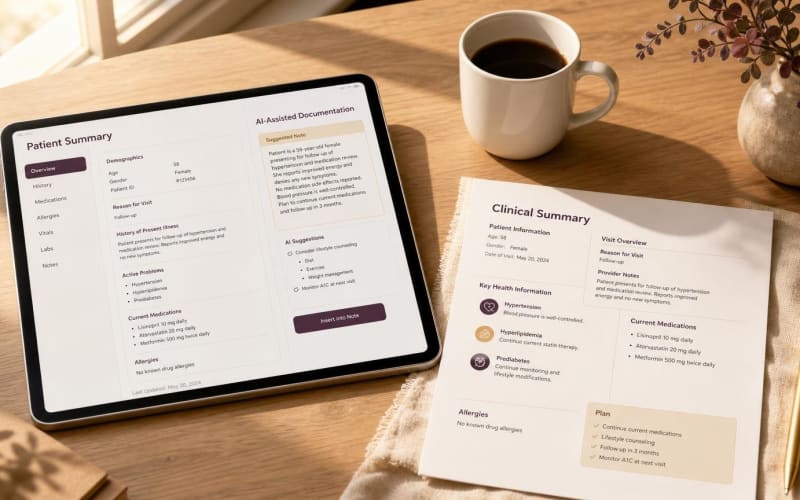
eClinicalWorks v12 runs within Chrome, exposing the progress note as browser-rendered components, frequently inside iframes and tabbed sections. Merry AI's extension resolves the active progress-note frame before writing, so text cannot land in a messaging panel. Patient identity is matched against the open encounter header before every insertion.
The Chapter 934 attestation is injected into a dedicated block within Assessment/Plan, for example: "Patient and all present parties were informed that an ambient transcription system would capture oral communications during this visit and gave prior consent pursuant to Fla. Stat. § 934.03(2)(d)." HPI text containing IBD duration and failed therapies is written to the HPI tab.
No note is signed automatically. The clinician reviews, edits, and signs within eCW, preserving authorship validation consistent with CMS documentation integrity guidance. To review your Florida GI workflow against these controls, Schedule a 15-Minute Workflow Audit.