Statutory Interpretation of Florida 934.03 for Multispecialty Clinics
Florida Statute 934.03(1)(a) prohibits the intentional interception of any wire, oral, or electronic communication unless a statutory exception applies. Under section 934.02(3), interception means the aural or other acquisition of communication contents through any electronic, mechanical, or other device. An ambient documentation microphone that streams a clinician-patient conversation to a transcription engine meets that definition, whether or not audio is ever written to disk.
The controlling exception is section 934.03(2)(d). It permits interception only when all parties to the communication have given prior consent. In a multispecialty group, the parties often include more than the clinician and patient: parents in pediatrics, spouses in cardiology, interpreters in behavioral health, and trainees in orthopedic clinics. Each person speaking in the room is a party, and each must consent before capture begins.
Clinical rooms carry a reasonable expectation of privacy, so encounter speech qualifies as oral communication under section 934.02(2). Section 934.03(4)(a) classifies violations as third-degree felonies. Section 934.10 authorizes civil actions for actual damages or liquidated damages of the greater of $100 per day or $1,000, plus punitive damages and attorney's fees. Exposure accrues per encounter, not per clinic.
Prior Consent Versus Retroactive Notice
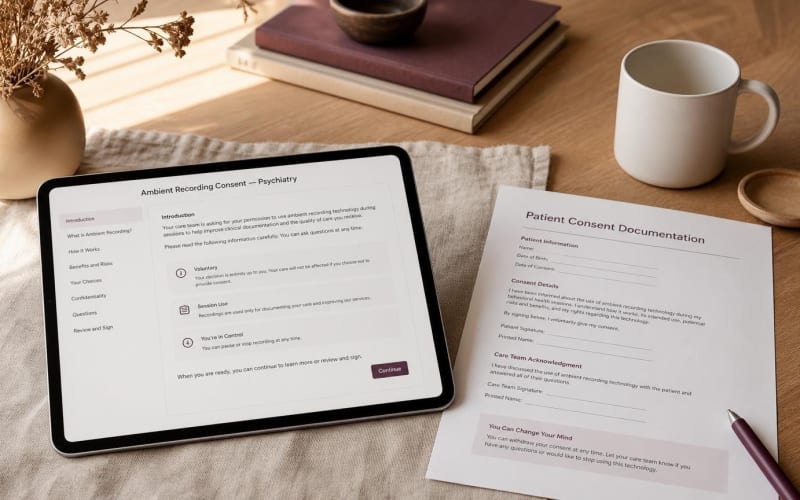
Posted signage and intake forms provide organizational notice. They do not prove that every participant in a specific encounter consented before the microphone opened. The statute requires prior consent. A workflow that starts streaming and records consent afterward is noncompliant on its face, even if every party would have agreed.
Directive P1 therefore requires the clinician to confirm and record consent from every participant present before any ambient audio capture. When a new participant enters mid-visit, such as a family member joining a pediatric well visit, capture pauses until that person consents and the addition is logged.
Consent-Gated Capture Architecture
Merry AI treats consent as a technical precondition rather than a policy reminder. The extension runs a four-state machine: BOOTSTRAP, NOTE_OPEN, CONSENT_LOGGED, and STREAMING. It does not request microphone access through getUserMedia until the state reaches CONSENT_LOGGED. That state requires a detected encounter note editor and a confirmed DOM write of the consent clause.
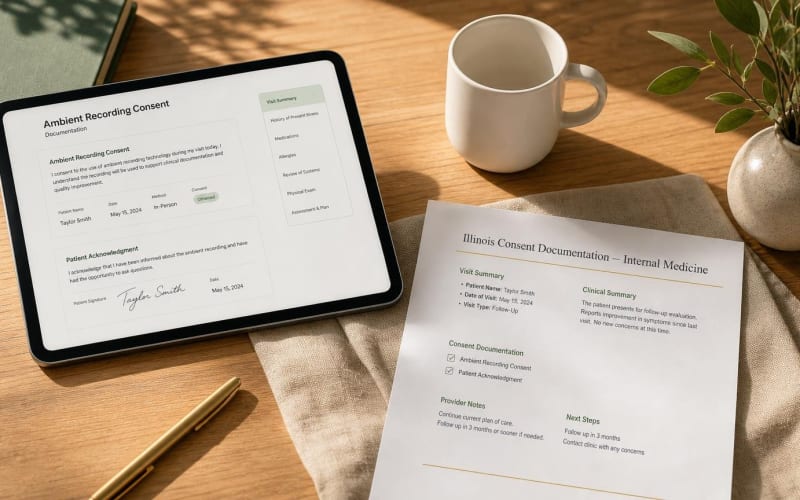
The consent clause is injected into the active note field, typically a contenteditable region or textarea within the chart frame. It records the date, time, participant count, participant roles, and statutory reference. Because the clause sits inside the signed encounter note, it stays with the legal medical record through EHR export, release-of-information requests, and payer audits.
Audio is held only in volatile process memory during real-time transcription, then overwritten and released. No local files, temporary system files, crash dumps, or quality-assurance archives contain raw audio. This reduces breach surface. It does not replace prior consent, because section 934.03 regulates acquisition rather than retention.
Chrome Overlay Checkbox Gating (Directive P7)
Directive P7 gates the overlay recording button behind a consent checkbox in Chrome. The record control renders disabled, with aria-disabled set to true. It activates only after two conditions are met: the clinician checks an attestation that all parties present have verbally consented, and the extension confirms the consent clause in the note DOM.
Unchecking the attestation, closing the encounter, or switching patients returns the state machine to NOTE_OPEN and releases the microphone track. Resuming the visit requires new consent. This prevents capture from carrying over between back-to-back visits, a common failure point in high-volume multispecialty schedules.
Statutory Comparison Across Documentation Models
The table below contrasts how each documentation model addresses the core elements of section 934.03.
| Compliance Dimension | Manual Charting | Standard Generic AI Scribes | Merry AI Compliance Architecture |
|---|---|---|---|
| Prior all-party consent, 934.03(2)(d) | Not applicable; no interception | Policy-level notice; no technical gate | Microphone locked until consent logged |
| Consent evidence in record | None required | External forms or none | Timestamped clause injected into note |
| Mid-visit participant changes | Not applicable | Rarely detected | Capture pauses pending new consent |
| Raw audio retention | None | Often retained for QA | RAM-only, zero disk persistence |
| Chrome record control | Not applicable | Always enabled | Disabled until attestation checkbox |
| Exposure under 934.03(4) and 934.10 | Minimal | Elevated per encounter | Reduced by enforced workflow |
Generic ambient tools often rely on clinicians remembering to obtain consent. In an all-party jurisdiction, memory is not a control. An enforced gate turns a statutory obligation into system behavior that can be verified.
Specialty Documentation and Billing Integrity
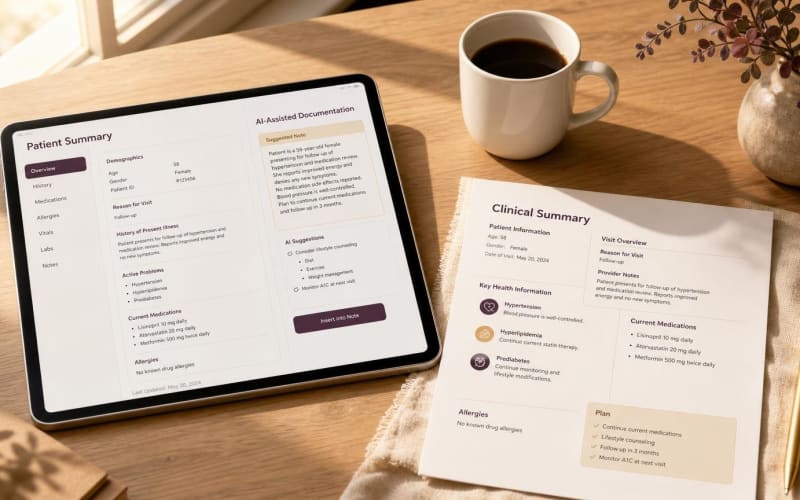
Compliant capture must still produce clinically precise notes. In behavioral health, transcripts support DSM-5-TR criteria counts, symptom duration, PHQ-9, and C-SSRS documentation. In cardiology, stated NYHA class and LVEF values with modality go to discrete fields only after clinician confirmation. Orthopedic range-of-motion degrees are recorded only when spoken, never inferred. Pediatric anticipatory guidance maps to Bright Futures sections.
Clinician attestation remains the final safeguard. The clinician reviews every injected element before signature, which protects data integrity and the clinician's authorship of the legal record.
G2211 and Modifier 25/59 Traceability
HCPCS add-on code G2211 reflects the complexity of longitudinal care and is reported with office or outpatient E/M codes 99202-99215. The assessment and plan must show a continuing focal-point relationship or ongoing care for a single serious or complex condition, not boilerplate. CMS permits G2211 with a modifier 25 E/M only when the same-day service is an annual wellness visit, vaccine administration, or Medicare Part B preventive service.
Modifier 25 requires a significant, separately identifiable E/M service. Merry AI therefore keeps procedure narrative and E/M decision-making in separate note sections. Modifier 59 requires documented distinctness by site, session, or organ system, and the overlay prompts the clinician to state it explicitly.
Peer-reviewed evidence on ambient documentation accuracy and consent practices is indexed at https://www.ncbi.nlm.nih.gov/pmc/. To review your consent workflow, Chrome gating, and specialty templates against section 934.03, Schedule a 15-Minute Workflow Audit.