Statutory Compliance Architecture for Connecticut CGS § 52-570d
Connecticut CGS § 52-570d prohibits recording an oral private telephonic communication unless one of three conditions is met. The first is prior written consent, or consent obtained at the start and recorded as part of the communication. The second is a verbal notification recorded at the beginning. The third is an automatic tone warning repeated about every fifteen seconds. Any aggrieved party may sue in Superior Court for damages, costs, and reasonable attorney's fees.
For telehealth psychiatry, the exposure is concentrated. A single session may include a patient, a parent or conservator, a case manager, and a second clinician. Each participant is a party whose knowledge of the recording must be established. CGS § 53a-189, which addresses criminal eavesdropping, runs parallel to the civil statute. An undocumented capture event therefore carries more than reimbursement risk.
The Telephonic Scope Question
The statutory text references telephonic communications, but most telepsychiatry now runs over IP-based video platforms. The reviewed materials contain no explicit extension of § 52-570d to VoIP or video sessions, although Connecticut guidance reads the statute broadly. Merry takes the conservative position. It applies all-party consent logic to every audio capture, regardless of transport layer, including audio-only visits joined by landline.
Consent Capture and Note Header Injection
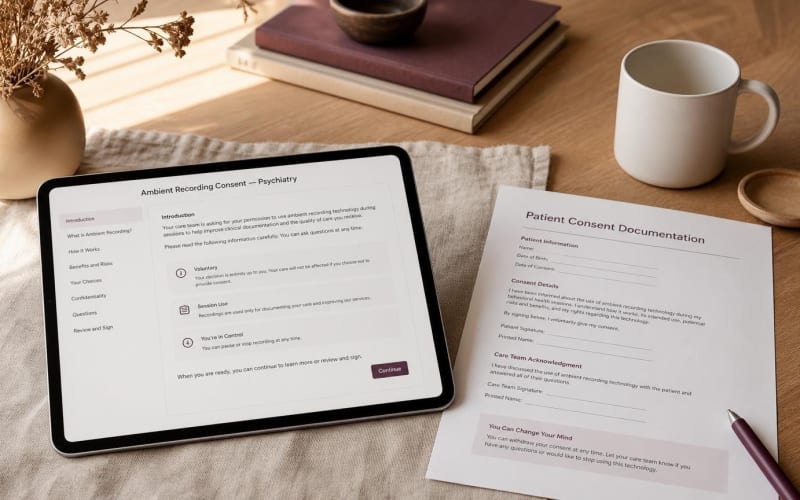
Merry plays an audible recording notice as soon as the session opens, before any clinical content is exchanged. The notice states that audio is captured solely to generate the clinical note, and it asks each participant to confirm. The notice satisfies the verbal notification pathway under § 52-570d(a)(2). The spoken confirmations also obtain consent at the start of the communication, consistent with § 52-570d(a)(1).
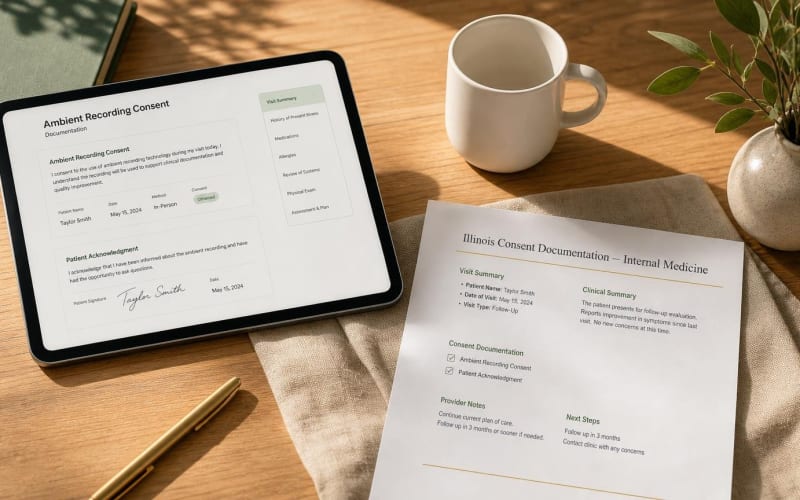
Each consenting party is named. A generic statement that all parties agreed is weak evidence if a caregiver later disputes participation. Merry records each participant, their relationship to the patient, and the timestamp of the notice. The extension then writes a standardized line in the first visible position of the note header. For example: Recording consent (CGS § 52-570d): audible notice played 09:02 ET; verbal consent from the patient and from the patient's mother, each named in full; audio processed in volatile memory only and not retained.
DOM Targeting Across EHR Editors
Header injection depends on precise selector profiles. Plain textarea fields, contenteditable rich-text editors, and iframe-hosted documentation modules each need distinct handling. Merry marks the consent line with a unique class, which prevents three failure modes. The line never merges into the subjective narrative. It never lands inside structured widgets such as suicide risk screens. It never duplicates when a note is reopened. Injection waits until the editor fully loads, so autosave cannot strip the line before signature.
Jurisdiction and encounter context gate every write. Before applying Connecticut language, the extension confirms two conditions: a telehealth psychiatry encounter type, and a Connecticut patient or billing location. This keeps the wrong template out of in-person and out-of-state charts. Non-audio logs link the consent event, session identifier, and encounter number. The audio itself is discarded from RAM after transcription.
Statutory Comparison of Documentation Models
The table below contrasts three documentation models against the obligations of § 52-570d and the downstream audit trail.
| Compliance Dimension | Manual Charting | Standard Generic AI Scribes | Merry AI Compliance Architecture |
|---|---|---|---|
| Recording notice under § 52-570d(a)(2) | Not applicable; no audio captured | Left to clinician habit or intake forms | Audible notice played automatically at session start |
| Named all-party consent | Not applicable | Often a generic checkbox with parties unnamed | Each participant named with role and timestamp |
| Chart-visible consent evidence | Not applicable | Kept in vendor logs outside the legal record | Injected into note header and preserved through signature |
| Audio retention | None | Frequently persisted for quality review | Processed in RAM and discarded after transcription |
| State-specific logic | Depends on the clinician | Clinic-level policy not enforced in product | Per-jurisdiction templates gated by encounter context |
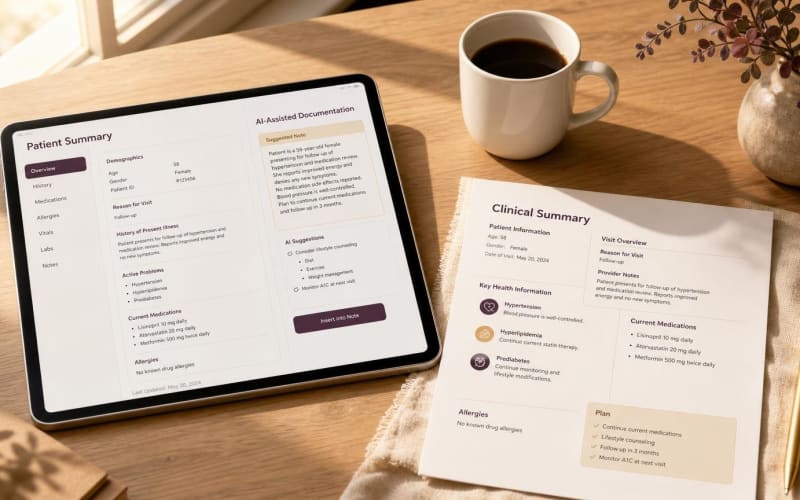
| Documentation burden | High; G2211 narrative often thin | Moderate; complexity capture varies | Longitudinal narrative drafted for clinician review |
Persistent audio storage widens exposure, because a retained file is itself evidence of a recording event that must be defended. RAM-only processing does not remove the consent obligation, since transient capture is still capture. It does limit what can be subpoenaed, breached, or repurposed.
Reimbursement Integrity and Clinician Attestation
The consent header protects legal standing, but it does not justify billing. The clinical content remains governed by the CMS documentation rules in MLN006764. Psychiatric medication management visits billed as office or outpatient E/M codes 99202 through 99215 may carry HCPCS G2211. The record must reflect an ongoing longitudinal relationship for a serious or complex condition. Diagnostic evaluations under 90791 or 90792 require their own content documentation.
NCCI Modifier Discipline
Modifier 25 and modifier 59 are among the most heavily audited NCCI bypass mechanisms, and a consent line satisfies neither. When a psychotherapy add-on such as 90833 accompanies an E/M service, the record must show psychotherapy time separate from E/M work. Merry drafts distinct assessment and plan content alongside a separately timed psychotherapy narrative. The consent header sits above both and contributes nothing to modifier or add-on justification.
Clinician attestation remains the final safeguard. The psychiatrist reviews the drafted note, confirms that the named participants match who actually joined, and signs. Teams building internal validation protocols can find peer-reviewed literature on ambient documentation accuracy at https://www.ncbi.nlm.nih.gov/pmc/. To review your telepsychiatry workflow against § 52-570d, Schedule a 15-Minute Workflow Audit.