A Documentation Workflow Built for WebPT / Therabill
Clinical documentation inside WebPT rarely fails because therapists lack diligence. It fails because the objective exam—joint-by-joint range of motion in degrees, active versus passive measurements, outcome-measure trajectories like LEFS or NDI—must be re-typed into SOAP 2.0 flowsheet cells while the patient sits waiting. The measurement lives first in the clinician's hands and voice, then in short-term memory, then finally in a grid, and every hop introduces transcription error and lost minutes. Merry AI closes that gap by capturing spoken findings and injecting them, structured and confirmed, directly into the fields WebPT already renders.
Outpatient physical therapy operates on an episode-of-care model with strict CMS documentation requirements. The MLN905365 guidance and Medicare Benefit Policy Manual Chapter 15 require certified Plans of Care, defensible medical necessity language, quantitative progress at least every tenth visit, and discharge summaries that compare onset to final status. Merry AI is architected to honor these constraints rather than route around them, because a note that cannot survive a payer audit has no value regardless of how fast it was written.
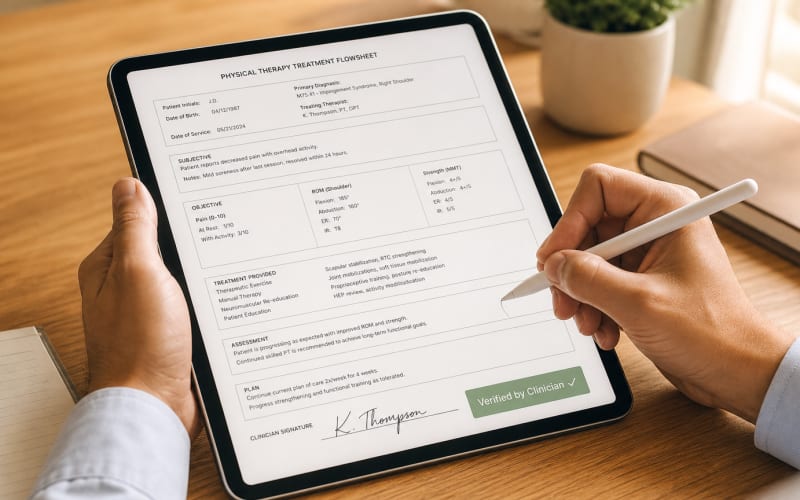
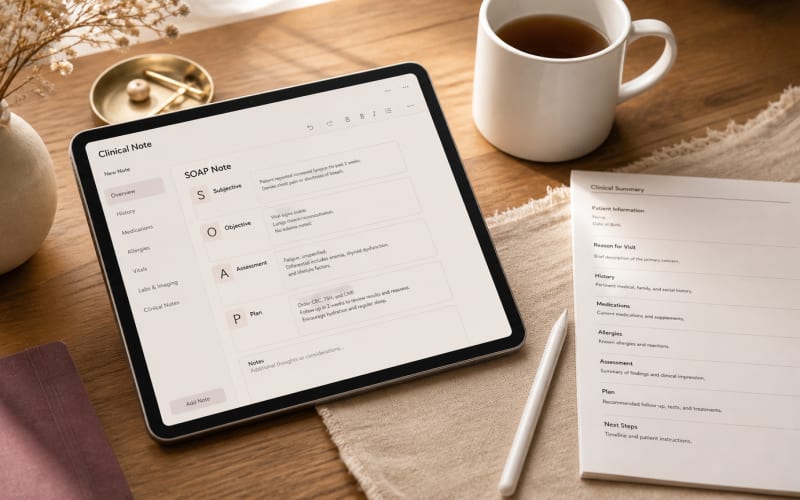
Our differentiator is precision of placement. Where generic scribes drop a paragraph of prose into a free-text box, Merry AI parses "left shoulder AROM flexion one-oh-five, PROM one-thirty-five, painful arc ninety to one-twenty" into discrete objects—joint, side, motion, AROM value, PROM value, pain behavior—and writes each into the correct flowsheet column for the correct visit date. The Objective narrative and the structured grid populate simultaneously, and the Assessment section receives goal-progress language derived from the numeric deltas.
Why DOM Injection Beats API Marketplace Integration
WebPT does not expose a public, general-purpose write API for third-party scribes. Its own AI partners are embedded through private, contractual integrations, and the platform's HL7 data package to Therabill is a closed pipeline engineered to protect HIPAA-regulated billing and clinical data. Waiting for marketplace access means negotiating a partner agreement, paying per-seat integration fees, and accepting server round-trip latency on every write. For a busy outpatient clinic, that is a non-starter.
Merry AI takes the browser-native path instead. Our Chrome Extension operates inside the clinician's already-authenticated WebPT session and resolves the specific input selectors that make up the SOAP 2.0 flowsheet. It writes to exactly the fields a therapist would click, dispatching native input and change events so WebPT's own validation and carry-forward logic fire normally. Because the data lands in supported fields, it flows cleanly through the HL7 packaging to Therabill without corrupting data integrity.
The architectural tradeoffs are worth laying out explicitly:
| Architecture | Deployment Overhead | Latency | Annual Fee | Audit Defensibility |
|---|---|---|---|---|
| Traditional API Marketplace | Partner contract, IT provisioning, credential exchange | 1.5–4s server round-trip per write | Per-seat + integration fees | High, but gated behind vendor approval |
| Manual Copy-Paste | None, but 100% human effort | Minutes per note | $0 tooling, high labor cost | Variable; prone to cloning and transcription error |
| Merry AI DOM Injection | Chrome install, zero IT | 0.4s local field mapping | Flat practice plan, no marketplace fee | High; lands in native validated fields |
This table clarifies the central point: Merry AI delivers the field-level precision of a formal API integration with the friction profile of a browser bookmark. There is no marketplace listing to purchase and no lag between speaking a measurement and seeing it appear in the grid.
DOM Field Mapping for ROM and PROM
Precise field mapping is the heart of the engineering. Each SOAP 2.0 flowsheet cell has a stable DOM identity, and Merry AI maintains a mapping layer that binds parsed clinical objects to those selectors. When a therapist narrates a comparative re-assessment, the extension appends a new dated row and computes the delta—shoulder flexion 90° at eval, 120° at visit four, 150° at discharge—so the trajectory is machine-readable rather than buried in prose. Range validation flags implausible values before injection, protecting against mis-heard numbers.
Preserving the Therabill HL7 Handoff
Because Therabill receives WebPT data as HL7 packages, every value Merry AI writes must reside in a field that WebPT exports. We deliberately never scrape hidden state or inject into unsupported elements. This discipline means billing providers, CPT minutes under the 8-minute rule, and service facility mappings configured on the Therabill side stay consistent with the clinical record, keeping documentation and claims aligned for services like 97110, 97112, 97116, and 97140.
Compliance, Coding, and the Author-of-Record Principle
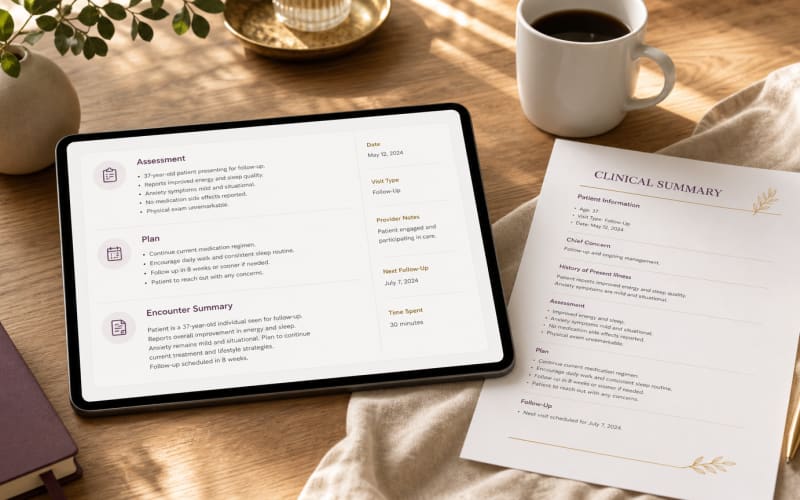
Every draft Merry AI generates is exactly that—a draft. The clinician reviews the parsed measurements, edits any narrative, and applies their signature before the chart is committed. This preserves the therapist as the author of record, which is both an ethical requirement and an audit necessity under CMS anti-cloning rules. Merry AI actively assists here by surfacing visit-specific changes and refusing to replicate static text from prior encounters.
For clinics running integrated outpatient E/M alongside rehab, Merry AI supports capture of the CPT G2211 complexity add-on code for longitudinal, single-provider care of patients with comorbidity-driven complexity, per CMS guidance MM13473. The engine recognizes when documentation establishes an ongoing care relationship and prompts for the supporting narrative rather than auto-appending the code, keeping the coding decision in clinician hands.
Baseline, Goals, and Medical Necessity
Defensible goals require measurable baselines. Merry AI flags when a goal has no quantitative starting point and suggests specific, functional target language—"increase right shoulder AROM flexion to 160° to enable overhead reaching for work tasks"—that ties the impairment metric to participation-level necessity. This is the exact documentation posture payers scrutinize during post-payment review.
Getting Started Without an IT Project
Deployment is intentionally boring. Each therapist installs the extension, signs in with their existing WebPT credentials, and the Merry AI account maps to that user so voice documentation is correctly attributed. Audio capture runs on the clinic tablet or laptop under an executed BAA with zero retention. There is no server to stand up and no firewall exception to file. To explore rollout options across your clinic, Explore Merry AI Practice Partner Plans.
Before you commit to any change in your documentation workflow, we recommend a structured review of where minutes are actually lost in your SOAP 2.0 process. Schedule a 15-Minute Workflow Audit and we will map your highest-friction fields directly. When you are ready to build out your note library, Access 1,000+ EHR Clinical Templates for rehab-specific evaluation, daily, progress, and discharge structures pre-mapped to WebPT semantics.