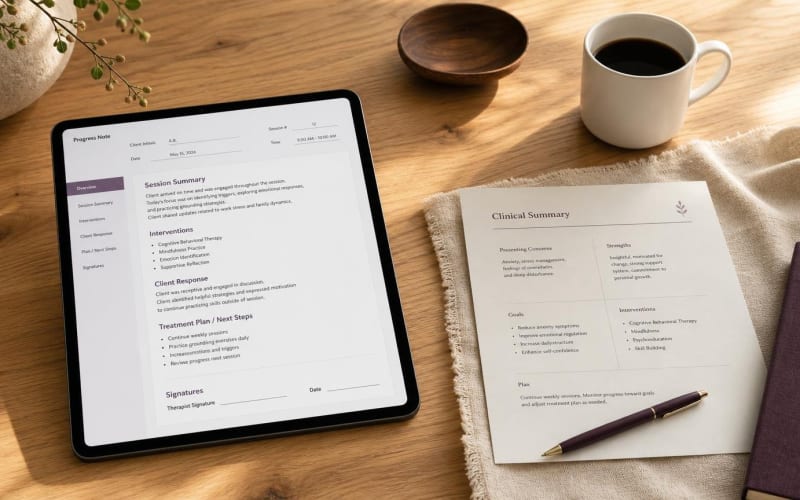
One group recording becomes one individualized 90853 note per attendee
Group psychotherapy documentation in TheraNest breaks down at the point of scale. A clinician running an eight-person process group leaves the room with one shared memory of the session and eight separate charts to complete, each of which must stand alone under CPT 90853 review. Writing those notes by hand often pushes documentation into evenings, and shortcuts such as cloning one narrative across every chart create the exact pattern auditors look for.
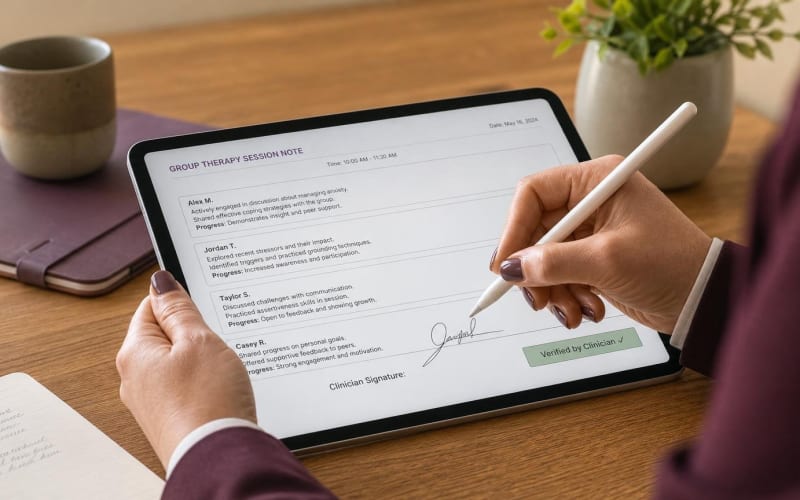
Merry AI addresses this by diarizing a single consented group recording, attributing speech to each rostered attendee, and drafting a separate note for every client. Each draft contains a short description of the group modality and themes plus an individualized section covering that client's participation, response, and progress toward treatment plan goals. The clinician reviews every draft, and the Chrome Extension writes each approved note into the correct TheraNest client record.
Browser-native DOM mapping bypasses EHR marketplace paywalls entirely
The Chrome Extension works inside the clinician's own authenticated TheraNest session. When a progress note or group note screen is open, the extension identifies the narrative note field on the page, writes the approved text into that field through the browser Document Object Model, and stops. TheraNest's native Save and Sign controls then persist the note exactly as if the clinician had typed it.
No server API is involved. There is no HL7 interface, no FHIR endpoint, no partner agreement, and no per-seat integration fee. Practices do not wait on a vendor roadmap, and IT teams do not open firewall ports or provision service accounts. Write-back happens client-side in under 500 milliseconds once the clinician clicks insert.
Five clinician-controlled steps move each split note into the correct TheraNest chart
Step 1: Open the TheraNest group session for the scheduled date and confirm the session time and duration. These details populate the shared header of every attendee's note.
Step 2: Load the attendee roster. Merry reads the attendees marked present on the TheraNest group session screen, so only clients who actually attended receive a draft. Absent and late-cancel clients are excluded from drafting entirely.
Step 3: Confirm speaker attribution before drafting. Merry's diarization proposes which voice segments belong to which attendee. Any segment it cannot attribute with confidence is flagged for clinician review rather than assigned by guess.
Step 4: Review each individualized draft. The clinician edits participation details, adds clinical judgment, and confirms that the content reflects the client's DSM-5-TR diagnosis and the treatment plan goal addressed in session.
Step 5: Inject and sign per client. Before writing, the extension checks that the client name on screen matches the draft. It then writes the approved note into that client's note field, and the clinician completes TheraNest's Save and Sign actions before moving to the next attendee.
Every CPT 90853 note must prove what this specific client did in the group
Payers reviewing group psychotherapy claims expect each beneficiary's record to stand on its own. CMS behavioral health documentation guidance calls for records that fully disclose the extent of services furnished and support the claims billed. For 90853, that typically means the note identifies the group modality, date, duration, and number of participants, describes the therapeutic themes and interventions used, and records this client's individual engagement, statements, insight, and behavioral response.
Near-identical notes across multiple charts are a classic audit flag. If eight clients receive the same paragraph with only the name changed, the documentation no longer demonstrates individualized care or medical necessity. Merry structures every draft so the shared group section stays brief and the individualized participation section carries the clinical weight, drawn from what that attendee actually said and did in the recording.
Medical necessity ties back to the client's diagnosis and treatment plan. Merry's behavioral health templates prompt for presenting symptoms, functional impact, the goal addressed in session, and observable progress. They can also reference recent PHQ-9 or GAD-7 scores the clinician has already recorded in TheraNest.
Structured TheraNest fields remain clinician-selected, not machine-filled
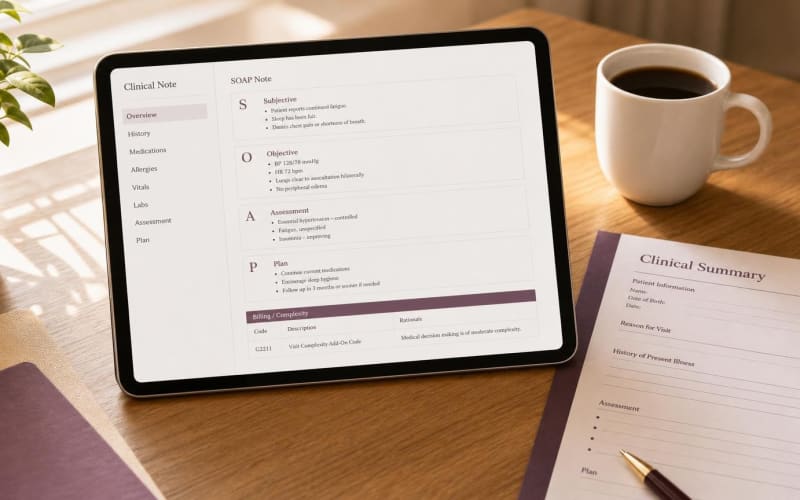
Merry writes narrative text only. Diagnoses, CPT codes, and service details continue to be selected through TheraNest's searchable DSM and CPT database, and any required template fields are completed through TheraNest's own interface. This separation matters: an extension that filled narrative fields while skipping required structured fields would create records that look complete but fail validation or billing review. Keeping code selection in the clinician's hands preserves the link between narrative justification and the billed service.
Psychotherapy notes stay segregated from the billable progress record
HIPAA treats psychotherapy notes differently. Under 45 CFR 164.501, process notes that analyze session content and are kept separate from the rest of the medical record receive heightened protection. Merry's templates separate billable progress content, such as interventions, participation, and progress, from private process observations, and the extension never writes process material into a progress note field.
Group sessions multiply disclosure risk because several clients share sensitive information in one room. Under an executed BAA, Merry retains zero audio and zero transcript after drafting, and each client's note contains only that client's individualized content. Other attendees are referenced by role, never by name.
G2211 and modifier 25 attach to E/M visits, not to group psychotherapy alone
CMS defines HCPCS G2211 as an add-on to office or outpatient E/M codes 99202 through 99205 and 99211 through 99215, and to home or residence E/M codes 99341, 99342, 99344, 99345, and 99347 through 99350. It reflects longitudinal complexity in an ongoing care relationship. It does not attach to a standalone 90853 group psychotherapy claim.
Psychiatric prescribers who also run groups, or who see clients for medication management on the same day, need distinct documentation for each service. The E/M note must show history, medical decision making, and medication management that are significant and separately identifiable, which is the basis for modifier 25. CMS pays G2211 alongside an E/M billed with modifier 25 only when the other same-day service is an annual wellness visit, vaccine administration, or another Part B preventive service. Merry keeps E/M drafts and psychotherapy drafts in separate templates so longitudinal complexity evidence is never buried inside a group narrative.
Three integration paths carry very different setup and compliance costs
The comparison below summarizes how each approach handles TheraNest group documentation.
| Criterion | Traditional API Marketplace Integration | Manual Copy-Paste | Merry AI Chrome DOM Injection |
|---|---|---|---|
| Setup requirement | Vendor partnership, API credentials, IT project | None | Chrome Extension install per clinician |
| Integration fees | Often per-seat or platform fees | None | Zero API fees |
| Server-side access | Required | Not required | Not required |
| Per-attendee 90853 drafts | Depends on vendor scope | Clinician writes each note by hand | One individualized draft per rostered client |
| Field targeting | Mapped through API schema | Clinician selects field manually | DOM field mapping with client identity check |
| Risk of cloned notes | Moderate | High when clinicians copy forward | Reduced by individualized participation sections |
| Failure mode | Interface outage blocks write-back | Human error, wrong chart | Falls back to manual paste if selector fails |
| Final authority | Clinician signature | Clinician signature | Clinician review and TheraNest Sign action |
General-purpose ambient scribes are typically designed around one clinician and one patient. Multi-client group sessions, per-attendee splitting, and DSM-centric behavioral health templates usually fall outside their core workflow, which leaves TheraNest group practices copying and pasting the same output into several charts.
Selector validation keeps injected text in the correct TheraNest field
DOM-based integration carries one real risk: TheraNest can update its interface at any time, and a changed selector could point text at the wrong element. Merry validates the target field and the on-screen client identity before every write. If a selector fails or the target is ambiguous, the extension does not guess. It presents the approved note for manual paste instead.
Provenance records support internal audits. TheraNest's own audit log will show the clinician as the author, so Merry keeps internal logs of when each draft was generated and inserted. Practices can also append a standardized attestation line stating that the note was drafted with documentation assistance and reviewed, edited, and signed by the treating clinician.
Consent, contracts, and state rules require practice-level review
Every group member must consent to recording before the session begins, and that consent should be documented in each client's chart. State legislatures, including California and Texas, continue to add rules on AI use in healthcare, so practices should obtain legal review of current statutes, confirm that extension use aligns with their TheraNest agreement, and verify that internal security policy permits browser extensions on clinical workstations.