Merry AI writes per-patient PHP/IOP notes directly into Credible service note fields
Group sessions create the documentation bottleneck in addiction medicine programs. A single 180-minute IOP block with ten participants produces ten billable service notes. Each note needs ASAM dimensional content, exact attendance minutes, and progress against an individualized treatment plan. Clinicians often rebuild the same group narrative ten times and then edit each copy. That is the pattern payers flag as cloned documentation.
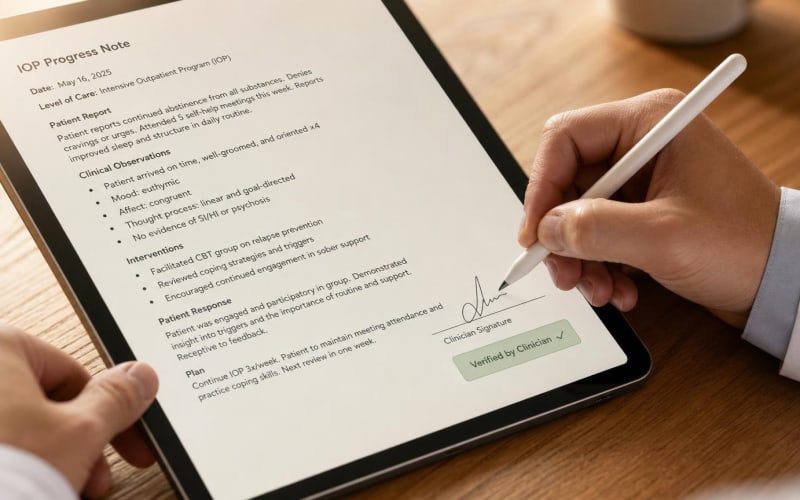
Merry AI splits one encounter into separate per-patient drafts. Speaker diarization attributes participation to each client, session timestamps anchor arrival and departure, and the system generates a narrative organized by ASAM dimension. The clinician opens each client's Credible service note, reviews the matching draft, and the Chrome Extension writes it into the mapped fields.
The Chrome Extension writes into Credible the same way a clinician types
Credible is delivered as browser forms: service note headers, narrative text areas, time fields, and program-specific pick lists. Merry AI's extension reads that rendered page in the clinician's active tab. It locates fields by visible labels and ARIA attributes rather than fragile element IDs, inserts text, and fires the input and change events Credible uses for validation and autosave. No server API, HL7 interface, or Qualifacts marketplace contract is involved.
From Credible's audit log perspective, every write appears as data entry by the logged-in user. That keeps the audit trail intact, and it is also why governance matters. The extension is configured to touch only narrative, minutes, and approved structured fields. It never edits diagnoses, signs notes, or submits claims.
Authorization, field mapping, and injection follow a fixed four-step sequence
Step one: authorize the extension. An administrator or clinician installs Merry AI from the Chrome Web Store and grants site permission only for the agency's Credible domain. Because the extension runs inside an existing authenticated session, no firewall change, VPN, or credential sharing is needed.
Step two: map service note fields. During a one-time mapping session, the clinician opens a representative PHP or IOP service note. Merry AI detects fields such as Start Time, End Time, Duration, Narrative, Goals Addressed, and any ASAM risk rating fields the agency has configured. The map is saved per program and per service type.
Step three: inject after review. Merry AI never writes into Credible before the clinician reviews the draft in the side panel. After edits, the clinician clicks Insert, confirms each populated field, and signs inside Credible using the agency's normal signature workflow.
Step four: monitor template drift. When Credible form layouts change, label matching fails closed. Merry AI flags unmatched fields instead of guessing, so content is never routed into the wrong box.
Every per-patient note carries ASAM dimensions, minutes, and treatment plan progress
Each draft maps observed behavior to ASAM dimensions exactly as documented in the session. Dimension 1 captures withdrawal symptoms or craving reports. Dimension 2 captures biomedical issues such as a missed hepatitis C follow-up. Dimension 3 captures co-occurring depression or PTSD symptoms. Dimension 4 captures readiness to change, Dimension 5 captures relapse risk and coping skill use, and Dimension 6 captures recovery environment factors such as housing instability. Agencies using the ASAM Criteria 4th Edition can select the updated dimension labels, including Person-Centered Considerations.
Attendance minutes are documented explicitly. Each note records per-patient start and stop times, total minutes, and any late arrival or early departure. Minutes derive from the clinician-confirmed roster and session timestamps, and the clinician confirms them before insertion. This supports unit calculation for codes such as H0015 and 90853 and answers the most common PHP and IOP audit question: was this person present for the time billed.
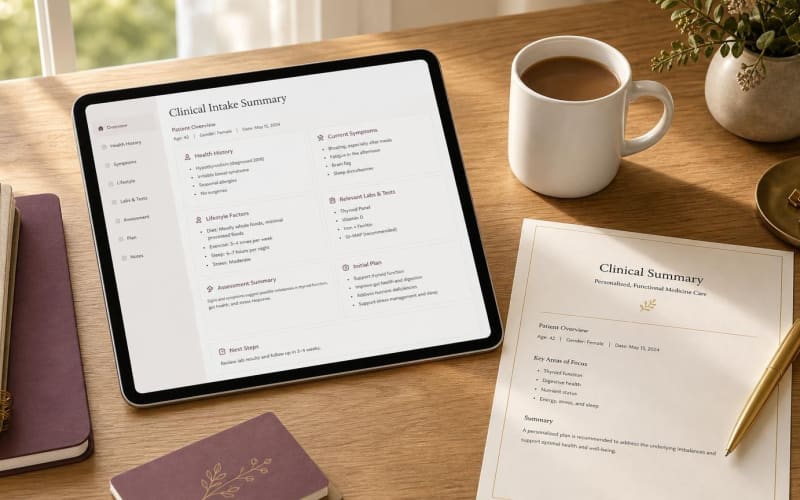
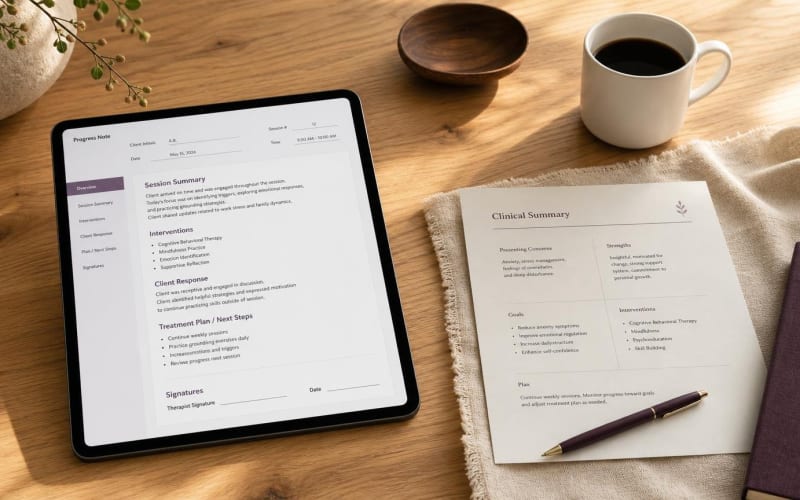
Treatment plan progress links each session to the client's individualized goals in Credible. The draft names the goal addressed, the intervention delivered (relapse prevention, CBT skills, motivational interviewing), the client's response, and whether progress is advancing, stable, or regressing. The CMS behavioral health documentation fact sheet states that records must fully disclose the extent of services furnished. Per-patient specificity is how group notes meet that standard.
Notes describe only what occurred. Merry AI excludes speculative level-of-care justification language. If a client said little during a session, the note records limited participation rather than inventing engagement. DSM-5-TR criteria appear only as clinical observations that support the treating clinician, never as autonomous diagnostic changes.
Group notes and same-day E/M notes stay separate to protect Modifier 25 claims
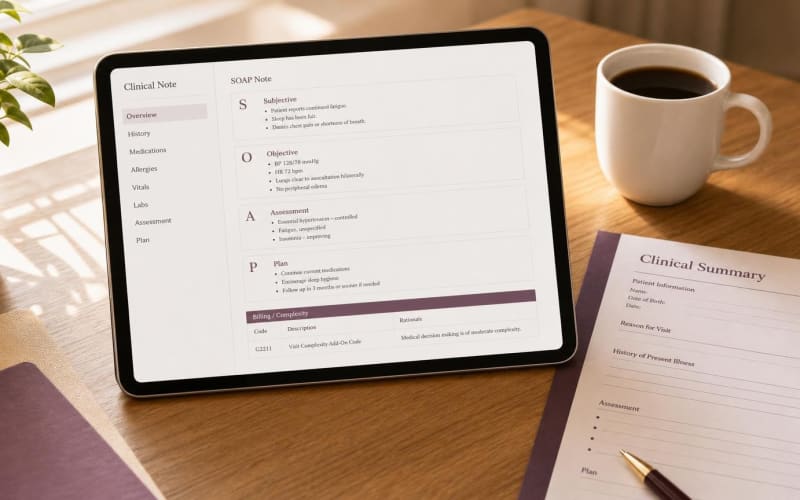
Many addiction medicine clients see a prescriber for medication management on the same day they attend IOP. Merry AI populates group service notes and E/M notes from separate templates and never copies group narrative into an E/M record. The E/M note focuses on medical decision making, such as a buprenorphine dose adjustment or toxicology review, which keeps that visit significant and separately identifiable for Modifier 25.
HCPCS G2211 applies only to office/outpatient or home E/M visits, as stated in the CMS G2211 FAQ. It does not attach to group psychotherapy. Merry AI supports G2211 indirectly: consistent ASAM documentation across group notes shows the ongoing, complex care relationship that the prescriber's E/M note references.
Browser-native DOM mapping removes the API marketplace dependency for Credible agencies
| Criterion | Traditional API Marketplace Integration | Manual Copy-Paste | Merry AI Chrome DOM Injection |
|---|---|---|---|
| Setup time | Weeks to months of vendor scoping | None | One mapping session per program |
| IT involvement | Interface engineering and security review | None | Chrome site permission only |
| Recurring fees | Marketplace or interface fees | None | No API or interface fees |
| Field-level accuracy | High, limited to exposed endpoints | Low, depends on clinician attention | High, mapped to visible Credible fields |
| Group session splitting | Rarely supported | Manual rewrite per client | Per-patient drafts from one session |
| Attendance minutes | Separate workflow | Typed by hand | Clinician-confirmed and injected |
| ASAM structure | Depends on vendor template | Inconsistent | Built into every draft |
| Failure mode | Interface outage blocks notes | Paste errors and cloned text | Fails closed and flags unmatched fields |
The comparison shows a practical tradeoff. API integrations offer stable endpoints but rarely expose the PHP and IOP service note fields addiction programs depend on. Manual copy-paste costs nothing up front but consumes clinician time and produces cloned group notes. DOM injection works on the fields clinicians already use.
42 CFR Part 2 records require governance beyond HIPAA
Substance use disorder records carry stricter confidentiality under 42 CFR Part 2. Merry AI operates under an executed BAA, does not retain session audio or transcripts after note generation, and never reuses one client's narrative in another client's chart. Agencies in states with AI disclosure or consent statutes should confirm their consent language with counsel before enabling recording.
Each draft includes a provenance line stating that the note was drafted with documentation assistance and reviewed by the signing clinician. This aligns with the authorship validation principles in the CMS EHR documentation integrity fact sheet.
Clinician attestation remains the final control. Merry AI drafts, maps, and inserts. The licensed clinician reviews, edits, and signs. Credible remains the legal record.