Practice Fusion SOAP fields accept Merry AI drafts directly from the browser
Clinical documentation inside Practice Fusion rarely fails because clinicians lack dedication. It fails because a family physician closing a visit with a patient carrying diabetes, hypertension, and depression must rebuild the longitudinal story from memory, then type it into four separate SOAP text areas before the next room turns over. The AMA has reported that physicians spend roughly a third of their time in the EHR documenting patient interactions.
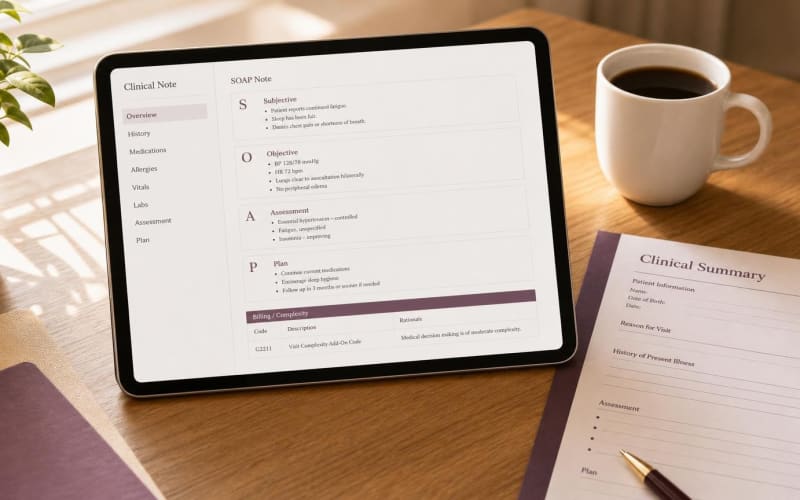
Merry AI closes that gap with a Chrome Extension that reads the Practice Fusion chart note page as the clinician sees it, locates the Subjective, Objective, Assessment, and Plan textareas, and writes the reviewed draft into each one through standard browser input events. No server API, marketplace listing, or vendor-side interface is involved. Practice Fusion saves the content exactly as it would save typed text, and nothing becomes part of the legal record until the clinician signs.
Browser-native DOM mapping bypasses EHR marketplace paywalls entirely
The extension follows four steps on every encounter:
- Detect the chart note: The content script confirms it is on a Practice Fusion charting page and waits until the SOAP note has fully rendered.
- Map each SOAP textarea: Fields are matched by their visible section labels and position, not by fragile class names that change with interface updates.
- Write through input events: Text is inserted the way keyboard entry would arrive, so Practice Fusion's own autosave and template logic behave normally.
- Leave the save to Practice Fusion: No backend call is made. Persistence happens only through the clinician's existing session.
Practice Fusion does not publish its DOM selectors or frame structure, so Merry re-validates the field map on each page load. If a target field cannot be matched with confidence, the extension stops and displays the draft for manual placement rather than guessing. A misplaced Plan in the Objective field is a documentation error, and the system is built to refuse that outcome.
Audio lives only in volatile memory. Microphone input is captured in the browser, transcribed under an executed BAA, and shredded from RAM once text is produced. No audio is written to disk or browser storage, and no transcript is retained. Only the derived draft reaches the Practice Fusion DOM.
Merry AI documents chronic duration, outside records, and coordination before it suggests G2211
CMS defines HCPCS add-on G2211 as visit complexity inherent to E/M services that serve as the continuing focal point for all needed health care services, or that are part of ongoing care for a single, serious or complex condition. Per the CMS G2211 FAQ, it may be reported with office/outpatient E/M codes 99202-99205 and 99211-99215, and with home or residence E/M codes 99341, 99342, 99344, 99345, and 99347-99350. National payment is roughly $16 to $17 per qualifying Medicare visit.
Auditors do not look for a dedicated G2211 field. They read the base E/M note and ask whether a longitudinal, focal point relationship is evident. Generic boilerplate pasted into every visit fails that test, and it creates exposure rather than revenue.
Merry's suggestion logic is gated behind three elements that must appear in the encounter conversation or the clinician's edits:
- Chronic condition duration stated: For example, 'Type 2 diabetes diagnosed 2019, managed in this practice since 2021.'
- Outside record review documented: Specialist letters, hospital discharge summaries, or outside labs, each named with source and date.
- Care coordination actions named: Referrals placed, communication with cardiology or behavioral health, care manager outreach, or medication reconciliation across prescribers.
If any element is missing, Merry does not suggest G2211. The review panel flags the gap so the clinician can document what actually occurred or decline the code. Text is never fabricated to satisfy a billing rule.
The $15,600 figure is illustrative. It reflects a panel with roughly 950 qualifying Medicare visits per year at about $16.50 each. Actual capture depends on payer mix, and some commercial payers have announced policies ending separate G2211 reimbursement, so practices should verify each contract before projecting revenue.
Family Medicine notes need specialty-grade criteria, not chronic-care boilerplate
A family physician works across behavioral health, cardiology, musculoskeletal care, and pediatrics in a single afternoon. Merry's Family Medicine templates anchor each SOAP section to recognized frameworks:
- Subjective captures DSM-5-TR elements: Symptom duration and functional impairment for depression, anxiety, and ADHD, rather than 'depression, chronic.'
- Objective records measurable findings: NYHA class and most recent LVEF for heart failure, ROM in degrees for joint exams, and growth parameters for children.
- Assessment cites explicit criteria: For example, 'HFrEF, NYHA II, LVEF 30% on most recent echo; MDD, recurrent, meets DSM-5-TR criteria.'
- Plan links visits over time: Medication titration against prior values, Bright Futures anticipatory guidance and screening status, and dated follow-up intervals.
This structure supports medical necessity for the E/M level itself and makes the longitudinal relationship visible without relying on stock phrases.
Modifier 25 and 59 language is inserted only when distinct work is documented
CMS allows G2211 with modifier 25 when the E/M is billed on the same day as an annual wellness visit, vaccine administration, or a Medicare Part B preventive service. For other same-day procedures, modifier 25 requires a significant, separately identifiable E/M service, and Merry inserts that language only when the note contains distinct problems and decision making apart from the procedure.
Modifier 59 requires concrete differentiation: a different session, site, organ system, or separate injury. Merry never auto-inserts generic distinct service statements. When the documentation does not support the modifier, the review panel says so.
Direct DOM injection removes the copy-paste step without adding IT burden
| Criterion | Traditional API Marketplace Integration | Manual Copy-Paste | Merry AI Chrome DOM Injection |
|---|---|---|---|
| Setup time | Weeks to months of vendor onboarding | None | Minutes, user-level install |
| IT or vendor approval | Partner agreement and security review | None | None for standard Chrome profiles |
| Recurring integration fees | Often per-practice or per-transaction | None | None |
| SOAP field placement | Depends on exposed endpoints | Clinician pastes each section by hand | Label-mapped write into each textarea |
| G2211 evidence gating | Rarely built in | Clinician memory only | Duration, outside records, and coordination required |
| Audio retention | Varies by vendor | Varies by scribe tool | Shredded from RAM, none stored |
| Final record control | Varies by workflow | Clinician | Clinician attestation required |
The comparison shows where time and risk actually accumulate. Marketplace integrations add contracts and delays. Manual copy-paste adds four context switches per note and invites misplaced sections. Direct DOM injection keeps the clinician inside Practice Fusion and keeps the signature where it belongs.
Clinician attestation remains the only path to a signed Practice Fusion note
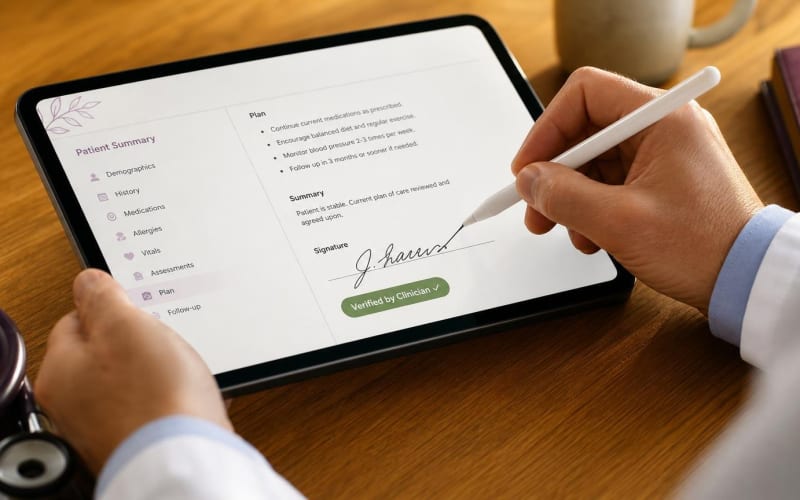
Every injected draft remains editable and unsigned. The clinician reads, corrects, and attests. Merry does not sign, submit claims, or alter a note after signature.
The 2020 Practice Fusion settlement, analyzed by Prictor in a 2022 PMC article, involved kickbacks from a pharmaceutical company tied to clinical decision support alerts intended to increase opioid prescribing. Merry accepts no sponsored content, and every suggestion it makes is traceable to the encounter or the clinician's own edits.
State AI disclosure rules vary. California AB 3030, for example, requires disclosure when generative AI produces patient clinical communications, with an exemption when a licensed provider reviews the content. Texas and other states have advanced AI in health care measures, so practices should confirm enacted requirements with counsel.
A 15-minute workflow audit shows whether your panel supports G2211
Bring one representative clinic day and we will map your Practice Fusion SOAP workflow, identify where chronic duration, outside record review, and coordination go undocumented, and estimate defensible G2211 capture for your payer mix. Schedule a 15-Minute Workflow Audit.