Browser-native DOM mapping writes Internal Medicine notes directly into NextGen Enterprise fields
Clinical documentation inside NextGen Enterprise rarely fails because internists lack dedication. It fails because a single established patient visit can carry heart failure, type 2 diabetes, stage 3b chronic kidney disease, and COPD, and each problem needs its own severity marker, medication decision, and follow-up interval. Typing that structure into separate HPI, Assessment, and Plan fields after clinic hours is where the evening charting backlog begins.
Merry AI's Chrome Extension operates as a DOM overlay inside the clinician's authenticated NextGen Enterprise browser session. It reads no chart data through a vendor API, opens no inbound firewall port, and does not require an interface engine. Instead, it locates the native note fields that NextGen renders in the browser and writes clinician-reviewable draft text into them, so the record is saved through NextGen's own Save and Sign workflow.
NextGen note fields are addressable text containers, which makes field-level injection reliable
NextGen Enterprise templates are built in the Template Editor using discrete field types such as text, numeric, date, and note fields. Note fields accept free text, and NextGen's own pipeline can import transcribed content into an RTF document that the Note File Monitor utility returns to the template. Because only string-style functions operate on note fields, they behave as text containers in the browser, typically rendered as textareas or contenteditable regions.
Merry AI maintains a selector map for each practice build, targeting the HPI, Assessment, and Plan note fields by stable IDs, classes, or data attributes. Many NextGen layouts render chart sections inside panes or iframes, so the extension enumerates frames, scopes its query to the correct iframe's contentDocument, and confirms the patient name and encounter date in the visible chart header before any write. If the context check fails, nothing is injected.
Injection appends or replaces text only within the targeted field and dispatches the native input and change events NextGen expects, which preserves edits the clinician has already made. Field write-back completes in under 500 milliseconds on a standard clinical workstation.
Encounter audio stays in volatile memory and is discarded once the draft is written
Audio capture is held in in-memory buffers only. No audio file is written to disk, browser storage, or any Merry AI server, and buffers are zeroized after the text draft is produced. Under an executed Business Associate Agreement, Merry AI stores zero audio and zero transcript. The only durable copy of the clinical narrative is the one the clinician signs inside NextGen Enterprise, which is already governed by HIPAA and state medical record law.
This posture carries less retention risk than workflows that embed audio files in the chart for later transcription, and less than ambient scribes that keep recordings or transcripts on their own cloud infrastructure. California and Texas continue to legislate on AI disclosure and health data retention, so practices should still disclose AI-assisted documentation to patients and review each statute's final text with counsel.
Three integration paths produce very different cost, risk, and field control for NextGen practices
| Criterion | Traditional API Marketplace Integration | Manual Copy-Paste | Merry AI Chrome DOM Injection |
|---|---|---|---|
| IT setup | Vendor agreement and interface build, often weeks to months | None | Chrome Extension install, optional policy allowlisting |
| Recurring fees | Marketplace or per-transaction fees | None | Zero API fees |
| Field mapping | Often a single whole-note block | Clinician pastes each section by hand | HPI, Assessment, and Plan mapped individually |
| Wrong-chart risk | Low, server-matched | High, clipboard driven | Low, chart header verified before every write |
| Audio retention | Frequently stored in vendor cloud | Depends on source tool | Volatile RAM only, zero stored |
| Write speed | Batch sync delay | Minutes per note | Under 500ms per field |
| Clinician attestation | Required | Required | Required, native NextGen signature |
Marketplace and HL7 integrations can offer bidirectional chart reads, but they require vendor agreements, configuration cycles, and recurring fees, and they frequently push a whole-note block that does not map cleanly to an Internal Medicine template. Manual copy-paste avoids fees but invites wrong-chart errors and strips field structure from the note.
Problem-oriented Internal Medicine notes give each chronic condition its own severity anchor and longitudinal plan
HPI captures chronology and modifiers for every active chronic problem
The HPI draft follows a problem-by-problem chronology. Heart failure entries carry NYHA class, most recent LVEF range, the current guideline-directed regimen including ARNI, beta blocker, MRA, and SGLT2 inhibitor, and any exacerbations since the last visit. Diabetes entries carry the A1c trend, hypoglycemia episodes, and microvascular or macrovascular complications. COPD entries carry GOLD group, mMRC or CAT symptom descriptors, exacerbation count, and oxygen use. CKD entries carry KDIGO G and A stage with eGFR trajectory and albuminuria.
Social determinants and complexity drivers such as polypharmacy, frailty, housing instability, and limited health literacy are captured when discussed during the encounter, since they shape medical decision-making and risk.
Assessment and Plan document the longitudinal relationship that G2211 requires
Every chronic problem receives a guideline-based severity statement, an explicit status such as stable, improving, worsening, or not at goal, relevant comorbidity interactions such as SGLT2 inhibitor dosing against eGFR, and a dedicated plan. The plan names medication changes, diagnostic intervals such as repeat echocardiogram or urine albumin-to-creatinine ratio, coordination with cardiology, nephrology, or endocrinology, and the next follow-up date.
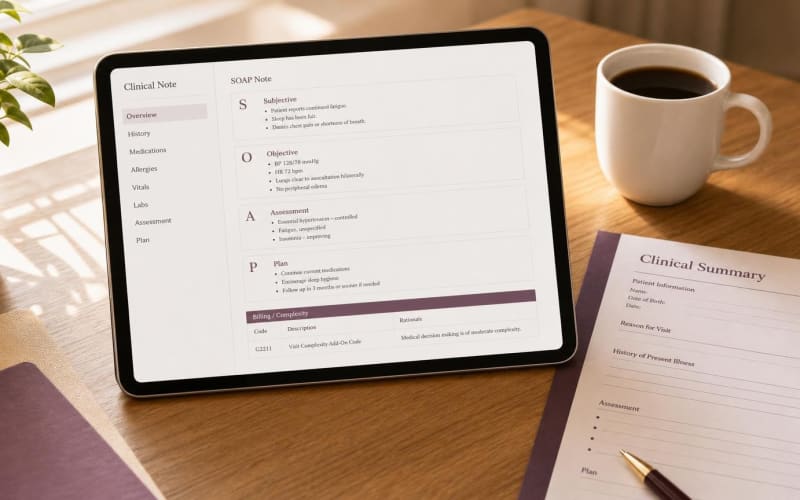
This structure directly supports HCPCS add-on G2211. Per the CMS G2211 FAQ, the add-on may be reported with office/outpatient E/M codes 99202-99205 and 99211-99215 and with home or residence codes 99341, 99342, 99344, 99345, and 99347-99350 when the practitioner serves as the continuing focal point for all needed services or provides ongoing care for a single serious or complex condition. Merry AI drafts an explicit longitudinal relationship statement in the Assessment so the rationale is visible to auditors.
At an approximate national rate near $16 per qualifying visit, consistent G2211 documentation across roughly 1,000 established Medicare visits per year can recover $15,600 or more per clinician. Actual figures vary by locality, payer mix, and coinsurance, and standard Part B deductible and coinsurance apply.
Modifier 25 and 59 segmentation keeps same-day services defensible on audit
G2211 is generally not payable when the base E/M carries modifier 25. Since January 1, 2025, CMS allows payment when the separately reported service is an Annual Wellness Visit, vaccine administration, or another listed Medicare Part B preventive service. Merry AI labels the E/M portion and the preventive or procedural portion as separate subsections, so the longitudinal complexity rationale appears only within the E/M narrative.
When modifier 59 applies, such as two distinct procedures at different anatomic sites, the Plan states each procedure with its own indication and site. Code selection remains the decision of the clinician and coder. Merry AI organizes the supporting evidence.
Every injected note stays a draft until the clinician reviews and attests
No text reaches the signed record without clinician review. Merry AI does not click Sign, does not finalize encounters, and does not alter previously signed notes. The clinician edits the draft, verifies severity data against labs and imaging in the chart, and attests through NextGen's native signature workflow.
Practices can start with Internal Medicine problem-oriented formats at Access 1,000+ EHR Clinical Templates, then Schedule a 15-Minute Workflow Audit to map their NextGen build's HPI and Assessment selectors.