Orthopedic injection notes fail on missing numbers, not missing effort
Clinical documentation inside ModMed EMA rarely fails because orthopedic clinicians lack dedication. It fails because the numbers that justify a procedure live in the conversation and never reach a discrete field. A surgeon hears that the patient took naproxen for eight weeks and finished six weeks of supervised physical therapy, then performs a knee injection, and the chart says 'failed conservative care.' That phrase rarely survives a payer review.
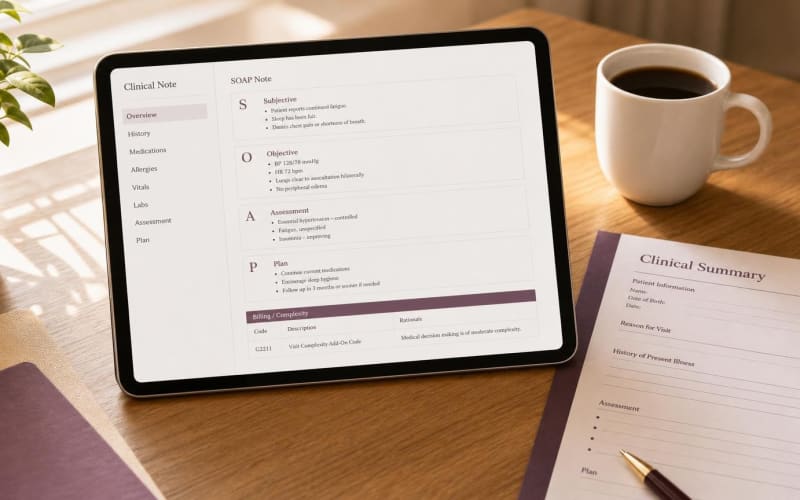
Merry AI closes this gap by capturing the encounter, drafting a structured orthopedic note, and writing each value into the ModMed EMA exam and plan fields the clinician already uses. The clinician reviews every value before it becomes part of the record.
CPT 20610 documentation must show ROM degrees, pain score, and dated conservative therapy failures
CPT 20610 describes arthrocentesis, aspiration, or injection of a major joint or bursa, such as the knee, shoulder, or subacromial bursa, without ultrasound guidance. CPT 20611 describes the same service with ultrasound guidance, including permanent recording and reporting. The code itself is simple. The medical necessity behind it is not.
Many commercial payers and Medicare contractor policies for services such as viscosupplementation expect objective evidence that conservative management was tried and failed. Auditors look for specific drugs, doses, dates, therapy duration, and measurable response, not summary language.
Merry AI enforces a pre-procedure capture rule. Before a 20610 draft is offered for injection, the orthopedic template requires four elements. First, joint, laterality, and ROM in degrees, for example: right knee flexion 0 to 105 degrees active, 0 to 110 degrees passive, extension lag 5 degrees. Second, a numeric pain score on a 0 to 10 scale with activity context. Third, the NSAID trial with drug, dose, start date, duration, and outcome. Fourth, the PT trial with start and end dates, visit count, and objective response. If any element is missing, the draft flags the gap for the clinician rather than filling it with templated language.
This rule also reduces cloning risk. Identical phrasing repeated across patients is a recognized marker of cloned documentation. Patient-specific degrees, scores, and dates differ by encounter, which is exactly what a reviewer expects to see.
Browser-native DOM mapping writes into EMA exam and plan nodes without a server API
The Merry AI Chrome Extension runs in the same browser tab where the clinician is already logged into ModMed EMA. There is no server-to-server connection, no FHIR write endpoint, and no marketplace subscription. The extension works with the encounter that is visibly open on screen.
Field mapping follows a fixed sequence. Step one confirms that the active patient and encounter in EMA match the Merry session. Step two locates the target section container, such as Exam or Plan, using visible labels and accessibility attributes, and operates inside the correct frame context. Step three locates the specific input control by name attribute, data attribute, ARIA label, or nearest label text. Step four writes the value and dispatches native input and change events, so EMA's own validation, autosave, and audit logging run as if the clinician had typed. Each step must pass before the next one starts.
Problem context is checked separately from page context. In a multi-problem visit covering bilateral knees and lumbar pain, each ROM value and pain score is tied to a joint and side. If the extension cannot confirm that a right knee value is landing in a right knee field, it halts and asks the clinician.
Write-back typically completes under 500 milliseconds per field set, because the work happens client-side in the open browser window rather than through a remote queue.
Because the extension writes through the clinician's own authenticated session, EMA's audit trail records the clinician as author. Merry also adds a short provenance line to the note stating that ambient documentation assistance was used and that the clinician reviewed and attested the content. This keeps vendor oversight transparent.
The extension never overrides EMA content. If a field already contains text, including content produced by EMA's native documentation tools, Merry prompts the clinician to append or skip. It never signs notes, never places orders, and never submits charges.
Direct DOM injection removes the retyping step that loses orthopedic detail
The table below compares three common ways orthopedic practices move documentation into ModMed EMA.
| Criterion | Traditional API Marketplace Integration | Manual Copy-Paste | Merry AI Chrome DOM Injection |
|---|---|---|---|
| Setup path | Vendor partnership, marketplace approval, IT project | None | Chrome Extension install, BAA, template mapping |
| Recurring cost | Marketplace and per-call API fees are common | Clinician and scribe time | No EHR API fees |
| Field targeting | Limited to endpoints the EHR vendor exposes | Usually one pasted text block | Discrete EMA exam and plan inputs located by label and attribute |
| ROM degrees and pain score | Often narrative only | Retyped by hand with transcription risk | Written as discrete values per joint and side |
| Dated NSAID and PT failures | Depends on endpoint support | Often summarized as failed conservative care | Drug, dose, dates, and PT visit count required before 20610 draft |
| Audit trail authorship | Integration account may appear as author | Clinician | Clinician session, plus provenance line in note |
| Audio retention | Varies by vendor, often cloud stored | None | RAM only, purged at session end |
| Time to go live | Weeks to months | Immediate | Typically one onboarding session |
Same-day E/M with 20610 requires modifier 25 evidence, and modifier 25 limits G2211
When an injection and E/M occur on the same date, the E/M line needs modifier 25 to show a significant, separately identifiable service. CPT 20610 carries a 0-day global period, and the decision to perform a minor procedure is included in the procedure itself. Separate work looks like reviewing the trajectory of failed NSAID and PT trials, discussing surgical referral or imaging, or managing a distinct second problem.
HCPCS G2211 adds payment for visit complexity in longitudinal care of a single serious condition or a complex condition. CMS does not pay G2211 when the office or outpatient base E/M carries modifier 25, except when modifier 25 is reported because the E/M occurred with an annual wellness visit, vaccine administration, or a Medicare Part B preventive service. Beginning January 1, 2026, that same exception extends to home or residence E/M base codes. For most orthopedic injection days, G2211 is therefore not payable.
Merry AI surfaces, never selects, billing codes. The draft highlights documentation that supports modifier 25 and flags when modifier 25 conflicts with a G2211 suggestion. On non-procedure follow-up visits for chronic osteoarthritis, the same longitudinal ROM and pain data support a G2211 review by the clinician or coder.
Modifier 59 and X modifiers apply only to distinct procedural services, never to E/M lines. Injections at separate anatomic sites, such as 20610 at the right knee and 20605 at the left wrist, require per-joint documentation to support XS. Bilateral major joint injections follow payer rules, such as modifier 50 for Medicare or RT and LT for other payers. Merry writes findings per joint so each modifier has evidence behind it.
Zero-day audio retention makes the signed note the only record
Merry AI holds session audio in volatile memory and purges it at session end under an executed BAA. No audio or transcript is stored. This removes a separate repository of PHI outside EMA.
It also raises the bar for the note itself. Without retained audio, the signed EMA note is the only evidence of what happened in the room. That is why the 20610 capture rule exists: complete, specific, dated values protect the clinician in an audit or dispute far better than a recording nobody reviews.
State record integrity rules generally require complete, accurate, and unaltered medical records, and several states are developing expectations for disclosure when automation contributes to documentation. Practices should classify the extension as internal infrastructure under their own compliance program and keep the provenance line enabled.
Clinician attestation remains the final control on every orthopedic note
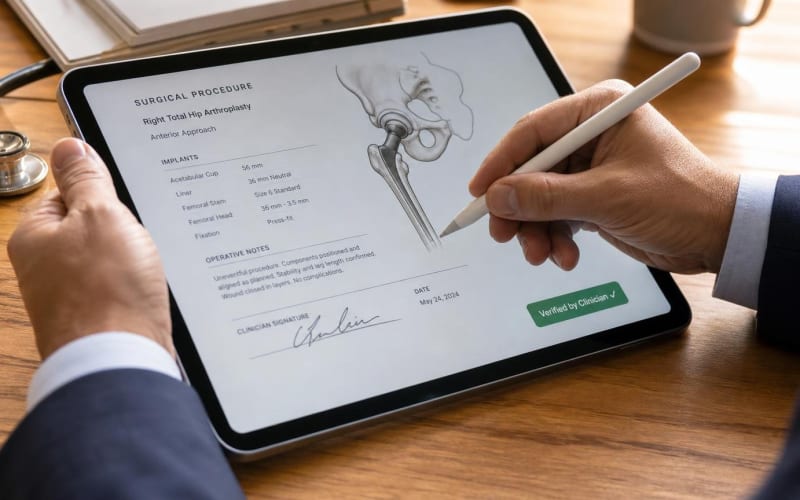
No draft reaches the chart until the clinician reviews each injected value and attests the note in EMA. Merry AI assists with structure and capture. Clinical judgment, coding decisions, and signature stay with the clinician.
Practices adopting Merry AI should document a written policy stating that ambient tools only assist, that clinicians review before signing, and that audio is not retained. Start with your current knee and shoulder templates at https://templates.scribing.io, then book a workflow audit at https://cal.com/merryai/demo.