A Documentation Workflow Built for Modernizing Medicine ModMed EMA
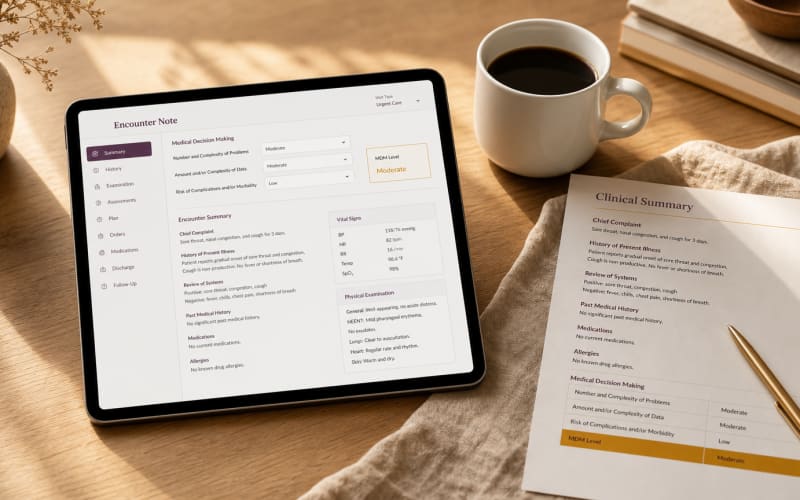
Clinical documentation inside Modernizing Medicine ModMed EMA rarely fails because clinicians lack dedication—it fails because the friction between speaking with a patient and encoding that encounter into structured fields is relentless. ModMed's EMA platform already delivers strong specialty-specific content for both Dermatology and Orthopedics: tap-and-go notes, prebuilt order sets, suggested coding, and downstream generation of prescriptions and referral letters after note approval. What EMA does not natively solve is the last mile between a natural, ambient conversation and the exact fields those workflows depend on.
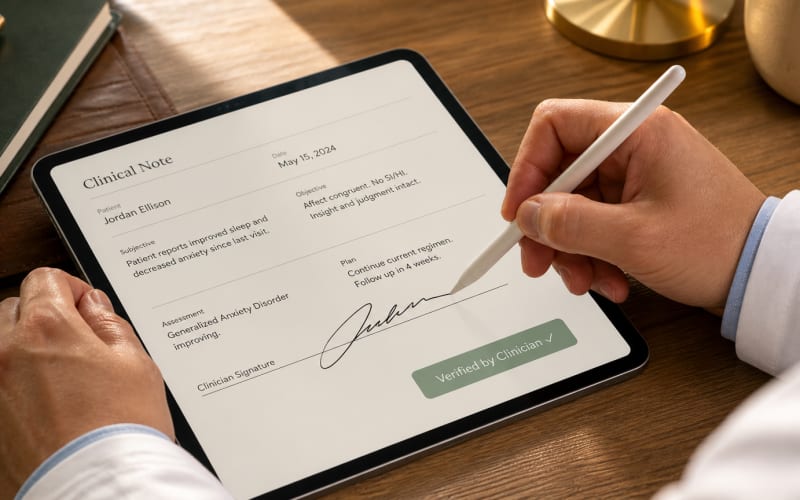
Merry AI closes that last mile without asking you to abandon anything ModMed already does well. Our Chrome Extension operates as a browser-native layer that listens during the encounter, structures the transcript into your chosen note format, and—only after your explicit review—writes the finished text directly into EMA's native input fields. There is no parallel system to reconcile, no export step, and no second login. The clinician remains inside the EMA browser tab from greeting to signature.
This architecture matters most in high-throughput specialties. A dermatologist documenting eight lesion checks and three excisions before lunch, or an orthopedist moving between fracture follow-ups and joint injections, cannot afford context switches. The value of Merry AI is not that it is smarter than the clinician; it is that it removes the mechanical tax of transcription and field navigation while keeping the physician firmly in control of the record.
Why Browser DOM Injection Beats API Marketplace Dependence
The honest engineering reality is that closed specialty EHRs like ModMed EMA do not expose open FHIR write endpoints for third-party ambient documentation tools in the way many vendors imply. EMA does publish a staged document-upload flow for attachments, but that is a narrow file-transport path, not a general mechanism for writing structured narrative directly into a live encounter's HPI, Assessment, or Plan fields. Any vendor promising native FHIR write access to those fields is either overstating their integration or forcing you through a costly, latency-prone marketplace pipeline.
Merry AI takes a different path. Because the clinician is already authenticated inside the EMA web interface, our extension writes into the DOM input selectors that EMA renders on screen. The text lands in the same fields you would type into manually, which means EMA's existing validation, coding suggestions, and downstream order automation all continue to function normally. Critically, the write happens under your active session, so EMA's own audit logging captures who created the content, when, and in which encounter—preserving the provenance expectations that HIPAA audit-log requirements demand.
There is a technical trade-off worth stating plainly: DOM-based injection depends on stable field selectors. When a vendor updates its web UI, selectors can shift. Our engineering team maintains a monitored selector map and versions our injection logic against EMA interface changes, so field mapping stays reliable across releases. This is the same discipline that keeps sub-second latency intact—we are not waiting on a remote API round trip, we are writing locally.
The Zero-IT Deployment Advantage
Traditional integration projects consume weeks of coordination between your practice, the EHR vendor, and an IT contractor. Merry AI's deployment model collapses that timeline to minutes. The extension installs from the Chrome Web Store, requests a scoped permission set limited to the ModMed EMA domain, and begins operating without firewall changes, VPN tunnels, or server provisioning. A solo dermatologist can be documenting live within a single visit; a twelve-provider orthopedic group can roll out without a single IT ticket.
Field Mapping for Dermatology and Orthopedics
Specialty structure drives everything in how we map fields. For dermatology, our templates encode lesion location, morphology narrative, procedure context for biopsies and excisions, and pathology follow-up language—populated into the corresponding EMA narrative fields. For orthopedics, the emphasis shifts to mechanism of injury, range-of-motion findings, imaging correlation, and protocolized treatment plans. In both cases the extension respects EMA's field boundaries so that suggested coding and order generation continue downstream. You can pull any of these structures from the Access 1,000+ EHR Clinical Templates library.
Integration Architecture Compared
The following comparison clarifies why the deployment model you choose determines your total cost and daily friction more than the AI quality itself.
| Architecture | Deployment Overhead | Latency | Annual Fee |
|---|---|---|---|
| Traditional API Marketplace | Weeks of IT + vendor coordination, marketplace approval | 2–6s round-trip per write | High marketplace + per-seat fees |
| Manual Copy-Paste | None, but constant human context switching | Human-bound, 30–90s per note | Vendor fee only, hidden labor cost |
| Merry AI DOM Injection | Minutes, clinician self-install | 0.4s streaming + local write | No marketplace fee, flat plan |
Manual copy-paste deserves scrutiny because it is the default many practices fall back on when marketplace integration proves too expensive. It appears free, but it silently reintroduces the exact transcription tax that ambient AI was meant to eliminate, and it invites copy errors that undermine the record. DOM injection preserves the speed of automation without the cost and lag of a marketplace API.
Coding Integrity and Compliance Provenance
Documentation quality directly determines coding accuracy, and coding accuracy determines revenue integrity. Merry AI is engineered to support—not replace—your coding judgment. For longitudinal outpatient care in dermatology and orthopedics, the extension surfaces documentation cues relevant to the office visit complexity add-on code G2211, which CMS permits alongside standard E/M codes when a clinician serves as the continuing focal point for a patient's care. Correct capture of that continuity narrative is a documentation problem before it is a billing problem, and structured notes make it defensible.
We treat compliance as a first-class engineering constraint rather than a marketing checkbox. Every draft is clearly an AI suggestion until the clinician reviews and signs it, at which point authorship of record is unambiguously yours. This distinction aligns with emerging ONC expectations around AI content provenance and with the audit-trail obligations under HIPAA. For clinicians validating their E/M and add-on code usage against current guidance, the authoritative reference remains the American Medical Association CPT resources, which we recommend consulting whenever documentation supports complex or continuing-care coding.
Data Retention and the Executed BAA
Our data posture is deliberately minimal. Audio and transcript content are processed in-memory during the streaming session and discarded once the note is committed—zero retention under an executed Business Associate Agreement. There is no long-term store of encounter audio to breach, no transcript warehouse to subpoena, and no dataset of your patients' PHI feeding external analytics. This is the quietest form of compliance: the safest data is the data that no longer exists.
Getting Started Without Disrupting Your Clinic
Adoption should feel invisible to your existing ModMed EMA rhythm, and that is precisely how we designed onboarding. You install the extension, select or generate your specialty template, and run a single live encounter to feel the flow. Because nothing about EMA's configuration changes, there is no rollback risk—if you close the extension, you simply return to standard EMA documentation. The lowest-risk way to evaluate whether DOM injection fits your practice is to watch it operate on one real workflow.
The most productive next step is a short, structured conversation about your specific field mapping and volume. Schedule a 15-Minute Workflow Audit and we will walk through your dermatology or orthopedic documentation pattern, confirm selector stability for your EMA version, and quantify the time you stand to recover per clinic day. When you are ready to standardize across providers, Explore Merry AI Practice Partner Plans to see how flat, marketplace-free pricing scales with your group rather than penalizing every added seat.