Merry AI writes SOAP notes into CharmHealth through the browser, not the server
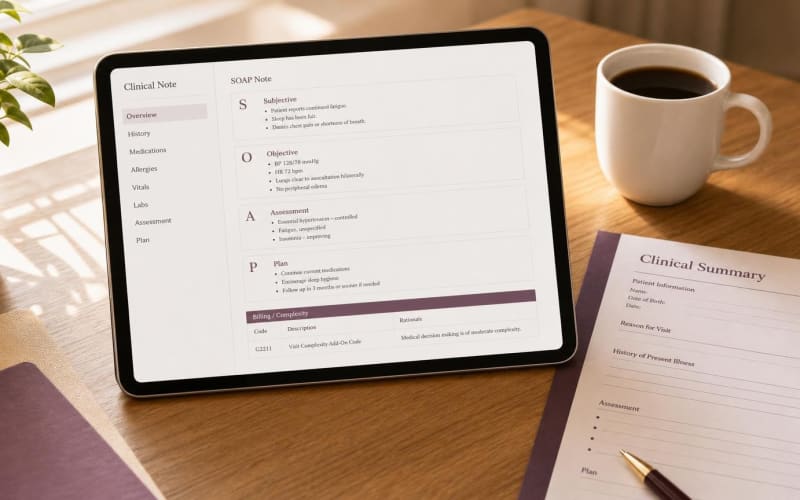
Family physicians working in CharmHealth document across Quick, Brief, Comprehensive, and SOAP chart types, often within a single clinic session. Merry AI operates where that documentation actually happens: the clinician's open Chrome tab. The extension attaches a DOM overlay to the CharmHealth encounter frame, drafts each SOAP section from the visit, and writes the approved text into the matching editor fields on the page.
No server API is involved. Merry does not request a CharmHealth API key, a marketplace listing, or an interface engine. The extension reads and writes only the fields the signed-in clinician can already see and edit, so CharmHealth role-based access controls stay fully in force. If a user cannot edit the Plan field, Merry cannot edit it either.
Browser-native DOM mapping bypasses EHR marketplace paywalls entirely
Traditional integrations route through vendor APIs, partner programs, and recurring interface fees. For an independent family practice, that path can mean months of contracting before a single note is written. Manual copy-paste avoids the contract but moves the burden back onto the clinician, who must paste each section into the correct box and hope nothing lands in the wrong patient's chart.
The comparison below shows why client-side DOM injection fits small and mid-sized family medicine practices.
| Dimension | Traditional API Marketplace Integration | Manual Copy-Paste | Merry AI Chrome DOM Injection |
|---|---|---|---|
| Setup time | Weeks to months of vendor approval | None | Minutes: install extension, grant microphone access |
| IT involvement | Interface engineering and credential management | None | None for most practices |
| Recurring integration fees | Common marketplace and interface charges | None | Zero API fees |
| Field placement accuracy | Depends on mapped data elements | Clinician-dependent, error-prone | Maps Subjective, Objective, Assessment, Plan editors by on-page labels |
| Respects CharmHealth permissions | Uses service-level credentials | Yes | Yes, inherits the signed-in user's role |
| G2211 and modifier 25 awareness | Rarely evaluated at point of documentation | None | Reads the E/M line and gates the G2211 suggestion |
| Audit trail of AI content | Varies by vendor | None | Logged acceptance, edits, and attestation |
Three steps connect Merry to a live CharmHealth encounter
Step 1: Enable microphone permission. The clinician grants Chrome microphone access to the Merry extension once. Merry captures the visit conversation only while the clinician has activated it for the current encounter.
Step 2: Attach the overlay. When the clinician opens a scheduled visit from Chart Notes or starts a walk-in encounter from the patient dashboard, Merry attaches its overlay to the CharmHealth encounter frame and confirms the patient context shown on screen before drafting begins.
Step 3: Inject the SOAP sections. After the visit, Merry presents the draft Subjective, Objective, Assessment, and Plan in the overlay. The clinician edits and approves, and Merry writes each section into its matching CharmHealth editor field. Nothing is saved to the chart until the clinician saves it.
G2211 is suggested only when the clinician is the continuing focal point
CMS defines HCPCS add-on G2211 as visit complexity inherent to E/M care that serves as the continuing focal point for all needed health care services, or ongoing care for a single, serious or complex condition, as described in the CMS G2211 FAQ. It is reportable only alongside office or outpatient E/M codes 99202-99205 and 99211-99215, and since January 1, 2026, alongside home or residence E/M codes 99341, 99342, 99344, 99345, and 99347-99350.
Merry treats the focal-point relationship as the trigger, not the mere presence of an E/M code. The extension proposes a G2211 attestation only when the note documents an ongoing longitudinal relationship: established patient status, active chronic problems under this clinician's management, and a plan that carries care forward. Episodic visits, such as a one-time urgent visit with no continuing relationship, receive no G2211 suggestion.
Modifier 25 on the E/M line suppresses the G2211 suggestion every time
CMS Transmittal 12461 states plainly that G2211 applies to O/O E/M visits other than those reported with modifier 25 (CMS Change Request 13473). Merry reads the E/M charge line in the CharmHealth encounter. When modifier 25 is present, Merry does not insert a G2211 attestation and does not prompt the clinician to add the code.
CMS added preventive-service exceptions beginning January 1, 2025, for same-day services such as the annual wellness visit, vaccine administration, and other Medicare Part B preventive services. Merry still never auto-appends G2211 in these cases. Instead, it flags the encounter for clinician or coder review, so any exception is applied by a person who has read the full note and confirmed the documentation supports it.
Specialty criteria, not boilerplate, make a G2211 attestation defensible
Repeated identical attestation sentences invite audit scrutiny. Merry builds each attestation from the clinical content already in the note, so the Assessment reflects the actual longitudinal work performed for that patient.
Behavioral health in primary care draws on DSM-5-TR criteria: diagnosis, symptom duration, functional impairment, PHQ-9 or GAD-7 trends, and suicide risk monitoring alongside psychotropic management.
Cardiometabolic care references NYHA class, recent LVEF, ASCVD risk scores, serial blood pressure and lipid values, and medication titration across ACE inhibitor, ARB, ARNI, beta blocker, MRA, and SGLT2 therapy.
Musculoskeletal and chronic pain visits capture range of motion in degrees, strength testing, gait, fall risk, and functional scales such as the Oswestry Disability Index across months of multimodal management.
Pediatric continuity care follows Bright Futures periodicity, ASQ or M-CHAT developmental screening, immunization status, and subspecialist coordination for conditions such as ADHD or asthma.
A resulting attestation might read: Ongoing management of NYHA class II heart failure and stage 3 CKD as this patient's continuing focal point of care, with serial LVEF review, diuretic adjustment, and nephrology coordination. The clinician edits or rejects this text before it is saved.
The narrative attestation and the superbill charge are confirmed together
CharmHealth separates the chart note from the billing selections, even though both live within the encounter view. An attestation sentence in the Assessment does not by itself place G2211 on a claim. Merry surfaces both items in one review step: the proposed Assessment language and a reminder that the G2211 charge line must be added by the clinician in the billing section. This prevents notes that claim complexity without a matching charge, and charges that lack supporting documentation.
The clinician signs the record, and Merry logs every action
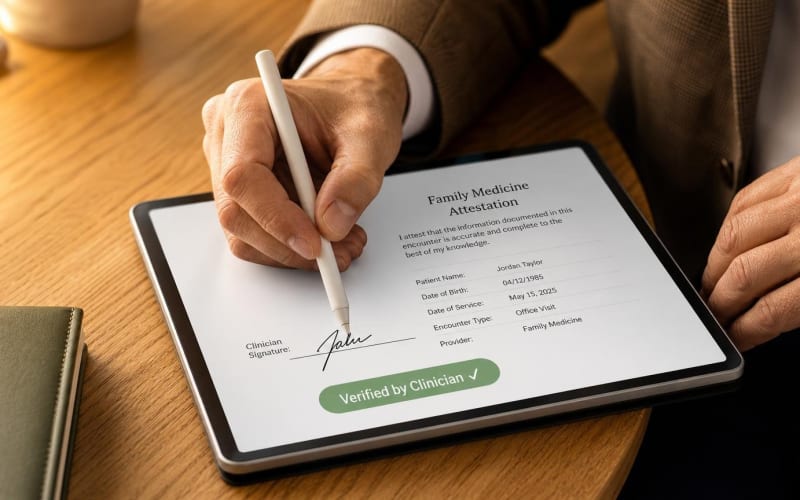
Every injected section is labeled as a Merry draft inside the overlay until the clinician accepts it. Merry records who accepted, edited, or rejected each section and each billing suggestion, and when. This supports state medical board expectations that the physician personally owns the content of the note and the final coding decision.
Privacy controls remain strict by design. Merry operates under an executed Business Associate Agreement, and no audio or transcript is stored after the note is finalized. Practices in states with emerging AI disclosure rules should review their patient notice language with counsel; Merry's labeling and audit log give that review a concrete record to work from.
Modest G2211 rates add up across a family medicine panel
G2211 pays roughly $16 per qualifying Medicare visit at national rates. Across about 1,000 eligible longitudinal visits a year, a single family physician captures more than $15,600 that is often left unbilled when attestations are skipped or written inconsistently. Merry's role is to make the qualifying visits visible and the documentation specific, while the clinician makes every coding decision.