A Documentation Workflow Built for Athenahealth (athenaOne)
Clinical documentation inside Athenahealth (athenaOne) rarely fails because clinicians lack diligence. It fails because the encounter workflow is unforgiving of timing and context. athenaOne frames the outpatient visit as a five-stage sequence: Check-in, Intake, Exam, Sign-off, and Checkout. Encounters are created at check-in, not at scheduling time, which means any documentation written against an appointment that has no live encounter is treated as a data-integrity violation. Merry AI is engineered around that reality rather than against it.
Most integration vendors approach this problem by building a server-to-server connector through the athenahealth Marketplace. That path carries onboarding fees, per-call metering, and the ever-present risk of rate-limit backoff when a busy group practice generates dozens of concurrent write-backs. Merry AI takes a fundamentally different route: a browser-native Chrome Extension that operates inside the clinician's already-authenticated athenaOne session, writing reviewed notes directly into the DOM input selectors of the encounter you are actively documenting.
The distinction matters enormously for outpatient group practices where multiple providers document across Family Medicine, Behavioral Health, and specialty departments simultaneously. Because the extension reads live UI state instead of hammering catalog endpoints, it never triggers the per-practice API throttling that degrades marketplace connectors during peak clinic hours.
Why DOM Injection Beats API Marketplace Connectors
The core architectural claim is simple and important to state precisely: Merry AI does not hold native FHIR write access into athenaOne, and it does not need it. A DOM-native extension inherits the exact permissions of the logged-in clinician. When you generate a draft, the extension locates the encounter documentation field or the Clinical Inbox document view and populates it as though you had typed the text yourself. There is no separate service account, no OAuth token stored in a backend, and no inbound connection into your athenahealth tenant.
This design collapses the deployment timeline from weeks to minutes. A traditional API integration requires marketplace registration, tenant-level provisioning, compliance review, and firewall coordination. Manual copy-paste, the fallback most clinicians actually use, requires no setup but reintroduces transcription error and doubles documentation time. DOM injection captures the best of both: zero backend provisioning with direct, structured field population.
| Architecture | Deployment Overhead | Latency | Rate-Limit Risk | Annual Fee |
|---|---|---|---|---|
| Traditional API Marketplace Integration | Weeks of IT, compliance, and tenant provisioning | API queue lag plus backoff retries | High during peak clinic hours | Setup fee plus per-call metering |
| Manual Copy-Paste | None | Human transcription speed | None | None, but high labor cost |
| Merry AI DOM Injection | Minutes, workstation-level install | 0.4s field mapping | None; reads UI state, no catalog calls | Flat Practice Partner plan |
Notice the middle column carefully. Because the extension resolves the active encounter from context the clinician can already see, it performs read-light, write-focused work. It does not repeatedly query appointment, encounter, and encounter-type catalogs for every visit. That single design choice is what keeps a twelve-provider group practice from ever seeing an HTTP 429 backoff error.
Respecting the Five-Stage Encounter Workflow
Merry AI enforces a strict precondition before any note is written: the patient must be checked in, and a live encounter object must exist in a state appropriate for documentation. The extension confirms the encounter is resolvable from the appointment context before it populates a single field. If sign-off has already locked the encounter, injection is blocked, preserving the integrity of the billing record.
Per-Department EncounterType Mapping
Encounter types in athenaOne are configured per department, not globally. A Telehealth Follow-Up in Behavioral Health may map to an entirely different EncounterType identifier than the same appointment label in Family Medicine, often because of distinct billing modifiers and documentation standards. Merry AI maintains a cached, per-department mapping keyed to practice, department, and appointmenttypeid, so the correct EncounterType is resolved in real time without a live catalog lookup on every encounter.
Clinical Inbox Routing and Documentation Integrity
The Clinical Inbox is the central hub of the athenaOne clinician home page, surfacing Encounters, Clinical Documents, and unsigned worklists. Merry AI routes every draft as a signature-required clinical note so it appears exactly where clinicians expect to find pending work. The extension implements a post-and-confirm loop: it populates the note, then verifies the document surfaces in the provider's Unsigned Documents queue before marking the draft as delivered inside the Merry AI interface.
This confirmation step prevents orphan notes, the silent failure mode where documentation is written but never routed to a reviewable queue. In a group practice, orphaned notes are especially dangerous because a colleague covering a shared panel may never see that documentation exists. By anchoring routing to the Clinical Inbox worklist, Merry AI keeps every provider's queue an accurate reflection of outstanding work.
Preserving the Clinician as Author of Record
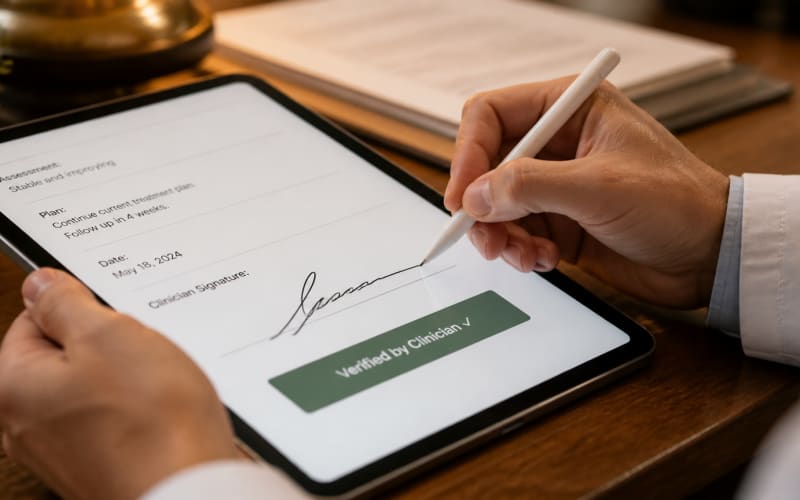
Every draft Merry AI produces is exactly that: a draft. Nothing commits to the chart without the clinician's explicit review and signature. athenaOne's audit log correctly attributes the note to the signing provider with accurate timestamps, and Merry AI adds an internal provenance marker indicating the draft was AI-generated and clinician-reviewed. This preserves defensible authorship and satisfies the accountability expectations that both payers and compliance officers scrutinize.
Coding Integrity and CPT G2211 Capture
Outpatient group practices increasingly depend on accurate capture of visit-complexity add-on codes. HCPCS add-on code G2211, effective January 1, 2024, is reportable with office and outpatient E/M visits (CPT 99202-99205 and 99211-99215) when the visit serves as the continuing focal point for a patient's care or represents ongoing management of a single serious or complex condition. Merry AI's structured templates surface the documentation language that substantiates G2211, helping clinicians capture legitimate longitudinal-care complexity that would otherwise go unbilled.
Because the add-on code is not restricted by specialty, the opportunity spans a group practice's entire provider roster. Accurate documentation is the linchpin, and clinicians should anchor their billing decisions in the current CMS guidance and the broader clinical evidence base available through repositories such as https://www.ncbi.nlm.nih.gov/pmc/. Merry AI's role is to make the supporting narrative accurate and complete, never to auto-assign a code without clinician judgment.
When documentation, EncounterType mapping, and coding language are aligned inside a single injected draft, the downstream billing workflow inherits clean, defensible input. That alignment is where a well-architected documentation layer quietly earns its keep.
Security, Compliance, and Getting Started
Merry AI operates under an executed Business Associate Agreement with zero audio or transcript retention after draft generation. All transit is TLS-encrypted, host permissions are scoped strictly to the athenaOne domain, and no PHI is written to unencrypted browser storage. Because the extension inherits the clinician's authenticated session, access is inherently tied to provider identity and role, eliminating the shared-service-account exposure common to backend integrations.
For group practices ready to evaluate the fit, the path forward is deliberately low-friction. Start by browsing the template library, then book a mapping review tailored to your department's appointment-type catalog. You can Access 1,000+ EHR Clinical Templates, Schedule a 15-Minute Workflow Audit, or Explore Merry AI Practice Partner Plans to see how a DOM-native layer fits your existing athenaOne workflow without a single API contract.