Merry AI binds AdvancedMD progress note fields through Chrome DOM selectors, not server APIs
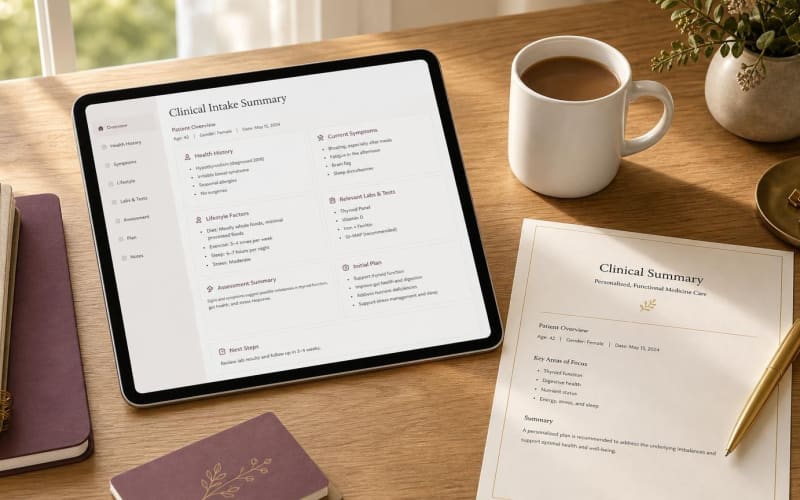
Clinical documentation inside AdvancedMD rarely fails because podiatrists lack dedication. It fails because a diabetic foot ulcer visit produces two different kinds of clinical work, the cognitive evaluation and the hands-on debridement, and both are typed into one narrative under time pressure. Merry AI addresses that problem at the browser layer.
AdvancedMD renders its charting surface as a cloud-based web application with an HTML rich text editor, configurable templates, and sub-notes within a single encounter. Because every narrative field exists as an element in the browser DOM, the Merry AI Chrome Extension can locate those fields through a content script without touching AdvancedMD servers, databases, or a marketplace API.
The extension follows four steps. It detects that the encounter note editor has fully rendered. It matches labeled containers, such as assessment and plan or procedure sub-notes, against a versioned selector map configured for your practice templates. It writes the reviewed draft into each mapped field as client-side input. It then stops, leaving the clinician to edit, sign, and commit.
AdvancedMD also offers native AI scribing that operates inside its own platform. Merry AI is a third-party tool, and it is not built, endorsed, or supported by AdvancedMD. The distinction matters for vendor risk review, and practices should evaluate both options against their specialty needs.
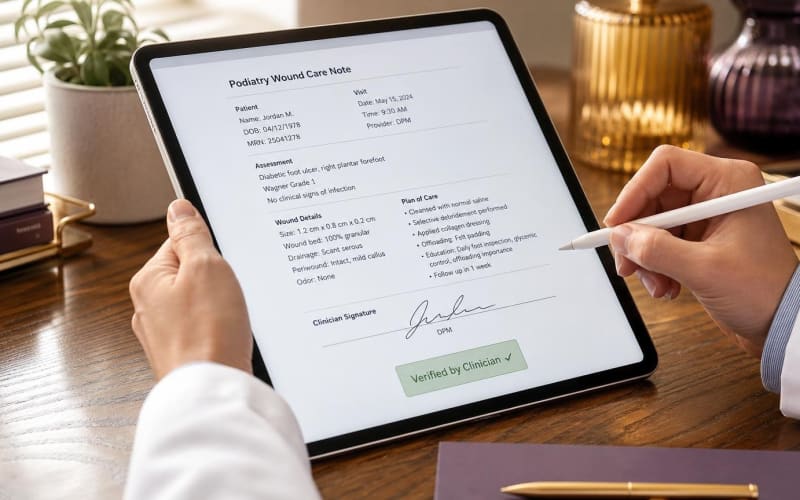
Podiatry wound notes fail audits when E/M reasoning and 11042 detail share one narrative
CPT 11042 carries a 0-day global period, and the evaluation that leads to the decision to debride is already included in the procedure payment. A same-day E/M service is reportable with modifier 25 only when it is significant and separately identifiable from that procedure. A single blended paragraph makes that separation hard for an auditor to see.
Merry AI enforces structural separation by writing E/M content and procedure content into different AdvancedMD fields. The E/M field holds history, examination findings, and medical decision-making about the patient's overall diabetic foot status. The procedure field holds only what happened during debridement. Nothing is duplicated across the two.
The E/M section carries A1c, ABI, and dated off-loading failures as decision evidence
Medical decision-making in wound care depends on factors beyond the ulcer itself. Glycemic control, perfusion, and response to prior off-loading determine whether a wound can heal, whether vascular referral is needed, and whether the plan should escalate. Merry AI places these factors in the E/M field as dated, sourced statements rather than generic phrases.
Each risk factor carries provenance. The most recent A1c appears with its result date. The ankle-brachial index appears with its test date and laterality, and the draft prompts for toe pressure or toe-brachial index when an ABI above 1.3 suggests noncompressible vessels. Off-loading history lists each modality, such as a removable cast walker or total contact cast, with start and failure dates and the documented reason for failure.
Values are never invented by the draft. If a value was not stated in the encounter or is not visible on the active AdvancedMD screen, the field is left as an explicit placeholder that the clinician must complete or delete. This keeps the E/M section reconciled against the chart rather than against a template default.
The 11042 section documents only the intra-procedural work of debridement
The procedure field records technical facts that support 11042 and any 11045 add-on units: wound location, pre-debridement length, width, and depth, the deepest tissue level removed, tissue types removed, instrument used, anesthesia, hemostasis, total debrided surface area, and the post-debridement wound bed appearance. Surface area drives unit count, so the draft states it in square centimeters.
Multiple wounds receive separate entries. When debridement occurs at more than one anatomic site, each site is documented independently so that the clinician and coder can evaluate whether modifier 59 or an X modifier is supported under NCCI edits. Merry AI does not assign modifiers. It structures the record so the coding decision has clear evidence.
Browser-native DOM mapping bypasses EHR marketplace paywalls entirely
The comparison below summarizes how the three common approaches differ for an AdvancedMD podiatry practice.
| Criterion | Traditional API Marketplace Integration | Manual Copy-Paste | Merry AI Chrome DOM Injection |
|---|---|---|---|
| Connection method | Vendor server to EHR API | Clipboard between windows | Content script inside the clinician's browser |
| IT and contracting effort | Partner agreement, credentials, security review | None | Extension install, optional Chrome policy allowlist |
| Per-connection fees | Often charged per provider or per call | None | None |
| E/M vs 11042 field separation | Depends on API field exposure | Depends on clinician effort | Mapped to distinct AdvancedMD containers |
| Dated A1c, ABI, off-loading evidence | Possible if API exposes data | Typed manually | Placed with source date or blank placeholder |
| Template update risk | Managed by vendor release cycle | Low | Managed through versioned selector maps |
| Clinician attestation | Required | Required | Required before chart commit |
G2211 eligibility depends on whether modifier 25 is present on the same claim
CMS defines HCPCS G2211 as an add-on to office or outpatient E/M codes 99202 to 99205 and 99211 to 99215 when the clinician serves as the continuing focal point for a serious or complex condition. Longitudinal diabetic foot ulcer management can meet that definition when the documentation shows ongoing responsibility for the condition.
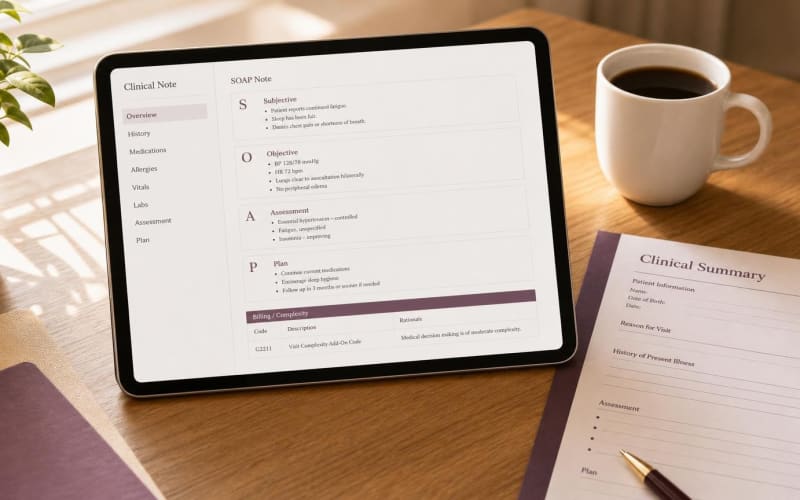
CMS does not pay G2211 when the base E/M is reported with modifier 25, except when the other same-day service is an annual wellness visit, vaccine administration, or a Medicare Part B preventive service. A wound visit billed as E/M with modifier 25 plus 11042 therefore does not support G2211. Merry AI flags that combination for the clinician instead of suggesting the add-on.
Standalone follow-up E/M visits are where G2211 applies in wound care, such as a visit where the podiatrist reassesses healing, adjusts off-loading, and coordinates vascular or endocrine care without performing debridement. On those visits the E/M field highlights the longitudinal relationship and dated risk factor trends that support the add-on.
Selector maps are versioned so AdvancedMD template updates do not misroute text
AdvancedMD updates its templates and editor over time, and any DOM-based tool must account for that. Merry AI stores the mapping between logical sections, such as E/M assessment, procedure narrative, and risk factors, and the DOM containers on your instance as a versioned configuration. If an expected container is missing or renamed, the extension writes nothing to that field and alerts the clinician.
Every injection event is logged with the time, the target section, and the map version used. AdvancedMD's own audit trail attributes the signed note to the logged-in clinician, so this separate log gives compliance teams a record of which text the extension drafted, consistent with CMS guidance on authorship validation and documentation integrity in EHRs.
Audio is discarded after transcription and the clinician remains the author
Ambient capture begins only after the patient is informed and consent is documented according to practice policy and applicable state law. Audio is processed in memory for transcription and discarded once the draft text is produced. No audio or transcript is retained under the executed BAA, and the only persistent clinical artifact is the note the clinician signs.
Attestation is the final control. The extension cannot sign, lock, or submit a note. The podiatrist reads both the E/M field and the procedure field, corrects any value, confirms the dates of A1c, ABI, and off-loading entries, and attests to the record as its author.
Competing scribes push generic text into AdvancedMD instead of mapped sections
Published comparisons describe gaps for AdvancedMD users. Suki lists no native AdvancedMD integration. Freed uses push-only browser delivery that does not pull prior labs or notes. Heidi and DeepScribe do not list AdvancedMD among confirmed write-back systems in the same comparisons. For a specialty that depends on separating E/M and procedure documentation, field-level mapping is the deciding capability.
Practices evaluating this workflow can review their current AdvancedMD wound templates with our team and see which fields the selector map would bind before any clinician uses the extension on a live chart.