CLINICAL MEMORY
Longitudinal Wound Trending
Find wound-assessment prompt packs at templates.scribing.io to draft notes in seconds and compare serial measurements using the same method without overwriting prior values.
Specialty Clinical Playbook
Structured exudate, size, and tissue-percentage capture mapped straight into your wound flowsheet with human-in-the-loop review. Book your audit at https://cal.com/merryai/demo.
 Dr. Sarah Chen, MD
Specialty Architecture
Engineered to mirror the assessment sequence, CMS documentation expectations, and flowsheet discretization required by wound care nursing.
CLINICAL MEMORY
Find wound-assessment prompt packs at templates.scribing.io to draft notes in seconds and compare serial measurements using the same method without overwriting prior values.

CONTEXT RETRIEVAL
Retrieve prior length/width/depth, tissue-percentage trajectories, and drainage trends in one structured draft without tab bouncing across the chart.
WORKFLOW INTELLIGENCE
Surface longitudinal complexity add-on evidence for chronic non-healing wounds and auto-draft care plans. Claim your 15-Minute Workflow Audit today.
SPECIALTY-AWARE REASONING
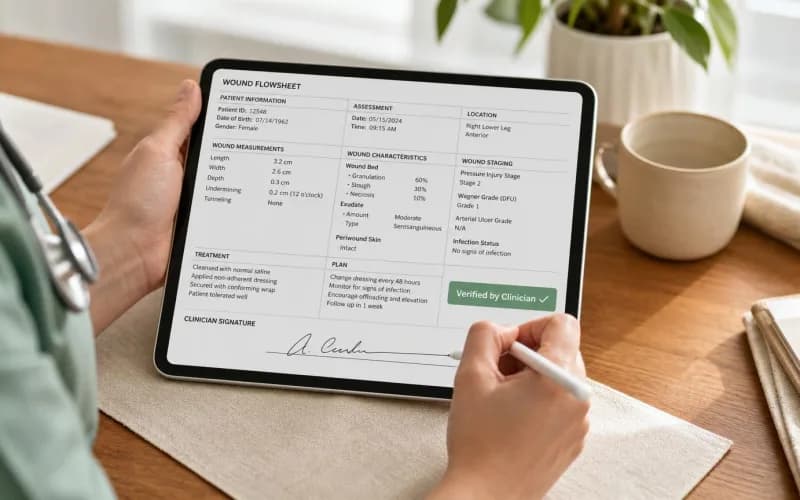
Diarize bedside dialogue and map exudate, dimensions, and wound-bed composition into flowsheet-approved discrete fields without silent synonym conversion.
Point-of-Care Flow
Zero IT friction, zero complex API setup, and human-verified attestation on every mapped value.

Wound care nursing documentation demands the simultaneous handling of measured findings, subjective patient report, and treatment response, all sequenced from assessment to intervention. Merry AI's core function is deliberately narrow and defensible: it performs structured transfer of wound-assessment findings—exudate, wound dimensions, and tissue percentages—directly into the corresponding wound-flowsheet rows for clinician review. This is engineered as clinician-reviewed decision support, never autonomous charting, because wound fields carry clinical and legal consequences that only an authorized nurse or provider may finalize.
CMS wound-care guidance explicitly expects documentation of wound size and depth, exudate amount and type, predominant tissue characteristics, infection status, periwound condition, and pain considerations. Merry AI extracts only findings supported by the source note, dictated assessment, or structured input, then maps them into predefined fields while preserving the original wording. The safest architecture follows a strict chain: assessment source → AI extraction → field mapping → nurse verification → flowsheet commit → audit trail. At no point is a value guessed, inferred from a prior assessment, or silently converted.
Discretization is the foundational principle separating a defensible wound flowsheet from an unstructured narrative blob. Research on modeling flowsheet data for secondary use confirms that discrete fields—not large free-text boxes—enable trend reports, quality audits, handoff, clinical decision support, and billing review (https://www.ncbi.nlm.nih.gov/pmc/articles/PMC5591037/). Merry AI therefore maps every anchor field into its own discrete destination, retaining field-level provenance so the original source and the final clinician-entered value remain distinguishable in the record forever.
Anchor-field discipline governs everything Merry AI writes. The product claim is intentionally precise: Merry AI maps documented exudate, wound size, and tissue-percentage findings directly into the corresponding wound-flowsheet rows for nurse review and confirmation. It does not diagnose a wound, determine a pressure-injury stage, or select treatment. The clinical logic matrix below binds each specialty framework to its required data points and its billing-evidence function.
| Diagnostic Framework | Required Clinical Data Points | Billing / Audit Evidence |
|---|---|---|
| Linear wound measurement | Length × width × depth, units (UCUM cm/mm), method, pre/post-debridement context | CMS-required current dimensions and depth for coverage review |
| Exudate characterization | Amount (none/scant/small/moderate/large), type (serous/serosanguineous/sanguineous/purulent), color, odor | Surgical-dressing recurring-evaluation drainage documentation |
| Wound-bed tissue composition | Granulation %, slough %, eschar/necrotic %, epithelial %, total = 100% | Debridement tissue-type and depth correspondence to service billed |
| Periwound & infection findings | Intact/macerated/erythema, purulence, warmth, odor | Escalation prompt and complexity evidence, not autonomous diagnosis |
| Longitudinal continuity | Serial assessments, same-method comparison, documented change reasons | HCPCS G2211 complexity add-on for continuing focal-point care |
Exudate is never collapsed into a single free-text phrase. When the source states "moderate serosanguineous drainage," Merry AI populates amount = moderate and type = serosanguineous as separate structured fields while retaining the verbatim wording. Critically, it does not silently convert synonyms—"scant" is not auto-mapped to "small" unless your organization has explicitly configured those terms as equivalent in the value set. This synonym governance protects trending integrity and audit defensibility.
Size mapping honors numeric integrity across length, width, depth, unit of measure, measurement method, timestamp, and pre- or post-debridement context. Merry AI never infers a missing depth from a prior assessment, never treats "about 4 cm" as a precise 4.0 cm without preserving the approximation, and never reverses length and width unless a fixed orientation is organizationally defined. Internally inconsistent values—such as a depth exceeding length, or a dramatic unexplained change—trigger a comparison warning rather than a silent commit. Undermining and tunneling with clock-face location are captured as distinct fields where used.
Tissue composition follows strict validation because wound-bed percentages inform dressing selection and healing trajectory. Following wound-assessment documentation guidance recommending 10% increments summing to 100%, Merry AI rejects or flags totals below or above 100%, identifies duplicate categories, and requests clarification when the source says "mostly granulation" without a configured percentage. It refuses to convert "clean wound bed" into 100% granulation absent explicit support, and it preserves uncertainty such as "approximately 50% slough" rather than presenting it as an exact figure. Ambiguous descriptors like "yellow tissue"—which may be slough, fibrin, exudate, or dressing residue—are never auto-classified as necrosis.
Flowsheet configuration precedes deployment and requires discrete fields for wound identity, type, location, laterality, dimensions, undermining and tunneling, the exudate fields, tissue percentages, periwound condition, wound edges, infection indicators, pain, photographs with metadata, dressing orders, and clinician attribution with timestamp. Terminology design binds SNOMED CT concepts, UCUM-compatible units, and organization-approved drainage and tissue vocabularies so that "serosanguineous," "serosanguinous," and "blood-tinged serous" are governed by a deliberate policy rather than treated as unrelated values.
The verification screen displays source text or image context beside each proposed value, the intended destination field, confidence or ambiguity indicators, missing required fields, the running tissue-percentage total, measurement units, and previous assessment values for comparison. Every value carries an explicit accept, edit, reject, or defer action, followed by a clear final-submit step. The system never writes into the legal medical record without an appropriate review and attribution model, and any narrowly-scoped auto-commit must be separately approved and audited.
CMS coverage expectations frame every field Merry AI touches. For debridement, the record must identify tissue type removed and depth, and those details must correspond to the service billed—a general wound assessment is never a substitute for procedure-specific documentation. Studies show that structured EHR templates measurably improve capture of wound-care data in chronic populations such as veterans with diabetic foot ulcers (https://www.ncbi.nlm.nih.gov/pmc/articles/PMC3591837/), reinforcing why discretized, template-driven mapping outperforms narrative dictation for coverage defensibility.
Pressure-injury documentation demands clinical interpretation that Merry AI deliberately declines to automate. The system does not infer stage from tissue percentages or depth alone, because staging requires full-assessment judgment and knowledge of obscured structures and wound-bed visibility. Record integrity is preserved end-to-end: original source content, the AI proposal, clinician edits, the final signed value, user identity, timestamp, and model version all persist so audit logs answer what was extracted, where it was mapped, who reviewed it, what changed, and when it was signed.
Human-in-the-loop governance is non-negotiable given the ambiguity endemic to wound documentation. A governance committee should define approved use cases, prohibited autonomous actions, required review fields, escalation rules, performance thresholds, retrospective audit sampling, and a revalidation schedule after any model or EHR change. Pre-production validation must test dry wounds, all drainage types, missing and approximate measurements, multiple wounds per note, pre/post-debridement pairs, undermining, and contradictory narrative-versus-structured values—with acceptance criteria demonstrating reliable performance specifically for the three anchor fields. Explore validated wound-assessment prompt packs and Access Specialty Prompts at templates.scribing.io, then Schedule a 15-Minute Specialty Workflow Audit to map Merry AI against your flowsheet.

Convert dietetic assessments into clinician-reviewed ADIME drafts with transparent G0270 unit logic. Book your audit at https://cal.com/merryai/demo.

Convert member priorities and verified data into traceable, clinician-reviewed longitudinal summaries and care-goal records. Book your audit at https://cal.com/merryai/demo.

Structured GLP-1 documentation, BMI-indexed milestone tracking, and payer-ready prior-auth evidence built for metabolic medicine. Book your audit at https://cal.com/merryai/demo.