CLINICAL MEMORY
Longitudinal Diagnostic Memory
Track Wagner grade, wound area, and TcPO2 response across the full treatment series. Find hyperbaric prompt packs at Access Specialty Prompts at templates.scribing.io to generate notes in 5 seconds.
Specialty Clinical Playbook
Log ATA, time at pressure, and TcPO2 response into every 99183 session note. Book your audit at https://cal.com/merryai/demo.
 Dr. Sarah Chen, MD
Specialty Architecture
Built to follow the pacing, diagnostic frameworks, and documentation requirements of Wound Care and hyperbaric medicine.
CLINICAL MEMORY
Track Wagner grade, wound area, and TcPO2 response across the full treatment series. Find hyperbaric prompt packs at Access Specialty Prompts at templates.scribing.io to generate notes in 5 seconds.
CONTEXT RETRIEVAL
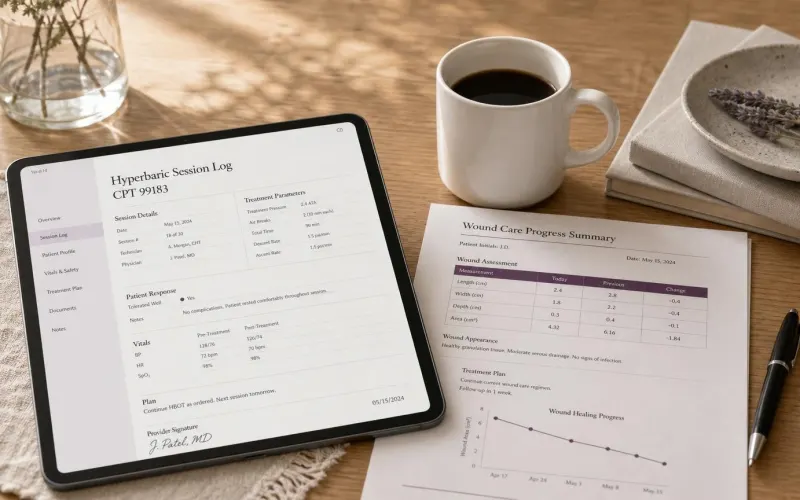
Retrieve prior session pressures, wound measurements, glucose trends, and the 30-day healing trajectory without switching tabs.
COMPLEXITY CAPTURE
Keep 99183 supervision work separate from qualifying E/M visits where G2211 applies. Schedule a 15-Minute Specialty Workflow Audit today.
SPEAKER ROUTING
Separate the physician, hyperbaric technologist, wound nurse, and patient, then route each finding into the correct section of the session note.
Point-of-Care Flow
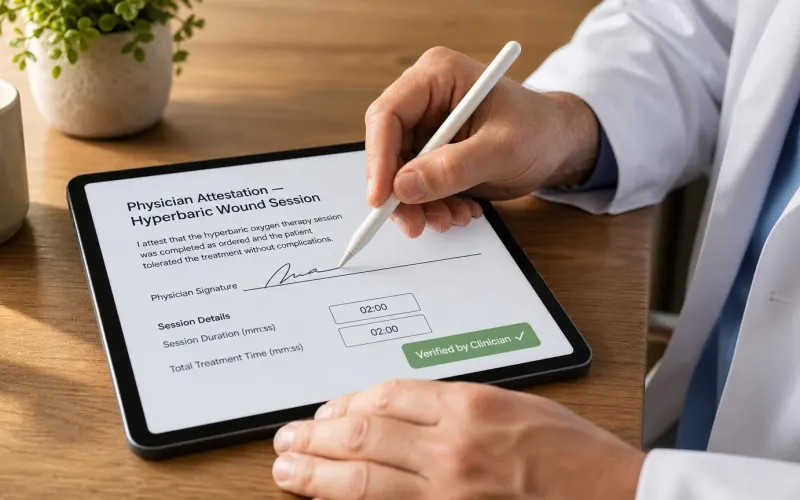
No IT friction, no complex API setup, and clinician attestation on every note.

A hyperbaric session is a procedure, not a conversation. CPT 99183 describes physician attendance and supervision of hyperbaric oxygen therapy, per session. The record behind each unit has to show that a physician was present for the work that matters: pre-dive clearance, compression, intra-session monitoring, and post-treatment evaluation. Generic ambient notes tend to capture what was said in the room and miss what was measured at the chamber. Reviewers notice the difference quickly.
Medicare coverage under NCD 20.29 is narrow and specific. For diabetic wounds of the lower extremities, three conditions must be met:
Continued treatment is not covered if measurable signs of healing are absent during any 30-day period of HBOT. Every session note therefore carries part of the medical necessity argument. A single thin entry can weaken the entire series.
Merry AI listens to the encounter in the wound center and the chamber suite. It separates the voices of the physician, the certified hyperbaric technologist, the nurse, and the patient. It then drafts a session record organized the way hyperbaric physicians already think. Values spoken aloud, typed into the extension panel, or read from the chamber log are placed into discrete lines rather than buried in prose. Nothing is signed until the attending reviews it.
Each draft records the core chamber parameters:
Physician presence is time-stamped at clearance, descent, monitoring checkpoints, and surfacing. Pre-dive checks are written as findings, not checkboxes. These include tympanic membrane assessment, lung auscultation, blood pressure, and fingerstick glucose. Any carbohydrate supplementation given before compression in insulin-treated patients is also recorded.
Transcutaneous oximetry carries the physiological story. The scribe logs the baseline periwound TcPO2 on room air, the oxygen-challenge or in-chamber value, and the reference site. It then calculates the change so the response is explicit. Wound length, width, depth, area, tissue composition, exudate, and Wagner grade are trended across sessions. A reviewer can then see measurable healing within each 30-day window rather than having to infer it.
Supervision work integral to the dive stays inside 99183. This includes the interval history, focused exam, review of vitals and glucose, and assessment for barotrauma or oxygen toxicity. Sometimes a separate, significant problem is addressed on the same date, such as a new heart failure exacerbation. In that case, the draft opens a distinct section with its own history, exam, and decision-making to support an E/M with modifier 25. Debridement and TcPO2 determinations are documented as their own services. G2211 is proposed only on qualifying office or outpatient E/M visits that reflect a longitudinal relationship, never on the 99183 line itself.
The matrix below shows how each diagnostic metric becomes billing evidence. Always confirm code descriptors and reporting rules against current https://www.ama-assn.org/practice-management/cpt resources and your contractor's local guidance.
| Specialty Diagnostic Metric | Required Clinical Data Points | Billing Evidence |
|---|---|---|
| Wagner grade and wound duration | Grade III or higher, location, dimensions, depth, dated 30-day course of standard care | NCD 20.29 covered indication; ICD-10-CM diabetic ulcer linkage for prior authorization |
| Chamber parameters | ATA, minutes at pressure, compression and decompression times, air breaks, session number | One unit of 99183 per session; series count tracked against payer limits |
| TcPO2 response | Room-air periwound baseline, oxygen-challenge or in-chamber value, reference site, percent change | Documented hypoxia and responsiveness supporting continued HBOT |
| Physician attendance | Time-stamped clearance, monitoring checkpoints, post-dive evaluation | Attendance and supervision requirement for 99183 |
| Perfusion and risk | ABI or toe pressure, A1c, pre- and post-dive glucose, NYHA class or LVEF when relevant | Medical necessity and risk-benefit documentation |
| Separate same-day problem | Distinct history, exam, assessment, and plan unrelated to HBOT | E/M with modifier 25; G2211 only on qualifying E/M visits |
When a metric is missing, the draft says so plainly. For example, a session may lack a documented TcPO2 response or a wound measurement within the current 30-day window. The scribe flags it for the attending before signing. It also defaults to conservative coding rather than suggesting modifiers the record cannot support.
The Merry AI Chrome Extension runs inside the browser window where your EHR already lives. Wound centers often chart across separate tabs for wound assessment, hyperbaric session, orders, and charge capture. The extension holds encounter context across those tabs. Measurements entered on the wound assessment carry into the session narrative. The charge capture view then shows 99183 alongside any supportable E/M, with the justification text attached. There is no interface build and no API fee.
Prompt packs for hyperbaric sessions, Wagner grade reassessments, and 30-day medical necessity summaries are available at https://templates.scribing.io. Each can be adapted to your chamber protocol, your treatment pressures, and the vocabulary your hyperbaric team already uses.
Protected health information is processed in memory and not retained after the session closes, under an executed Business Associate Agreement. The attending remains the author of record. Every note carries a clear attestation that the draft was reviewed and confirmed before signing. The aim is modest and specific: an accurate record of the dive, finished before the next patient is compressed.

Seizure counts, mg/kg dosing, and EEG dates structured into every plan. Book your audit at https://cal.com/merryai/demo.

Separate BPH E/M work from cystoscopy and track IPSS, PVR, and PSA velocity per year. Book your audit at https://cal.com/merryai/demo.

Structure tissue stages, sub-millimeter margin clearing, defect reconstruction, and distinct procedural defense.