
CLINICAL MEMORY
Longitudinal Goal-Trajectory Memory
Find 40+ SLP prompt packs at templates.scribing.io to draft notes in seconds while surfacing stale goals, missing baselines, and unresolved carryover questions.
Specialty Clinical Playbook
Convert verified SLP observations into transparent functional goal trajectories, multi-delta reporting, and defensible progress notes. Book your audit at https://cal.com/merryai/demo.
 Dr. Sarah Chen, MD
Specialty Architecture
Engineered to mirror the plan-of-care lifecycle, cueing hierarchies, and functional goal frameworks that define speech-language pathology documentation.
CLINICAL MEMORY
Find 40+ SLP prompt packs at templates.scribing.io to draft notes in seconds while surfacing stale goals, missing baselines, and unresolved carryover questions.
CONTEXT RETRIEVAL
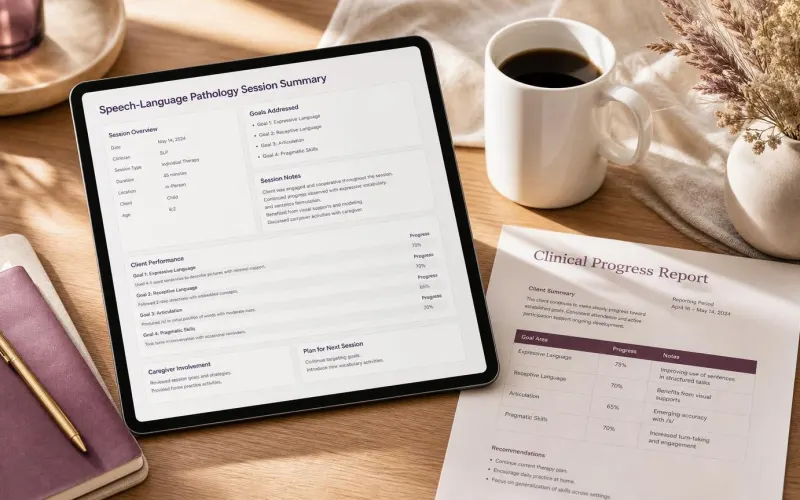
Retrieve prior intelligibility scores, cueing-hierarchy trends, and diet-texture history in one structured draft without tab bouncing between encounters.
WORKFLOW INTELLIGENCE
Connect intervention, functional limitation, skilled need, and POC goal to defend KX-threshold and progress-report requirements. Claim your 15-Minute Workflow Audit today.
SPECIALTY-AWARE REASONING
Diarize clinician, patient, and caregiver dialogue and map findings into ICF-aligned impairment, activity, and participation note sections.
Point-of-Care Flow
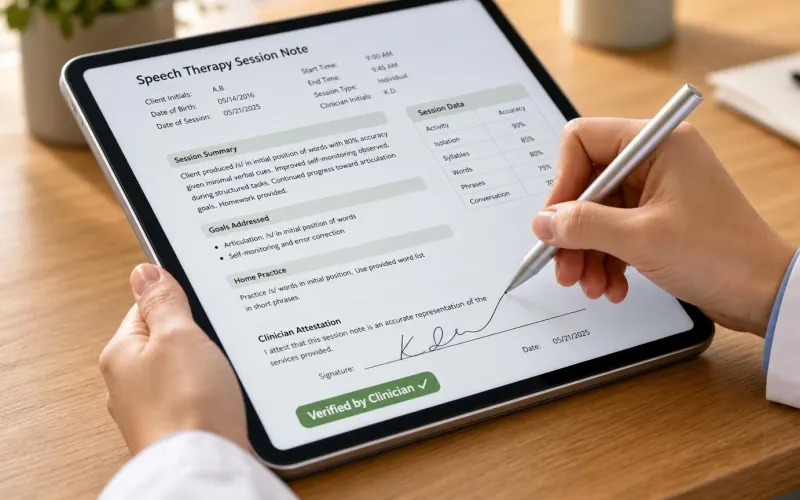
Zero IT friction, zero complex API setup, and human-verified attestation on every goal delta and progress narrative.
Clinical documentation in speech-language pathology spans an entire episode of care—from evaluation and certified plan of care through daily treatment, progress reporting, and discharge—while continuously preserving evidence of medical necessity, measurable functional change, and clinician accountability. ASHA does not mandate a single note format or universal timeline; requirements shift across outpatient, hospital, home-health, school, telepractice, and skilled-nursing settings, and across every payer contract. Merry AI is engineered as a structured clinical layer, not a narrative generator, so every reported change traces back to a baseline, an intervention encounter, an objective measure, and a signed clinician assessment.
The foundational distinction Merry AI preserves is the separation between the medical diagnosis, the therapy diagnosis, and the functional limitation. A cerebrovascular accident may be the medical diagnosis, aphasia the therapy diagnosis, and inability to communicate basic wants and needs the functional limitation. Collapsing these into one field destroys the medical-necessity narrative that payers and auditors require, so the intake architecture captures referral source, precautions, authorization limits, interpreter use, and caregiver participation as discrete, queryable fields.
Merry AI enforces a hard rule that no goal may be created without a documented baseline or an explicit, recorded reason a baseline is unavailable. The evaluation context—test name and version, date, raw and standard scores, cueing level, task conditions, communication partner, and environmental setting—is stored alongside the clinician's interpretation, prognosis, and skilled-therapy rationale. This structured capture is what makes downstream goal-delta calculation defensible rather than an illusion of precision.
Every speech-therapy goal in Merry AI is structured across four layers drawn from the World Health Organization's ICF framework: the impairment or skill target, the activity target, the participation or functional target, and the caregiver or environmental target. A goal object therefore stores a goal statement, domain, baseline value, target value, measurement type, unit, time horizon, required cueing, generalization context, status, responsible clinician, source measure, and review date. A free-text goal such as "improve expressive language" cannot support reliable delta reporting, so the system requires validated structured fields before a trajectory can be computed.
A critical engineering safeguard involves directionality, because not every measure improves as the number rises. Intelligibility percentage improves upward, while error rate, response latency, and cueing burden improve downward. Merry AI stores an explicit directionality flag rather than assuming every observation increases with progress, which prevents the reporting engine from misclassifying a reduction in prompting as clinical regression. This directional logic is validated against the same peer-reviewed rehabilitation outcome literature indexed at PubMed Central that informs functional-status measurement science.
Goal delta is never a single number in Merry AI; it is a family of clinically distinct values. The system computes absolute delta, percent change, target attainment, expected-versus-observed trajectory variance, assistance delta, generalization delta, and time-to-target variance. If intelligibility improves from 55% to 70% against an 80% target, Merry AI reports a 15-point absolute gain, a 10-point remaining gap, and 60% attainment of the baseline-to-target interval—yet it will not label the goal "met" or the change "clinically meaningful" until the clinician validates the interpretation.
A major analytic risk in therapy is overvaluing structured impairment scores while underrepresenting real-world function. A patient may improve on a confrontation-naming task without improving functional communication, while another may achieve meaningful classroom participation despite modest standardized-score movement. Merry AI therefore refuses to collapse impairment, activity, and participation into one composite; the trajectory engine displays all three, prioritizing communication of wants and needs, safe swallowing, instruction-following, caregiver independence, and AAC generalization across people, tasks, and environments.
Merry AI functions as a documentation assistant, never the clinical decision-maker. It extracts candidate measurements, identifies missing baseline or target fields, suggests trajectory updates, drafts a progress narrative, and flags inconsistent values—then requests clinician confirmation before anything is finalized. The final note visibly distinguishes observed data, AI-derived calculation, AI-generated draft language, clinician interpretation, and the clinician-authenticated conclusion, recording who accepted, edited, or rejected every suggestion for full auditability.
The following matrix demonstrates how Merry AI binds each speech-therapy diagnostic framework to the required clinical data points and the billing evidence that defends the encounter under CMS outpatient rehabilitation therapy rules and payer audit.
| Specialty Diagnostic Framework | Required Clinical Data Points | Billing & Compliance Evidence |
|---|---|---|
| ICF Impairment (speech sound / voice / fluency) | Standardized score, percent accuracy, cueing hierarchy, task condition | Evaluation with baseline, skilled-therapy rationale, POC certification |
| ICF Activity (connected speech, sentence-level) | Performance in structured vs conversational context, assistance level | Daily note skilled intervention + patient response, timed treatment minutes |
| ICF Participation (classroom, workplace, social) | Functional carryover, generalization context, environmental barriers | Progress report at 10 treatment days / 30 calendar days, medical necessity |
| Dysphagia / Feeding | Diet texture, liquid consistency, aspiration observations, supervision level | Physician order/referral, safety indicators, plan-of-care alignment |
| Caregiver / AAC Training | Strategy taught, caregiver independence, device use fidelity | Home program documentation, caregiver education note, discharge plan |
| Longitudinal Complexity (E/M) | Continuity of care, ongoing management relationship | CPT G2211 add-on per CMS MM13473, MDM evidence |
Each row is populated from diarized dialogue and validated structured entry, so the billed service is always supported by the encounter record. Merry AI keeps clinical content separate from billing content while guaranteeing traceability, addressing ASHA's principle that documentation must be accurate, codeable, understandable, timely, and error-free.
Progress reports in Merry AI never restate daily notes. The engine answers the questions a Medicare reviewer expects: what was the initial baseline, what has changed, is the change clinically meaningful, how much assistance remains, has the skill generalized beyond the treatment task, and is skilled therapy still medically necessary. CMS outpatient rehabilitation therapy guidance (MLN905365) triggers progress reporting when treatment exceeds 10 treatment days or 30 calendar days, whichever is less, and Merry AI surfaces this deadline as an active workflow prompt rather than a passive reminder.
The discharge workflow is equally disciplined, capturing final functional status, per-goal status of met, partially met, not met, discontinued, or deferred, objective final measurements, remaining limitations, home program, follow-up recommendations, and the discharge reason. A goal is never auto-marked "met" because a percentage moved; the clinician confirms whether the intended functional outcome was achieved and whether the result generalized. This guards against the false-precision risk that undermines both patient safety and audit defensibility.
Configurability is central to regulatory alignment, because record-retention periods, electronic-signature rules, telepractice consent, SLPA and clinical-fellow supervision, and school-based FERPA obligations vary by jurisdiction and setting. Merry AI ships payer-specific and state-specific policies as configurable controls with effective dates and human review, rather than hard-coding one jurisdiction's assumptions—supporting the five-year Medicare retention standard while accommodating longer internal and state requirements. Ready to see it against your own caseload? Schedule a 15-Minute Specialty Workflow Audit.
Because speech-language pathology lives across closed-garden private-practice, school, and outpatient EHRs, Merry AI deploys through a Chrome Extension performing DOM injection into the active browser window—no vendor API contract, no integration queue, no IT provisioning. Structured evaluation, daily, progress, and discharge notes populate the correct fields on a single click, and a human-readable legal record can be exported for any payer, auditor, or release-of-information request.
AI-specific controls close the loop on trust: no silent overwriting of clinician text, prompt and output logging, model-version tracking, source attribution for every extracted fact, confidence indicators, and a strict prohibition against generating undocumented treatment minutes, outcomes, patient responses, or goal attainment. Combined with zero-retention PHI handling and executed Business Associate Agreements, this architecture lets clinicians reclaim charting time without ceding clinical judgment. Explore the full library and start today at Access Specialty Prompts at templates.scribing.io.

Convert dietetic assessments into clinician-reviewed ADIME drafts with transparent G0270 unit logic. Book your audit at https://cal.com/merryai/demo.

Convert member priorities and verified data into traceable, clinician-reviewed longitudinal summaries and care-goal records. Book your audit at https://cal.com/merryai/demo.

Structured GLP-1 documentation, BMI-indexed milestone tracking, and payer-ready prior-auth evidence built for metabolic medicine. Book your audit at https://cal.com/merryai/demo.