
CLINICAL MEMORY
Longitudinal Patient Memory
Find 40+ prompt packs at templates.scribing.io to generate DAP/BIRP group notes in seconds and surface unresolved risk questions.
Specialty Clinical Playbook
Standardize multi-party group note-splitting and MSE metrics across 5-50 providers with centralized QA dashboards. Book your audit at https://cal.com/merryai/demo.
 Dr. Sarah Chen, MD
Specialty Architecture
Engineered to mirror the pacing, diagnostic frameworks, and documentation requirements of PHP/IOP Behavioral Health.
CLINICAL MEMORY
Find 40+ prompt packs at templates.scribing.io to generate DAP/BIRP group notes in seconds and surface unresolved risk questions.
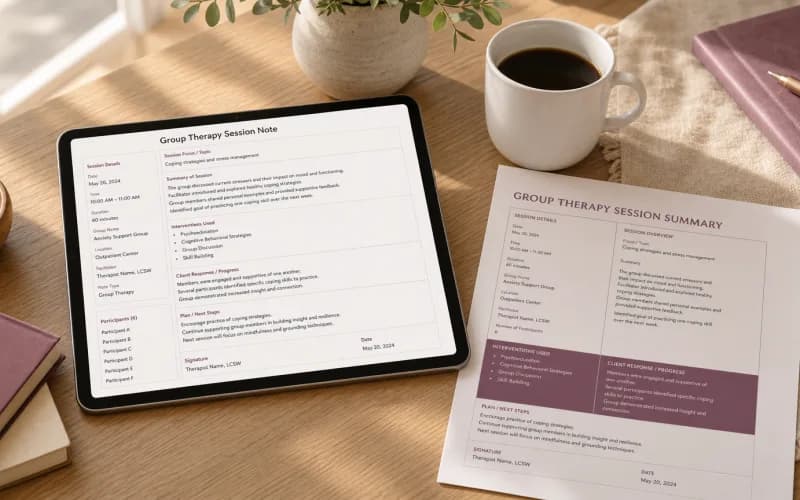
CONTEXT RETRIEVAL
Retrieve prior PHQ-9/GAD-7 trajectories, MSE trends, and level-of-care history in one structured draft without tab bouncing.
WORKFLOW INTELLIGENCE
Capture longitudinal complexity add-on revenue and auto-draft medical-necessity language. Claim your 15-Minute Workflow Audit today.
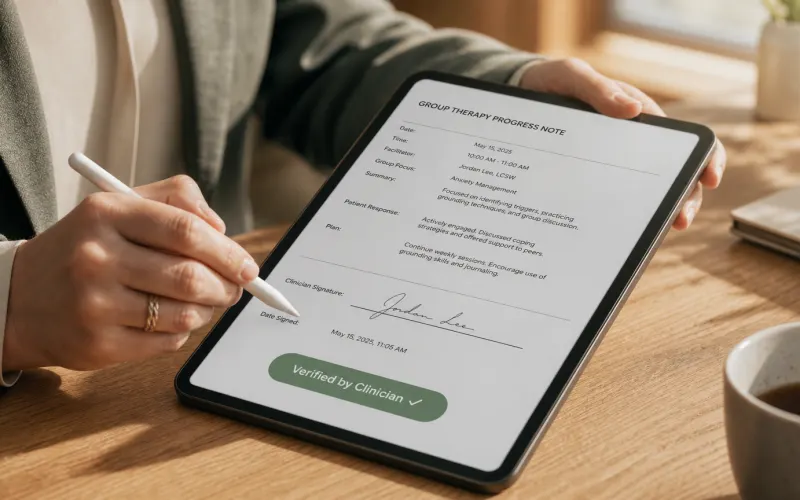
SPECIALTY-AWARE REASONING
Diarize multi-party group dialogues and map each participant's affect, participation, and risk into DAP/BIRP note sections.
Point-of-Care Flow
Zero IT friction, zero complex API setup, and human-verified attestation on every split note.

Documentation in PHP/IOP behavioral health carries a structural burden no other outpatient setting matches: a single 90-minute group session can generate eight, twelve, or twenty distinct clinical records, each of which must stand alone for medical-necessity review, utilization review, and payer audit. The clinical reality is that a facilitator delivers shared psychoeducation and process content once, yet every attendee requires an individualized note reflecting their participation, affect, insight, and risk. Merry AI was built to honor that asymmetry, capturing the shared session spine once and splitting it into participant-specific DAP or BIRP notes with distinct clinical fields.
Standardizing this across 5-50 providers is where most programs fracture. When each counselor free-texts a group note in their own idiom, QA departments lose the ability to run structured queries on suicidality assessments, MSE elements, or outcome completion. Merry AI enforces a unified schema at the point of capture, so mood, affect, thought process, cognition, behavior, and risk always land in the same discrete fields regardless of which clinician ran the group. Centralized QA dashboards then confirm that every group attendance entry resolves into a finalized individual note by end of day.
The engine treats speaker attribution as a first-class clinical signal. Acoustic diarization separates the facilitator's interventions from each participant's verbal contributions, then routes those turns into the correct client's chart. This mirrors the group-note-splitting workflows documented by platforms like Valant, where shared content auto-populates into each note while individualized entries remain mandatory, and aligns with published best practice that group documentation must include both shared session information and client-specific participation, response, and risk.
The following matrix maps the diagnostic and regulatory frameworks that govern PHP/IOP documentation to the specific data points Merry AI captures and the billing evidence each supports. This is the operational contract between clinical accuracy and revenue integrity.
| Specialty Diagnostic Framework | Required Clinical Data Points | Billing Evidence |
|---|---|---|
| DSM-5-TR diagnosis + MSE | Appearance, behavior, mood/affect, speech, thought process/content, cognition, insight/judgment, risk | Supports medical necessity and level-of-care justification for PHP vs IOP |
| Group Note-Splitting (DAP/BIRP/GIRP) | Shared session theme + per-participant participation, response, progress, individual risk | Individualized note per attendee for institutional 837i / Rev Code 0905 IOP billing |
| ASAM Level-of-Care Criteria | Dimensional severity ratings, step-up/step-down rationale, continued-stay reassessment | Utilization review and audit-readiness documentation |
| Standardized Outcome Battery | PHQ-9, GAD-7, SUD instruments captured longitudinally | Reportable aggregate outcomes across program and provider |
| CPT G2211 Complexity Add-On | Continuing focal-point relationship, ongoing serious/complex condition | Longitudinal complexity add-on revenue per CMS MM13473 |
Each row of this matrix is enforced at capture rather than reconstructed retrospectively. Because the MSE schema is a required structured field set, QA staff can query which notes are missing a risk assessment by provider and program, and clinical leadership can compare documentation completeness across tracks. Peer-reviewed guidance on structured behavioral-health documentation and outcome measurement is well catalogued at https://www.ncbi.nlm.nih.gov/pmc/, and our field schema is designed to remain interoperable with those measurement-based-care standards.
The central technical challenge in PHP/IOP is transforming one acoustic stream containing a facilitator and up to twenty participants into individually attributable, chart-ready notes. Merry AI performs speaker diarization to isolate turns, then applies role inference to distinguish the clinician's interventions from client disclosures. Shared content, the group topic, modality, curriculum module, and therapeutic exercise, is written once and propagated, while participant-specific affect, participation level, and stated risk are routed to the correct chart.
This produces genuine note-splitting rather than a duplicated omnibus record. Each attendee receives a note in the program's approved format, whether DAP, BIRP, or GIRP, containing the shared spine plus their unique clinical picture. The clinician reviews and edits each split note before signing, preserving the attestation requirement that keeps every record defensible under payer scrutiny.
A structured Mental Status Examination is non-negotiable for behavioral-health defensibility, yet free-text capture leaves it inconsistently documented. Merry AI treats mood, affect, speech, thought process, thought content, cognition, insight, judgment, and risk as discrete required fields. When a group session ends, notes missing any critical MSE or risk element are flagged before the clinician can finalize, converting an invisible compliance gap into a visible, resolvable exception.
Measurement-based care is now an expectation of accreditors and payers alike, and PHP/IOP programs are increasingly asked to demonstrate outcome trajectories rather than assert them. Merry AI pulls a core battery, PHQ-9, GAD-7, and SUD-specific instruments, directly into the note and surfaces prior scores so the clinician sees the trend without leaving the encounter. Those structured values then roll up into program-level and provider-level dashboards.
Centralized quality assurance becomes tractable only when documentation is structured at the source. Because Merry AI writes discrete fields rather than prose, QA teams can monitor outcome-measure completion rates per episode of care, notes missing level-of-care justification, and documentation timeliness segmented by provider, group, program, and site. This is the difference between a QA analyst reading a thousand narrative notes and a dashboard tile flagging the twelve exceptions that actually require coaching.
Every PHP and IOP claim ultimately rests on demonstrable medical necessity: why this intensity of care, why not less, why not more. Merry AI drafts continued-stay and step-down rationale language anchored to ASAM dimensional severity and the patient's documented trajectory. For FQHC and RHC IOP billing governed by CMS MM13264 and Revenue Code 0905, the linkage between scheduled group, documented attendance, delivered service, and individualized note is preserved end to end.
PHP/IOP teams overwhelmingly run on closed-garden platforms like Valant and Kipu, where formal API access is either unavailable or trapped behind lengthy vendor projects. Merry AI sidesteps that entirely with a Chrome Extension that operates inside the clinician's existing browser session, injecting finalized notes into the correct fields via the DOM. There is no integration engineering, no sandbox provisioning, and no IT ticket queue.
Security is architected as zero-retention. Audio is processed in-memory and RAM-shredded once the structured draft is produced, no raw recordings persist to disk, and every organization executes a Business Associate Agreement. For dual-diagnosis and SUD-inclusive tracks, 42 CFR Part 2-aware segmentation and consent handling sit alongside standard HIPAA access controls. You can access our full library of specialty prompt packs to standardize this workflow at https://templates.scribing.io, and when you are ready to see it against your own program, Schedule a 15-Minute Specialty Workflow Audit.
The final architectural principle is uniformity at scale. A program running 5-50 providers across mood, trauma, and SUD tracks cannot tolerate documentation variance if it expects clean audits and comparable outcomes. Merry AI ships program-specific templates, DAP, BIRP, GIRP, structured MSE, and treatment-plan scaffolds, that every clinician draws from identically, so the shared session spine and required clinical fields are constant while the individual clinical picture remains genuinely individualized.
Governance and clinical oversight are built into the delivery model through role-based review and co-signature routing, letting supervisors and medical directors attest to high-risk notes and level-of-care decisions. Combined with the centralized QA dashboards, this closes the loop from ambient capture to signed chart to program analytics. Explore the full template set at templates.scribing.io to see how each note type is pre-structured for your specialty.

Point-of-care translation of ABI/TBI, duplex, and CTA findings into audit-defensible pre-op clearance and prior auth packets. Book your audit at https://cal.com/merryai/demo.

Structured colonoscopy notes with discrete polyp morphology, Paris classification, and automated ADR tracking pushed into gGastro and Epic GI. Book your audit at https://cal.com/merryai/demo.
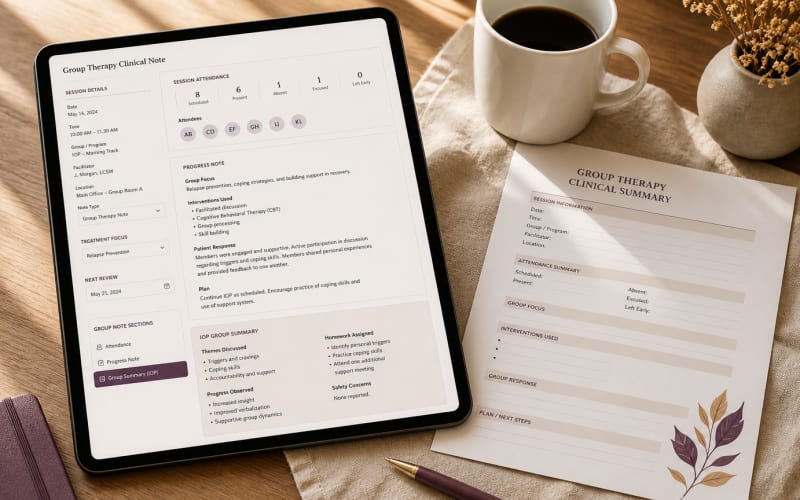
Turn one 3-hour group session into individualized, 42 CFR Part 2-compliant progress notes per client. Book your audit at https://cal.com/merryai/demo.