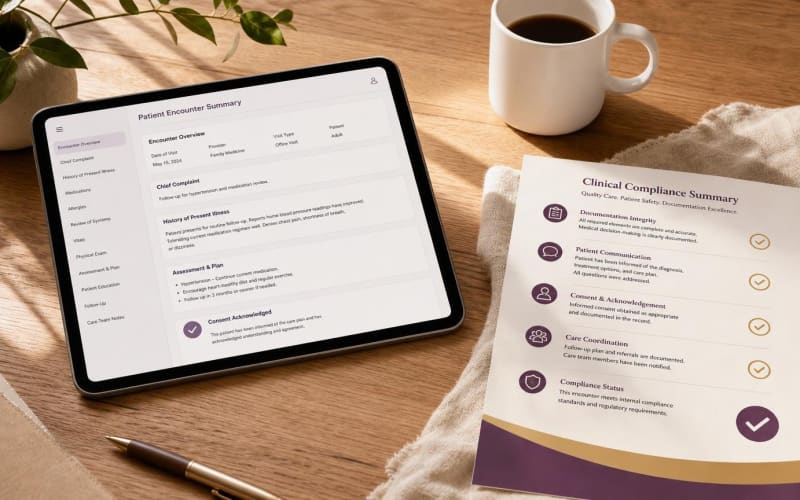
Statutory Compliance Architecture for Nevada SB 370
Nevada SB 370, enacted in 2023, added consumer health data provisions to NRS Chapter 603A, effective March 31, 2024. A regulated entity must obtain affirmative, voluntary consent before collecting consumer health data beyond what is needed to provide the requested service, and separate consent before sharing it. The Attorney General enforces violations as deceptive trade practices under NRS Chapter 598.
The HIPAA boundary comes first. Protected health information governed by 45 CFR Parts 160 and 164 is generally exempt from SB 370. The chart itself therefore remains under HIPAA. SB 370 can still reach adjacent data flows, such as intake apps, browser tooling, and vendor processing outside a business associate relationship. A conservative posture treats every ambient documentation step as potentially in scope.
Merry's architecture narrows that scope. Encounter audio exists only as transient data in volatile memory during active transcription. Buffers are overwritten and released after the draft note is generated. No audio file, object store, or database record persists. The Chrome extension writes text directly into the web EHR note field, so the provider's EHR remains the sole system of record.
Consent and Deletion Rights Before Recording
Behavioral health encounters carry layered consent obligations. These include psychotherapy consent, NRS 603A consent where applicable, and 42 CFR Part 2 restrictions when substance use disorder treatment records are involved. The most defensible control a clinic can implement is completing this sequence before the microphone activates.
P1: Confirming Consent Under NRS 603A
Before any audio is captured, the clinician confirms that the patient has given affirmative consent to ambient documentation. The clinician also informs the patient of the NRS 603A rights to confirm, access, and request deletion of consumer health data. The disclosure should state plainly that no recording is retained, that the note lives only in the EHR, and that session content is not used for model training.
Deletion rights require careful framing. A patient may request deletion of consumer health data held outside the medical record. That request does not override NRS 629.051, which requires Nevada providers to retain health care records for at least five years. Merry retains no audio or transcript, so a deletion request directed at the documentation tool has nothing residual to erase. The clinic should document that response in writing.
P7: Consent Toggle and EHR Field Sequencing
The Merry consent toggle is activated only after consent is documented. The clinician then opens the web EHR note field for the active encounter. This order prevents capture before authorization and anchors injection to the correct patient context.
Field targeting is a compliance control, not a convenience. The extension should confirm that the focused element is a clinical documentation field inside the progress note panel, whether a textarea, an input, or a contenteditable editor. It should also confirm that the patient name, date of birth, and encounter identifiers in the surrounding frame match the active chart. Injection into messaging, billing comments, or the wrong iframe creates misattributed behavioral health content. Where the EHR exposes a sensitive-note flag, the clinician sets it before injection.
Behavioral Health Documentation and Billing Integrity
Behavioral health payer audits concentrate on whether the record fully discloses the extent of services furnished, as CMS Medicaid integrity guidance states. Consent compliance does not cure an unsupported note.
DSM-5-TR, Risk, and G2211 Alignment
Each note should map symptoms to DSM-5-TR criteria clusters, state severity and specifiers, and record functional impact. Suicide and violence risk assessment belongs in a dedicated section that covers ideation, intent, plan, means, protective factors, and interventions.
For longitudinal psychiatric care, HCPCS add-on code G2211 requires documentation that the clinician serves as the continuing focal point for care or manages a single serious or complex condition. CMS does not pay G2211 when the base office/outpatient E/M code carries modifier 25. The exceptions are a same-day annual wellness visit, vaccine administration, or Medicare Part B preventive service. Under NCCI policy, modifier 25 attaches only to E/M codes, and modifier 59 never attaches to an E/M service. Screening codes that duplicate psychotherapy are not separately reportable.
Statutory Comparison and Audit Readiness
The table below contrasts three documentation models against these obligations.
| Compliance Dimension | Manual Charting | Standard Generic AI Scribes | Merry AI Compliance Architecture |
|---|---|---|---|
| NRS 603A consent capture | Consent form; no audio | Often implied by vendor terms | Toggle gated before capture (P7) |
| Audio retention | None | Cloud audio or transcripts often retained | RAM-only; buffers released after drafting |
| Deletion request response | Chart retained per NRS 629.051 | Vendor-side deletion workflow required | No residual tool data; chart retained |
| Secondary use or training | Not applicable | Frequently permitted by terms | None |
| 42 CFR Part 2 exposure | Chart only | Vendor storage of SUD content | No persisted SUD audio or transcript |
| System of record | EHR | Vendor portal plus API push | Direct web EHR field injection |
| G2211 and modifier 25 support | Clinician-dependent | Generic E/M templates | Longitudinal and distinct-service sections |
Clinics preparing for Attorney General inquiries should maintain four records: a written consumer health data privacy policy, a consent log, a deletion-response template, and an EHR selector validation record. Peer-reviewed literature on ambient documentation and behavioral health privacy is indexed at https://www.ncbi.nlm.nih.gov/pmc/.
Compliance teams reviewing Nevada deployments can Schedule a 15-Minute Workflow Audit to review consent sequencing, field targeting, and note structure against SB 370 and NCCI requirements. This page is informational and is not legal advice. Final determinations rest with practice counsel.