A Documentation Workflow Built for SimplePractice Group Sessions
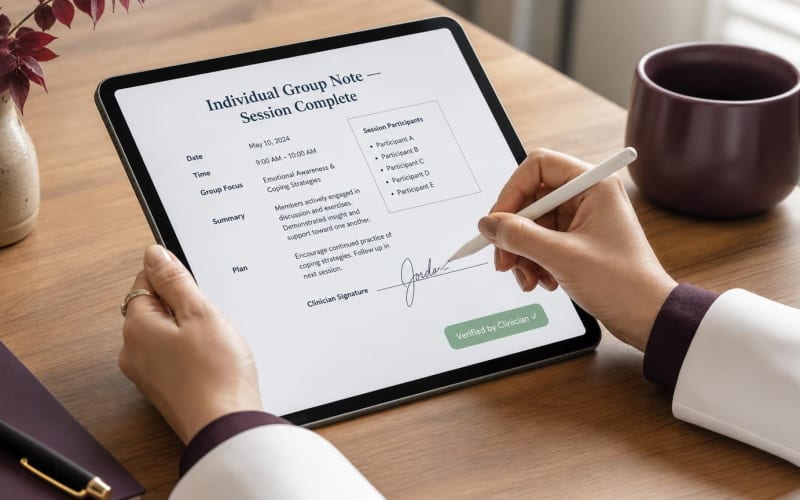
Clinical documentation inside SimplePractice rarely fails because clinicians lack diligence. It fails at the group appointment page. One ninety-minute session with eight clients produces eight separate documentation obligations, each attached to a different chart. SimplePractice supports a shared group note plus individual progress notes for every attendee, and it allows all notes to be signed together once complete. The structure is sound. The bottleneck is translating one conversation into many records by hand.
Merry AI addresses that translation layer directly. It separates each speaker in the group session and drafts an individualized progress note for every attending client. It then writes those drafts into the SimplePractice note fields already open in the clinician's browser. No closed API is involved, no marketplace listing is required, and no data passes through an integration partner before it reaches the chart.
CPT 90853 Individualization Architecture
CPT 90853 is billed per client, so each participant's record must stand on its own. An auditor reviewing one chart should find that client's presentation, participation, clinical response, and progress toward their own treatment plan goals. A blended narrative copied into every chart fails that test. It also discloses other members' protected information across records.
Speaker Diarization and Attendee Mapping
Before any draft is generated, Merry reads the attendee list rendered on the SimplePractice group appointment page and displays it beside the diarized speaker streams. The clinician confirms each mapping once, for example: speaker two is client J.M. and speaker four is client R.T. Scheduled clients marked absent are flagged, and no note is drafted for them. This confirmation step is deliberate. Voice separation is probabilistic, and a misattributed statement in a behavioral health record is a clinical and legal error, not a formatting issue.
Discrete Response and Goal Attribution
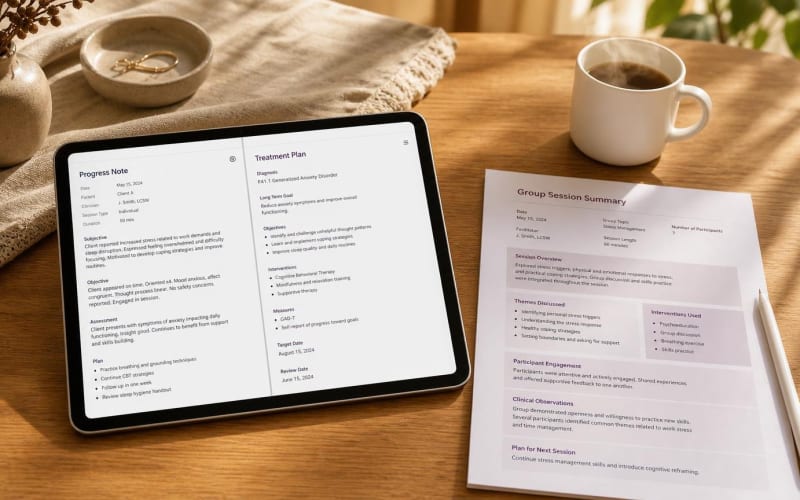
Each per-client draft follows a fixed structure:
- Group topic and modality
- Specific interventions delivered
- The client's observed participation
- Direct statements attributed to that client
- Risk screening status
- Progress toward the goals in that client's treatment plan
Other group members appear only as generic references such as 'a peer.' This preserves the minimum necessary standard inside each chart.
Specialty templates govern the vocabulary. DBT skills groups, SUD relapse-prevention groups, and trauma-focused process groups each carry distinct documentation expectations, including DSM-5-TR diagnostic specificity and modality-specific intervention language. Clinicians can start from the library at https://templates.scribing.io and adapt GIRP, BIRP, SOAP, or DAP structures to their program's record policy.
DOM Injection Into SimplePractice Note Fields
SimplePractice does not expose a general-purpose write API to third-party documentation vendors, and Merry does not claim one. The Chrome extension operates at the presentation layer, the same layer the clinician types into. It detects the active appointment context, locates the visible note editors, and writes text using standard DOM methods. It then dispatches the input and change events the application expects, so the text registers as native entry.
Iframe-Aware Field Targeting
Where note editors render inside embedded frames, the extension's content scripts run across permitted frames on the SimplePractice origin and resolve the editor element inside each frame. Each editor is targeted by its association with a specific client row, not by screen position. If the page structure changes or a selector cannot be resolved with confidence, injection halts and the draft stays in the Merry panel for manual placement. The extension does not guess.
Nothing is signed automatically. Injected text lands as an unsigned draft. SimplePractice's own signing controls remain the only path to a committed record.
The architectural trade-offs are summarized below.
| Architecture | Deployment Overhead | Write Latency | Annual Fee | Group Note Handling |
|---|---|---|---|---|
| Traditional API Marketplace Integration | Vendor partnership, IT review, credential provisioning | Dependent on sync jobs and rate limits | Marketplace and per-seat integration fees | Typically one note per recording |
| Manual Copy-Paste | None | Minutes per chart, multiplied by attendees | $0, paid in clinician hours | Manual rewriting per client; high misattribution risk |
| Merry AI Chrome DOM Injection | Browser extension only; no firewall changes | Client-side write, sub-second per field | No marketplace or API fees | One attributed draft per client, clinician-confirmed |
Compliance, Billing Boundaries, and Clinician Attestation
Psychotherapy notes stay separate by design. HIPAA distinguishes process notes kept apart from the medical record from the progress notes that support treatment and billing. Merry drafts progress notes only. Clinician process reflections are never injected into shared fields or attached to the client chart.
Billing narratives respect code boundaries. CPT 90853 is not an evaluation and management service, so HCPCS G2211 does not attach to it. Some psychiatric prescribers also conduct a separately identifiable office E/M visit (99202–99215) with the same client. In that case, Merry structures the E/M content distinctly and documents the longitudinal relationship that G2211 requires, consistent with CMS guidance. The coding decision remains with the clinician and billing staff.
State disclosure rules apply downstream. California AB 3030 requires a generative AI disclaimer and a path to a human clinician when AI-generated clinical content reaches patients. Practices that share summaries through the SimplePractice client portal can configure disclosure language. Every draft also carries an internal record of AI involvement for compliance review.
Evidence on documentation burden in behavioral health continues to accumulate. The peer-reviewed literature indexed at https://www.ncbi.nlm.nih.gov/pmc/ provides a baseline for evaluating time-to-sign and note quality in your own pilot. Measure before and after, per clinician and per group program.
The clinician remains the author. Every injected note is reviewed, edited where needed, and attested through SimplePractice's signature workflow. Merry shortens the distance between the session and the draft. It does not replace the clinician's judgment.