A Documentation Workflow Built for Kipu EMR
Clinical documentation inside Kipu EMR rarely fails because clinicians lack dedication. It fails because addiction treatment runs on group modalities, including IOP process groups, psychoeducation blocks, and relapse-prevention sessions, while payers and accreditors expect individualized records. A counselor facilitating a ten-person group at 2:00 PM owes ten distinct notes by end of shift, each tied to that client's treatment plan, level of care, and ASAM dimensional status.
The common workaround is cloning. One narrative is drafted, pasted into every attendee's chart, and lightly edited. Identical group narratives weaken medical necessity, obscure individual progress, and break the continuity between assessment, treatment plan, and progress note that CARF and Joint Commission reviewers trace. Merry AI was designed to remove the clone step entirely rather than accelerate it.
Multi-Party Diarization and ASAM Dimensional Mapping
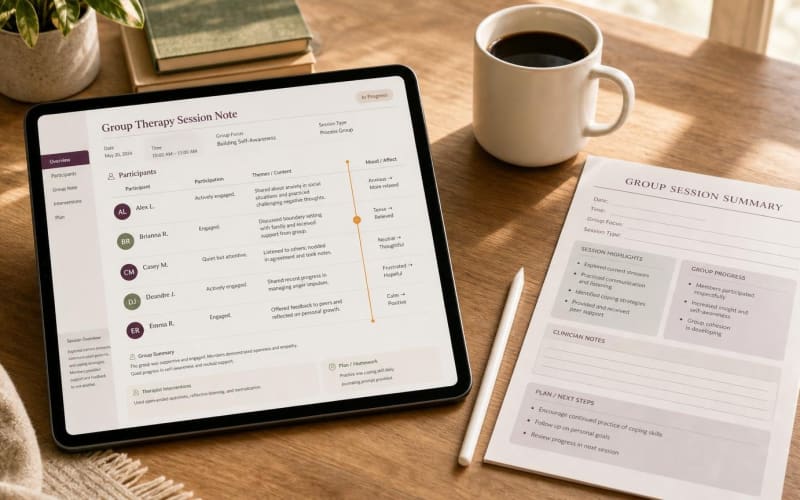
Merry AI records one group session and diarizes it into separate speaker tracks, supporting ten or more participants plus facilitators. Each utterance is attributed to an enrolled client, and the system generates one note packet per client containing session metadata, a participation summary, direct quotes, ASAM dimensional observations, and progress against that client's documented goals.
Suppressing Cloned Group Narrative
Shared group content is constrained to a short factual header: topic, modality, duration, facilitator, and location. Everything below that header is client-specific. If a client spoke twice and disclosed a craving episode, the note says so and quotes them. If a client attended but did not speak, the note documents observed affect and engagement instead of borrowing peers' statements.
Unique participation quotes anchor each record. A line such as "I drove past my old dealer's street and kept going" becomes attributable evidence of coping-skill application for one client only. The model never transfers a quote, disclosure, or risk statement from one speaker track into another client's note, which prevents cross-contamination of PHI between charts.
Six ASAM Dimensions Per Client
Each note maps observations to the six ASAM Criteria dimensions where evidence exists: intoxication and withdrawal potential; biomedical conditions; emotional, behavioral, or cognitive conditions; readiness to change; relapse or continued use potential; and recovery environment. Dimensions without session evidence are marked as not addressed rather than filled with generic language, preserving an honest record for level-of-care review.
Diagnostic language stays consistent with the client's existing problem list. Where session content supports DSM-5-TR substance use disorder criteria, such as craving or continued use despite consequences, the draft cites the statement and leaves diagnosis confirmation to the clinician. Code references can be verified against https://www.cms.gov/medicare/coding-billing/icd-10-codes.
Chrome DOM Injection Into Kipu Chart Fields
Kipu EMR does not expose a public FHIR write API for third-party progress notes, and Merry AI does not claim one. Instead, the Merry AI Chrome Extension operates inside the clinician's authenticated Kipu browser session. It reads the rendered page, locates the configured note-body textarea or rich-text editor, and writes the drafted text directly into those DOM input selectors. No marketplace listing, vendor fee, or server-to-server sync queue sits between draft and chart.
Selector mapping is configured per facility, because Kipu templates are customizable and field structures vary between organizations. During onboarding, group note, progress note, and treatment plan templates are cataloged, and mappings are stored in a configuration layer rather than hardcoded IDs. The Med Log, medication orders, and billing screens are excluded from write scope.
Patient-Context Verification Before Write
Before any text is written, the extension confirms that the open chart matches the intended client using page-level identifiers. For a ten-client group, note packets are queued and injected in parallel across open chart tabs, each gated by its own context check. A mismatch halts that packet and surfaces an alert; it never falls back to the nearest available field.
The architectural trade-offs are summarized below.
| Architecture | Deployment Overhead | Write Latency | Annual Fee | Group Note Handling |
|---|---|---|---|---|
| Traditional API Marketplace Integration | Vendor approval and IT project | Queued sync, minutes to hours | Marketplace and transaction fees | One note per encounter |
| Manual Copy-Paste | None | Minutes per chart | None, high labor cost | Cloned narrative risk |
| Merry AI Chrome DOM Injection | Extension install, no firewall changes | Direct write in active session | No marketplace fees | Per-client diarized packets |
Compliance, Reimbursement, and Attestation
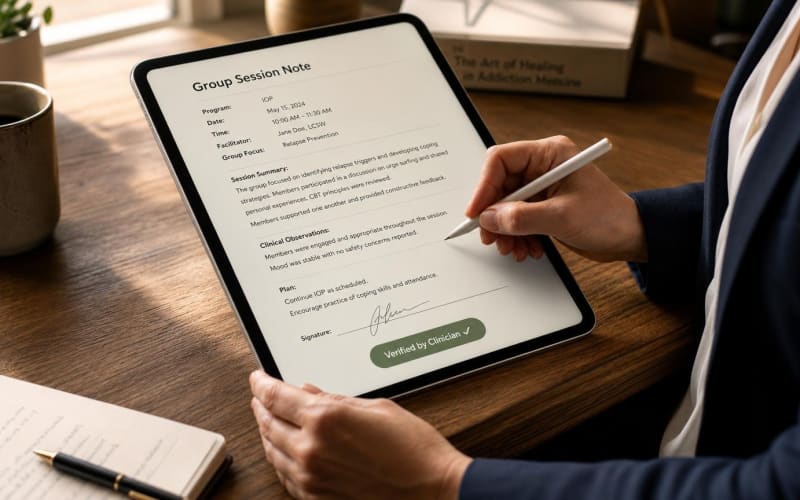
Every injected note remains a draft until the clinician reviews, edits, and signs it in Kipu. The extension does not sign notes or release them to the patient portal. This review gate supports California AB 3030 expectations for clinician-reviewed communications and Texas HB 1709 record standards, and each draft carries an internal AI-assistance indicator visible to auditors.
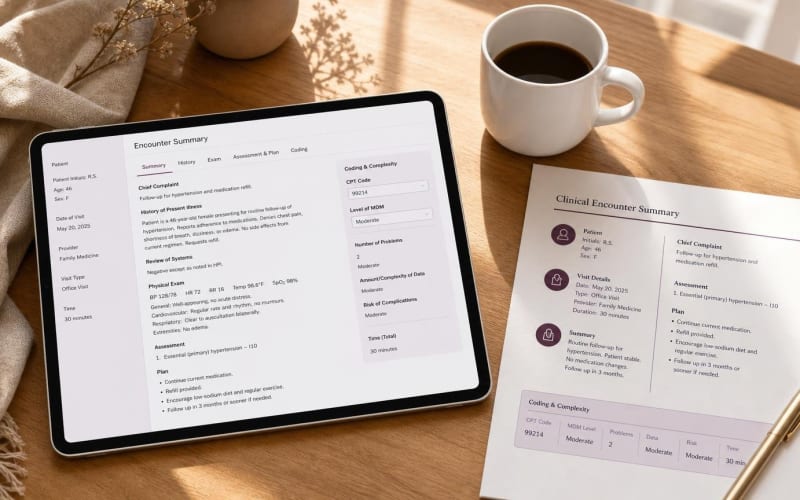
For medical management visits such as buprenorphine follow-ups, drafts surface longitudinal complexity evidence, including dose titration, co-occurring conditions, and coordination with psychosocial services, that supports HCPCS G2211 when billed with an eligible office/outpatient E/M code. Procedure content stays separate from E/M narrative, because G2211 is not payable when the E/M carries modifier 25 alongside a separately payable procedure. Group psychotherapy documentation stays distinct from same-day individualized E/M work.
Teams can start from structured addiction medicine templates at https://templates.scribing.io, including ASAM-aligned group, individual, and MAT follow-up formats that map to common Kipu field layouts. A short workflow audit identifies which templates, selectors, and review gates your facility needs before the first group session is recorded.