Browser-native DOM mapping writes CGM metrics into CharmHealth without a marketplace contract
Clinical documentation inside CharmHealth rarely fails because clinicians lack dedication. It fails because the CGM report lives in one window, the insulin titration lives in the clinician's head, and the Assessment field waits in a third place. Every transfer between those locations costs time and introduces transcription risk.
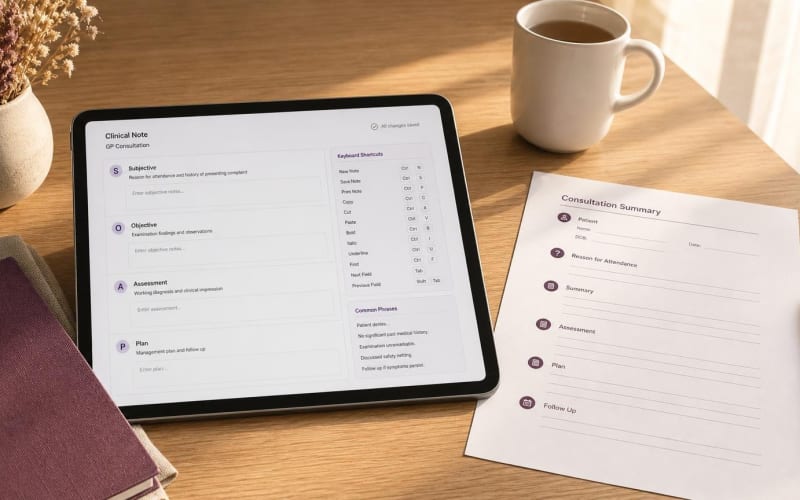
Merry AI's Chrome Extension operates entirely inside the clinician's authenticated browser session. It detects a CharmHealth SOAP Template encounter page, locates the mapped Assessment Notes component in the rendered DOM, writes the drafted text into that field, and dispatches standard input and change events so CharmHealth's front end registers the content exactly as if the clinician had typed it. No CharmHealth server API, FHIR endpoint, or vendor partnership is involved.
CharmHealth's own architecture confirms this pattern is sound. Its native AI Scribe inserts generated text into Notes components within the same encounter page, which shows these fields accept programmatic client-side input. When the clinician clicks Sign, CharmHealth stores the field contents in the encounter record, regardless of whether the text was typed, dictated, or injected.
Every endocrinology visit note carries five quantitative CGM anchors
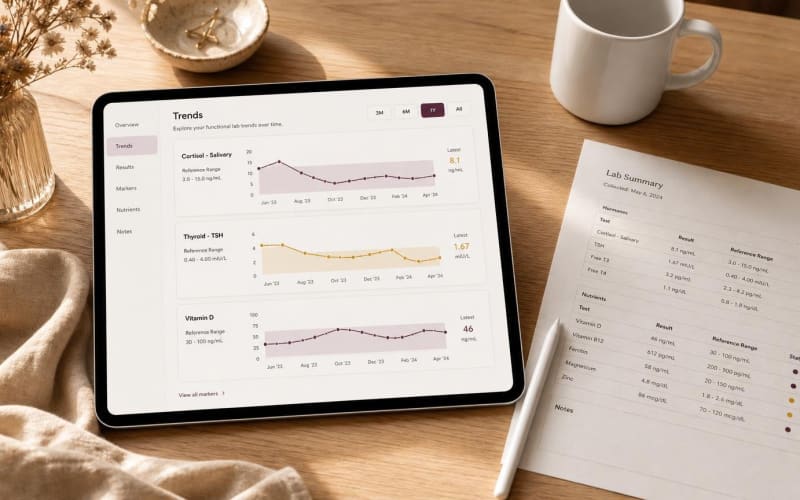
Directive P1 requires that each visit document 14-day CGM Time in Range, Time Below Range, Glucose Management Indicator, and the insulin dose change made at that visit. Merry's endocrinology templates treat these as structured documentation primitives, not optional narrative.
- Time in Range (TIR %): Percentage of readings between 70 and 180 mg/dL, with a target above 70% for most adults under the 2019 International Consensus on Time in Range.
- Time Below Range (TBR %): Percentage of readings below 70 mg/dL, targeted under 4%, with readings below 54 mg/dL targeted under 1%.
- Glucose Management Indicator (GMI): The CGM-derived estimate of A1c, documented alongside lab A1c so that discordance between the two is visible to the reader.
- Insulin dose change per visit: Basal units before and after, insulin-to-carbohydrate ratio, correction factor, or pump setting adjustments, stated with the rationale.
- Sensor wear time percentage: At least 70% wear across the 14-day window is required before TIR and GMI are interpreted as representative.
A typical injected Assessment block reads as follows:
Coefficient of variation is included because a CV above 36% signals unstable glycemia and raises hypoglycemia risk even when TBR appears acceptable. The clinician edits any value that does not match the source report before signing.
Pinning the extension and mapping the Assessment field takes under two minutes
Directive P7 defines the setup sequence. It is performed once per clinician and once per template layout.
- Pin the Merry extension from the Chrome toolbar puzzle icon so the injector stays one click away during the visit.
- Open the CharmHealth encounter from Home > Chart Notes for scheduled visits, or from the patient dashboard using the + (Add) icon, then select the SOAP Template chart note.
- Map the Assessment field by clicking the Merry icon, choosing Map Field, and clicking the Assessment Notes component. Merry stores the mapping against that template.
- Run the visit and review the drafted CGM summary, interpretation, and insulin change inside the Merry panel.
- Inject, edit, then sign in CharmHealth. The signature step remains entirely under clinician control.
Field mappings persist across encounters that use the same SOAP template. If a practice administrator changes the template layout under Settings > Encounter > Preferences, the clinician re-maps the affected field once.
Direct DOM injection removes both API fees and copy-paste transcription error
The three integration models differ in cost, time to deployment, and error exposure. The comparison below reflects how each performs in a CharmHealth endocrinology practice.
| Dimension | Traditional API Marketplace Integration | Manual Copy-Paste | Merry AI Chrome DOM Injection |
|---|---|---|---|
| CharmHealth contract required | Yes, vendor approval and fees | No | No |
| IT involvement | Integration project, credentials, testing | None | None, per-user install |
| Time to first note | Weeks to months | Immediate | Same day |
| Field-level placement | Depends on API scope | Clinician places manually | Mapped directly to Assessment |
| CGM metric structure | Generic text export | Retyped or pasted by hand | Templated TIR, TBR, GMI, dose change |
| Transcription error risk | Low | High | Low, with clinician review |
| PHI routed through extra servers | Integration middleware | None | No audio or transcript retained |
Copy-paste workflows introduce silent errors that auditors notice later: a TBR transposed from a prior visit, a GMI pasted into the wrong patient's note, or a dose change left out entirely. Field-mapped injection removes the clipboard from the workflow.
Structured CGM evidence supports HCPCS G2211 without automating the code
HCPCS G2211 captures longitudinal complexity for office and outpatient E/M visits that serve as the continuing focal point for care or form part of ongoing care for a single serious or complex condition. CGM-managed diabetes, with repeated device review and insulin titration over months or years, fits the CMS description directly.
CMS improper payment data shows why documentation quality matters. For the 2024 reporting period, the improper payment rate for E/M codes was 10.3%, about $3.9 billion. Incorrect coding drove 49.1% of those errors, and insufficient documentation drove 34.1%.
Merry structures the evidence, not the code. Trended TIR, such as an improvement from 52% to 68% over three months, paired with documented insulin titration, shows the ongoing relationship in the record itself. Merry never inserts G2211, modifier 25, or modifier 59, and never adds billing justification language. Code selection remains with the clinician and the coding team, who can verify complexity from the clinical facts on the page.
Clinician attestation keeps AI-assisted endocrine notes within state AI governance
Texas HB 1709 and California SB 1120 both emphasize human clinical judgment where AI output can influence access to or cost of care. Merry is positioned as a documentation assistant: it drafts, the clinician decides.
Every injected draft remains editable until signature, and organizations can audit insertion events or restrict auto-insertion for specific templates. No audio or transcript is stored under the executed BAA.
The result is a chart that records what the CGM showed, what the clinician concluded, and what dose changed, written into the correct CharmHealth field and signed by the person accountable for it.