Specialty Documentation Architecture
Wound care documentation lives or dies on numbers. A Medicare reviewer reading a CPT 11042 claim wants specific facts. These include length, width, and depth in centimeters, the tissue removed, and the deepest level reached. The reviewer also wants evidence that the wound is responding to a plan. Narrative impressions such as 'large ulcer, improving' do not survive an additional documentation request, and they rarely survive a chart audit.
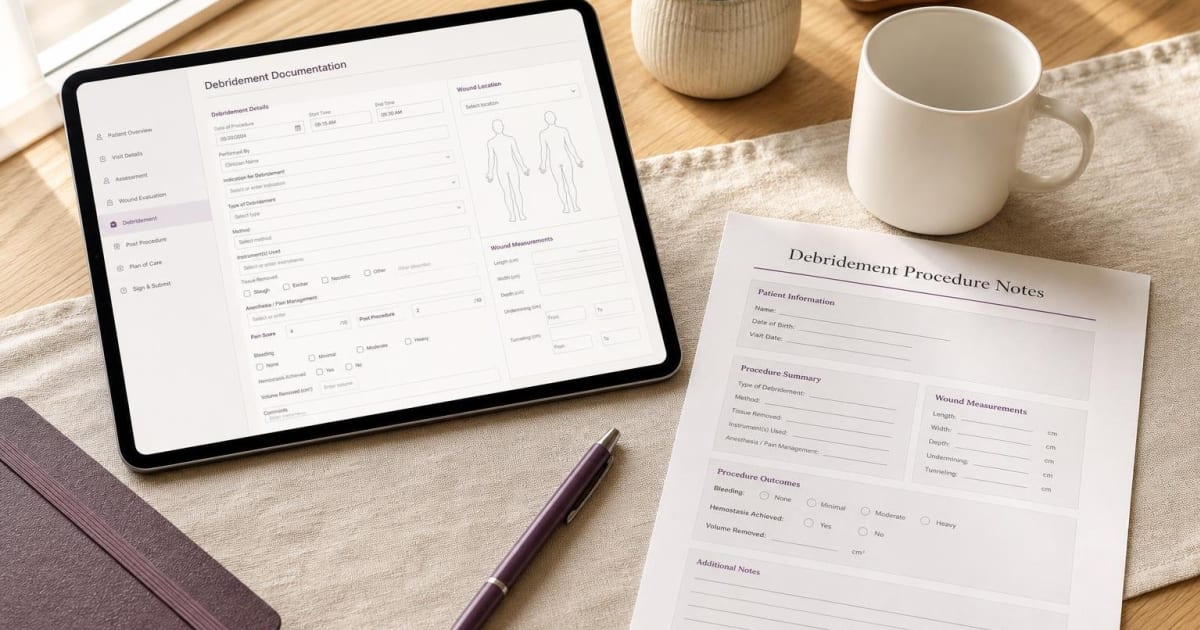
Merry listens to the encounter the way a seasoned wound nurse charts it. A clinician might say 'right plantar first metatarsal head, four point two by three point one by zero point six, sixty percent slough, forty percent granulation.' The system turns that speech into discrete fields rather than prose. Each numbered wound gets its own structured values:
- Laterality and anatomical site
- Wagner grade or NPIAP stage
- Undermining and tunneling by clock position
- Exudate amount
- Periwound condition
Context outside the wound bed matters as much as the bed itself. This includes ankle-brachial index results, toe pressures, HbA1c trends, offloading history, and compression adherence. Each statement is attributed by speaker. For example, the patient's account of wearing the walking boot 'most days' stays separate from the caregiver's report and the clinician's exam findings.
Measurement Capture for CPT 11042
CPT 11042 describes debridement of subcutaneous tissue, including epidermis and dermis if performed, for the first 20 sq cm or less. Each additional 20 sq cm, or part thereof, is reported with add-on 11045. Code selection depends on two things: the depth of tissue actually removed, and the total debrided surface area. That area is summed across all wounds debrided at the same depth.
Merry calculates surface area from the dictated length and width. It flags when the cumulative area crosses a 20 sq cm threshold. Pre- and post-debridement measurements are recorded side by side.
Merry also captures prior failed therapies, such as eight weeks of collagen dressings, total contact casting, or a prior course of enzymatic debridement. Local coverage determinations expect evidence that the plan was modified when healing stalled.
Clinical Logic Matrix
The matrix below maps each wound care indicator to the data points Merry extracts and the billing evidence those data points support.
| Specialty Diagnostic Metric | Required Clinical Data Points | Billing Evidence |
|---|
| Wound dimensions | Length x width x depth in cm, pre- and post-debridement | Surface area for 11042 and 11045 unit count |
| Depth of tissue removed | Deepest level reached: dermis, subcutaneous, muscle, bone | Distinguishes 97597 from 11042, 11043, 11044 |
| Tissue composition | % granulation, % slough, % eschar, exposed fat or fascia | Medical necessity for removal of devitalized tissue |
| Method and instruments | Curette, scalpel, forceps, hydrosurgical; hemostasis; anesthesia | Procedure note completeness per LCD L34587 |
| Perfusion status | ABI, TBI, PAD history, revascularization status | Healing expectation and risk stratification |
| Infection status | Erythema, purulence, probe-to-bone, culture results | Supports frequency and plan modification |
| Prior failed therapies | Dressings, offloading, compression, duration of each | Evidence of plan change when wound stalls |
| Serial progression | Percent area reduction since baseline and last visit | Ongoing response required for continued debridement |
Every row in this matrix corresponds to a field in the injected wound block. The coding team never has to infer depth from adjectives or compute area by hand. Always verify code descriptors against the current AMA set at https://www.ama-assn.org/practice-management/cpt.
Billing Boundaries: Modifier 25, 59, and G2211
Same-day evaluation and debridement is common in wound clinics, and it is where audits concentrate. CPT 11042 carries a zero-day global period. A separately reported E/M on the same date therefore needs modifier 25. It must also reflect work beyond the routine pre-procedure assessment.
Separating E/M From the Procedure
Merry keeps the two notes structurally distinct. The E/M assessment and plan holds work such as:
- Glycemic management
- Diuretic adjustment for venous edema
- A new vascular referral
- Evaluation of a second, unrelated problem
The procedure note holds the measurements, tissue removed, instruments, and post-procedure wound status.
Separate wounds on different sites may be debrided at different depths. In that case, per-wound identifiers support appropriate use of modifier 59 or the more specific XS modifier.
Where G2211 Legitimately Fits
Under current CMS policy, G2211 is not payable when the office E/M carries modifier 25 for a same-day procedure such as 11042. The 2025 exception is limited to annual wellness visits, vaccine administration, and Medicare Part B preventive services.
G2211 belongs on interval E/M visits without a procedure. On those visits, the clinician remains the continuing focal point for a serious or complex condition. One example is a diabetic foot ulcer managed alongside neuropathy and PAD. Merry surfaces longitudinal wound trajectories so this narrative is documented when it applies and left out when it does not.
DOM Injection Into the Procedure Note
The structured wound block arrives where the procedure belongs. Merry's Chrome Extension finds the procedure note textarea or rich-text editor inside the active EHR tab. This includes editors nested in iframes or shadow DOM. The block is inserted after a known anchor such as 'Procedure Performed:' or in place of a template placeholder. Where the EHR exposes discrete wound fields, length, width, and depth go into their own inputs.
Nothing is written after the signature. Every insertion is visible, editable, and logged before the clinician attests. The E/M narrative is never merged into the procedure section.
Specialty prompt packs cover diabetic foot ulcers, venous leg ulcers, and pressure injuries. They are available at https://templates.scribing.io.
A quiet afternoon clinic depends on charts that close before the last patient leaves. When measurements, tissue, method, and plan arrive in the right fields, the note reads the way an auditor expects. A colleague can also follow it at the next visit.