CLINICAL MEMORY
Longitudinal Diagnostic Memory
Recall prior eGFR, UACR, and blood pressure trends for returning patients. Find urgent care prompt packs at Access Specialty Prompts at templates.scribing.io to generate notes in 5 seconds.
Specialty Clinical Playbook
Suppress G2211 on episodic and modifier 25 visits. Document CKD complexity honestly. Book your audit at https://cal.com/merryai/demo.
 Dr. Sarah Chen, MD
Specialty Architecture
Built to match the pacing, diagnostic frameworks, and documentation requirements of Urgent Care, from Ottawa ankle rules to KDIGO staging.
CLINICAL MEMORY
Recall prior eGFR, UACR, and blood pressure trends for returning patients. Find urgent care prompt packs at Access Specialty Prompts at templates.scribing.io to generate notes in 5 seconds.
CONTEXT RETRIEVAL
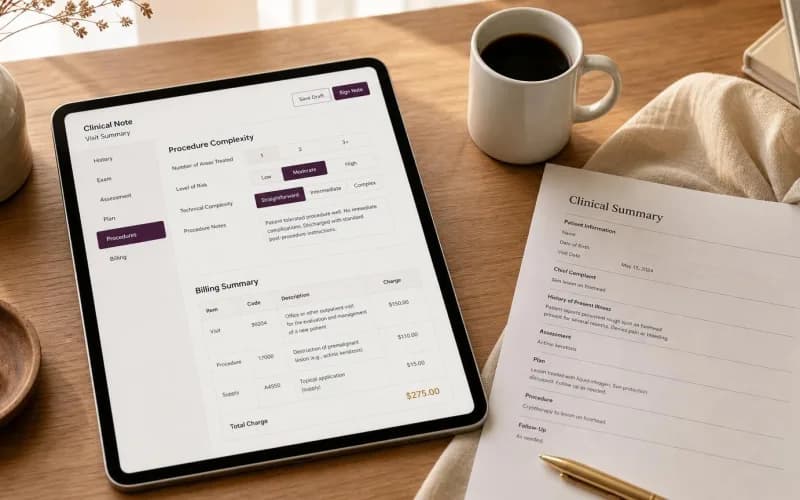
Retrieve prior wound measurements, CKD stage, and lab trends without moving between tabs mid-encounter.
COMPLEXITY CAPTURE
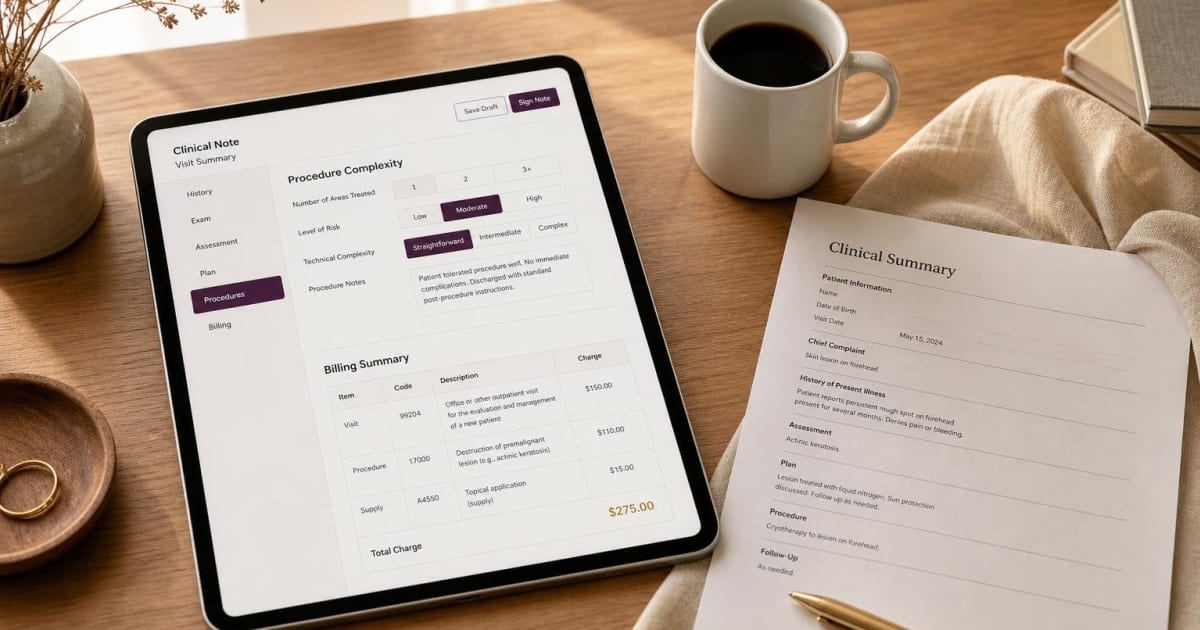
G2211 is never suggested for episodic acute visits or modifier 25 encounters. It is surfaced only where a continuing relationship is documented. Schedule a 15-Minute Specialty Workflow Audit today.
SPEAKER ROUTING
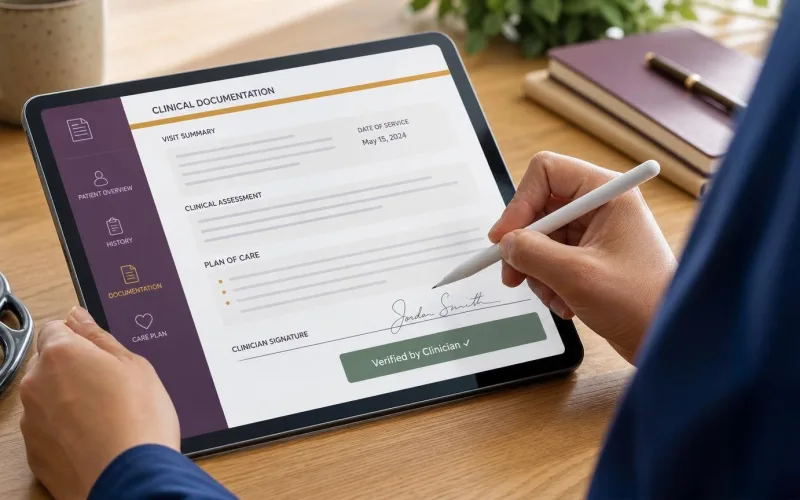
Diarize patient, caregiver, and interpreter dialogue and map findings into HPI, procedure, and discharge sections.
Point-of-Care Flow
No IT friction, no complex API setup, and human-verified attestation on every note.
Most urgent care encounters are episodic by design. A patient arrives with a forearm laceration, a positive Ottawa ankle exam, or a sore throat scoring three on McIsaac. The clinician delivers definitive care and discharges the patient with return precautions. HCPCS G2211 was written for something different: the visit complexity inherent to serving as the continuing focal point for a patient's care, or to ongoing management of a single serious or complex condition. When add-on logic is borrowed from primary care templates, the code drifts onto encounters it was never meant to describe, and denials follow.
The second denial pattern is mechanical. CMS directs contractors to deny G2211 when the same-day office/outpatient E/M visit carries modifier 25. Modifier 25 is common in urgent care because a significant, separately identifiable E/M service often accompanies a laceration repair, an incision and drainage, or a splint application. If the add-on is appended by habit, every one of those claims is a denial waiting to happen.
Merry AI treats every encounter as episodic until the documentation shows otherwise. The note engine will not suggest G2211 for an acute, self-limited presentation. It will not suggest G2211 on any encounter where modifier 25 is attached to the E/M service. This is a hard suppression rule, not a probability score. The clinician still documents thoughtful medical decision making, such as prescription drug management or a HEART score that drives disposition, and the E/M level reflects that work on its own merits.
Some urgent care sites have quietly become primary care for part of their panel. Consider a patient with stage 3b chronic kidney disease and hypertension who has no established nephrologist or PCP. That patient may return to the same clinician every few weeks for blood pressure titration, potassium checks, and medication reconciliation. In that narrow situation, with no modifier 25 on the claim, the longitudinal relationship can be real, and the documentation should show it plainly.
Kidney disease also shapes acute visits without making them longitudinal. An eGFR of 38 changes antibiotic dosing for a urinary tract infection and removes NSAIDs from an ankle sprain plan. Merry AI records that reasoning in medical decision making, where it supports the E/M level, and keeps G2211 off the episodic claim.
The engine looks for concrete evidence. That includes a documented prior relationship with the same practitioner, a chronic condition coded to specificity such as N18.32, trended eGFR and UACR values, a plan that anticipates the next visit, and coordination with labs or specialists. Diagnosis specificity should be confirmed against the current code set at https://www.cms.gov/medicare/coding-billing/icd-10-codes.
The matrix below summarizes how each indicator moves from bedside to claim.
| Specialty Diagnostic Metric | Required Clinical Data Points | Billing Evidence |
|---|---|---|
| Encounter type (episodic vs longitudinal) | Chief complaint, prior visits with same clinician, follow-up plan | G2211 suppressed for episodic acute visits |
| Modifier 25 status | Procedure note distinct from E/M history, exam, and MDM | G2211 never suggested; E/M stands on MDM |
| CKD stage (KDIGO G and A categories) | eGFR trend, UACR, stage-specific ICD-10 (N18.31, N18.32, N18.4) | Longitudinal complexity only when the relationship is documented |
| Wound repair | Length in cm, anatomic site, layers, etiology, contamination | Repair CPT by summed length, site, and complexity |
| Disposition risk | HEART, PERC, CURB-65, or Centor/McIsaac as applicable | MDM risk element supporting the E/M level |
Our Chrome Extension reads the Experity chart within the clinician's own browser session. It does not depend on brittle class names. Instead, it maps the procedure section and the discharge note through stable attributes, such as field labels, aria-labels, and name attributes. These are tied to wound length, repair type, procedure narrative, and discharge instructions. When Experity updates its interface, the mapping is revalidated before any field is written.
Procedure fields receive only values spoken or entered during the encounter. These include measured laceration length, anatomic site, repair complexity, anesthesia, and closure material. Discharge notes receive return precautions, renal dosing explanations, and follow-up timing, written in plain language for the patient.
Nothing is written into the chart silently. Each drafted value is shown to the clinician, labeled as system-drafted, and placed only after review. If a wound was not measured, the field stays empty, and the draft asks for the measurement rather than inventing one. Every coding suggestion, and every suppression of G2211, carries a visible rationale the clinician can read before signing. This posture matches growing expectations, including in states such as California and Texas, that the treating clinician review and attest automated documentation.
Start with a short retrospective review. Pull ninety days of claims and filter for G2211. Then separate the claims billed alongside modifier 25 or on clearly episodic visits. That list usually explains most of a clinic's denials, and it shows where template defaults have been doing the coding.
Next, load the urgent care prompt packs from https://templates.scribing.io. The packs include laceration repair, splinting, and chronic kidney disease follow-up templates organized around the matrix above. Each template keeps the procedure note distinct from E/M content, so modifier 25 claims stay defensible.
Finally, keep the attestation step unhurried. A clinician who spends thirty seconds reading a well-organized draft protects the claim, the patient, and the clinic's audit history. The goal is not more add-on codes. It is the right code, supported by the record, every time.
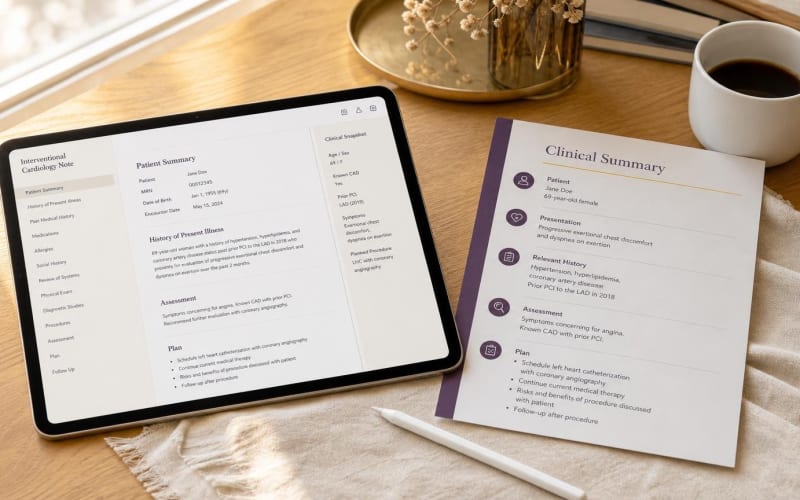
Discrete LVEF, stent date, and DAPT capture, with G2211 gated on modifier 25. Book your audit at https://cal.com/merryai/demo.
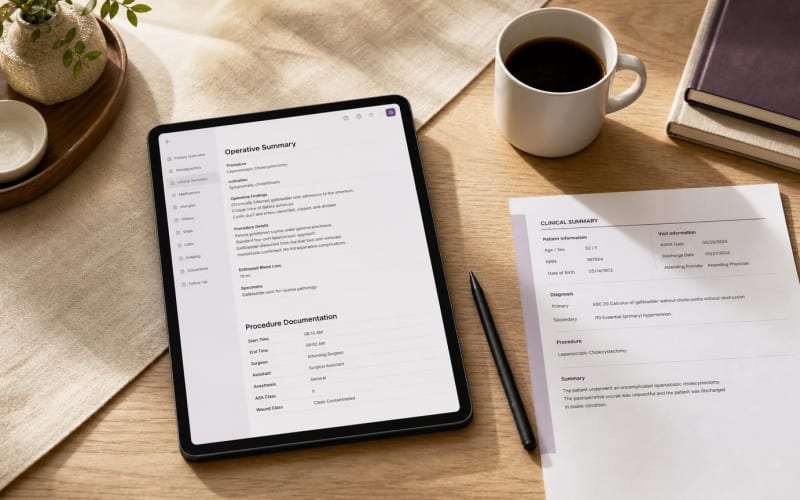
Separate Mohs stage maps from distinct E/M problems so modifier 25 holds under review. Book your audit at https://cal.com/merryai/demo.

Discrete LVEF, stent date, and DAPT capture, with G2211 gated on modifier 25. Book your audit at https://cal.com/merryai/demo.