
CLINICAL MEMORY
Longitudinal Diagnostic Memory
Carries prior ODI scores, operative levels, and conservative care dates into each visit. Find prompt packs at Access Specialty Prompts at templates.scribing.io to generate notes in 5 seconds.
Specialty Clinical Playbook
Document ODI, imaging level, and dated failed PT before modifier 25 reaches the claim. Book your audit at https://cal.com/merryai/demo.
 Dr. Sarah Chen, MD
Specialty Architecture
Built to follow the pacing, diagnostic frameworks, and same-day procedure documentation requirements of Spine Surgery.
CLINICAL MEMORY
Carries prior ODI scores, operative levels, and conservative care dates into each visit. Find prompt packs at Access Specialty Prompts at templates.scribing.io to generate notes in 5 seconds.

CONTEXT RETRIEVAL
Retrieve ODI trajectories, MRI level findings, and dated PT and NSAID trials without switching tabs.
COMPLEXITY CAPTURE
Keeps G2211 longitudinal visits separate from modifier 25 injection days so each claim holds its own evidence. Schedule a 15-Minute Specialty Workflow Audit today.
SPEAKER ROUTING
Separates patient, caregiver, and staff voices so the ODI score reflects the patient's own answers and each finding lands in the correct exam section.
Point-of-Care Flow
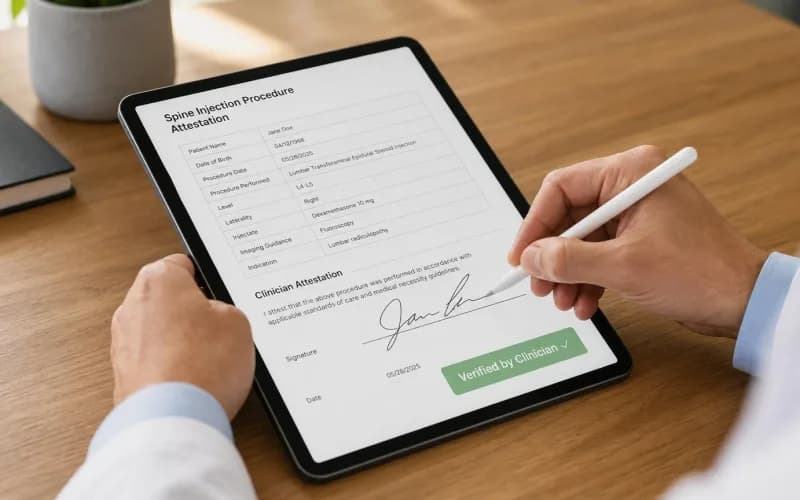
No IT friction, no complex API setup, and clinician-verified attestation on every note.
Most denied same-day injection claims do not fail because the injection was unnecessary. They fail because the evaluation and management service could not be separated from the procedure in the record. CPT 20610 covers arthrocentesis or injection of a major joint or bursa without ultrasound guidance. It carries a zero-day global period, and the decision to inject is already included in its value. When a spine surgeon also bills 99214 with modifier 25, the payer expects the note to show work beyond the routine pre-procedure assessment.
A spine clinic visit rarely looks simple. A patient with L4-L5 stenosis may arrive with axial back pain, a new left L5 radicular pattern, and greater trochanteric tenderness that mimics or adds to the spinal complaint. The surgeon evaluates the radiculopathy, reviews the MRI, adjusts the conservative plan, and then injects the trochanteric bursa. Two distinct clinical problems were addressed, and the note has to show that clearly enough for an auditor to follow.
The cost of thin documentation grows over time. A chart that reads 'back pain, injection given' invites recoupment of the E/M line, and repeated patterns draw targeted review.
Payers reviewing spine encounters look for three anchors before they accept a separately identifiable E/M. Merry AI is configured so that none of them depends on memory at the end of a long clinic day.
The ODI score must appear as a dated, scored instrument rather than a narrative impression. 'ODI 52 percent, severe disability, recorded today' carries weight. 'Patient quite limited' does not. Merry AI listens for the scored responses during intake review, calculates the percentage, and places it in the functional status portion of the exam. The prior score appears alongside it so the trajectory is visible.
Imaging must be tied to a specific exam finding and side. A note that says 'see MRI' leaves the reviewer to do the clinical reasoning. Merry AI drafts statements such as 'L4-L5 left paracentral protrusion contacting the traversing L5 root, concordant with left EHL weakness 4/5 and positive straight leg raise at 40 degrees.' That single sentence links level, structure, and examination.
Failed physical therapy needs dates. Payers expect start and stop dates, visit counts, and the reason the trial ended. NSAIDs need the same detail: agent, dose, duration, and whether the response was inadequate or the drug was not tolerated. Merry AI extracts these details from the conversation and prior notes. It presents them as discrete dated entries for the surgeon to confirm.
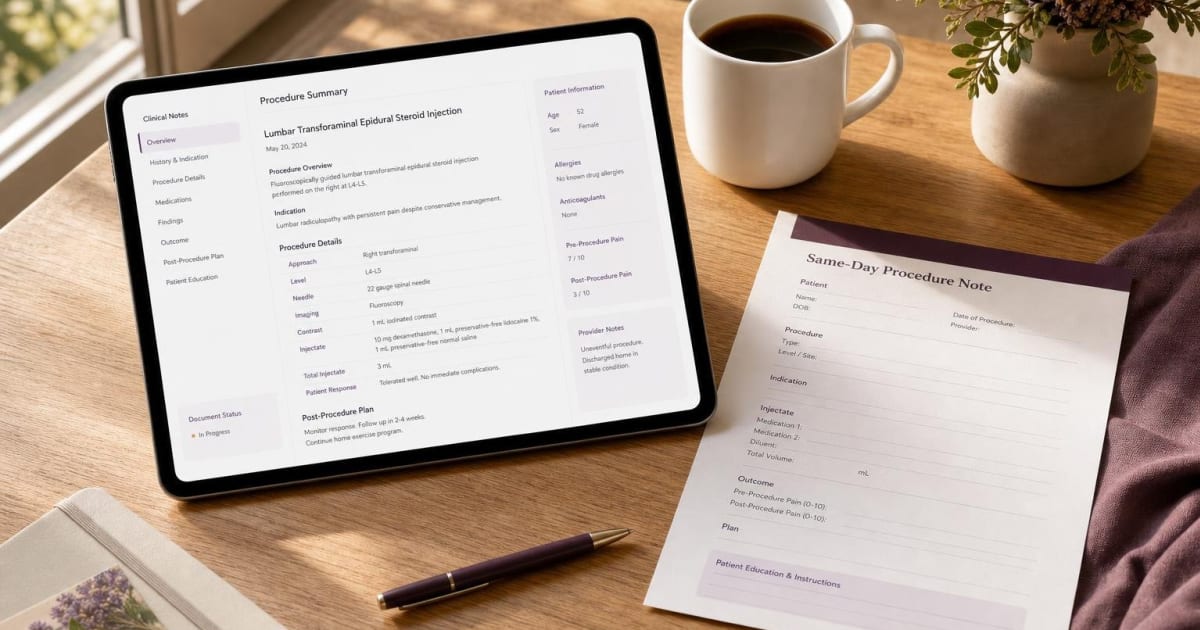
athenaOne separates exam narrative from structured procedure documentation. The Exam stage holds HPI, physical examination, and assessment text. The Procedure Documentation section opens its own template flow for the injection. That separation is clinically useful: the exam establishes why the injection was needed, and the procedure template records what was done.
The Merry AI Chrome Extension binds its overlay only to the athenaOne encounter exam and assessment DOM regions. ODI scores, imaging correlation, and conservative care chronology are written to those fields. The 20610 procedure template, including approach, medication, and laterality, stays under clinician control and is never overwritten by injected narrative. No API contract or interface fee is required.
Mapping by encounter stage also protects against interface changes. When athenaOne adjusts a field, the mapping layer is updated centrally so that assessment text does not end up in history. Every insertion is logged with its time and section, and every clinician edit is preserved. Compliance teams get a complete audit trail.
The clinical logic matrix below summarizes what each metric requires and how it supports the claim.
| Spine Diagnostic Metric | Required Clinical Data Points | Billing Evidence |
|---|---|---|
| Oswestry Disability Index | Scored percentage, collection date, prior score | Severity and medical necessity supporting E/M level |
| MRI Level Correlation | Spinal level, side, structure, concordant exam sign | Separately identifiable spinal evaluation for modifier 25 |
| Failed Physical Therapy | Start and end dates, visit count, outcome | Conservative care exhaustion for prior authorization |
| Failed NSAID Trial | Agent, dose, duration, response or intolerance | Medical decision making on drug management |
| Injection Site Exam | Distinct site, laterality, separate diagnosis | Supports 20610 as its own procedure line |
Modifier 25 belongs on the E/M line. Modifier 59 never does. Under NCCI policy, modifier 59 is reserved for distinct non-E/M procedures. Merry AI does not suggest modifier 59 for an E/M service. It flags notes where the evaluation content looks indistinguishable from the pre-injection assessment. Current descriptors are available at https://www.ama-assn.org/practice-management/cpt.
G2211 deserves careful restraint. Medicare generally does not pay G2211 when the base office E/M carries modifier 25. The narrow exceptions are annual wellness visits, vaccine administration, and certain Part B preventive services. Merry AI therefore reserves longitudinal complexity language for procedure-free follow-up visits where ongoing spine management actually occurs. Some commercial plans do not pay G2211 separately at all.
State AI rules add obligations. California AB 3030 requires an AI disclaimer and instructions for reaching a human clinician on patient-facing clinical communications produced with generative AI. Merry AI tags AI-drafted segments so after-visit summaries can carry that notice. Texas governance proposals point the same way, toward provenance logs and clear accountability.
Specialty prompt packs for spine evaluations, ODI capture, and injection-day notes are available at https://templates.scribing.io. The surgeon still reviews and signs every note, and that review remains the final safeguard.
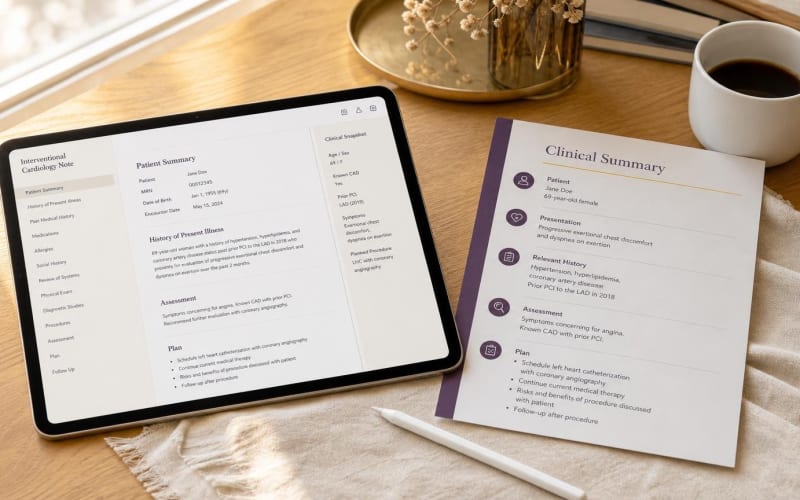
Discrete LVEF, stent date, and DAPT capture, with G2211 gated on modifier 25. Book your audit at https://cal.com/merryai/demo.
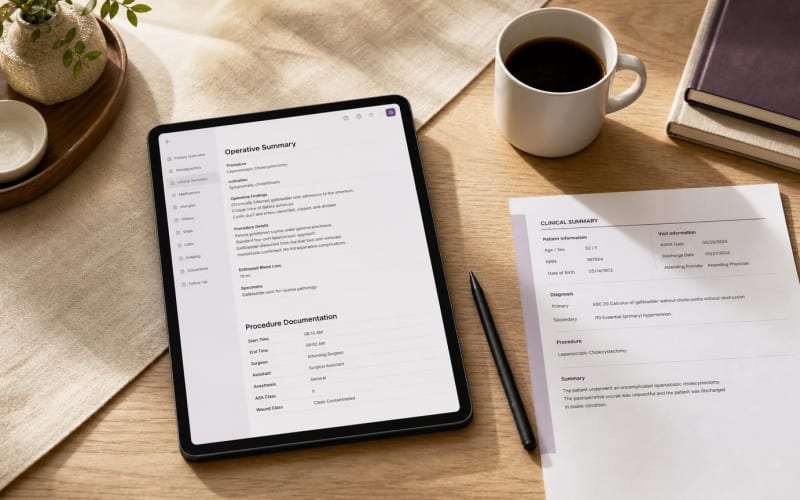
Separate Mohs stage maps from distinct E/M problems so modifier 25 holds under review. Book your audit at https://cal.com/merryai/demo.

Discrete LVEF, stent date, and DAPT capture, with G2211 gated on modifier 25. Book your audit at https://cal.com/merryai/demo.