
CLINICAL MEMORY
Longitudinal Diagnostic Memory
Holds A1c series, pump changes, and growth velocity across visits. Find prompt packs at Access Specialty Prompts at templates.scribing.io to generate notes in 5 seconds.
Specialty Clinical Playbook
Trend A1c and growth percentiles, then attest longitudinal G2211 complexity in the plan. Book your audit at https://cal.com/merryai/demo.
 Dr. Sarah Chen, MD
Specialty Architecture
Engineered to mirror the pacing, diagnostic frameworks, and documentation requirements of Pediatric Endocrinology.
CLINICAL MEMORY
Holds A1c series, pump changes, and growth velocity across visits. Find prompt packs at Access Specialty Prompts at templates.scribing.io to generate notes in 5 seconds.

CONTEXT RETRIEVAL
Retrieve A1c trends, basal and ratio settings, and growth percentile trajectories without tab bouncing.
COMPLEXITY CAPTURE
Capture longitudinal complexity add-on revenue. Schedule a 15-Minute Specialty Workflow Audit today.

SPEAKER ROUTING
Diarize clinician, caregiver, and adolescent dialogue and map clinical findings directly into specialty-approved note sections.
Point-of-Care Flow
Zero IT friction, zero complex API setup, and human-verified attestation on every note.
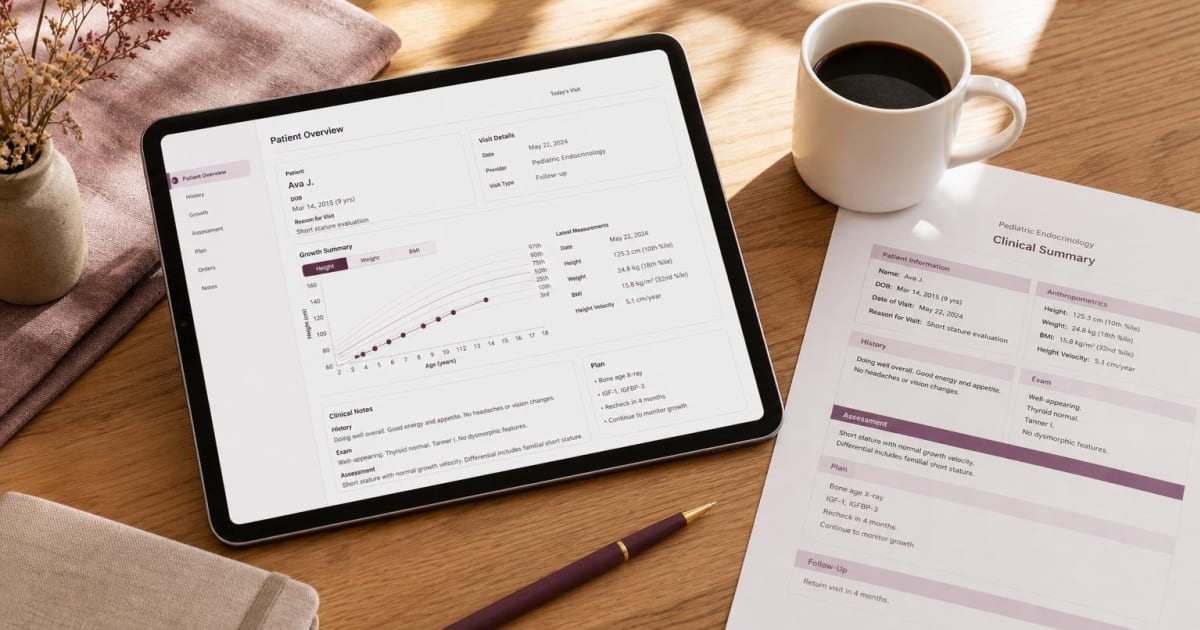
Pediatric endocrinology is a discipline of slopes rather than snapshots. A single A1c of 8.1% tells you little. The same value after 9.2% and 8.6% tells you the pump titration is working. A height at the 10th percentile is unremarkable until you see it was the 40th two years ago. Our documentation has always needed to carry that trajectory, and this trajectory supports the visit complexity add-on HCPCS G2211.
Merry AI listens to the encounter and separates the clinician, the caregiver, and the adolescent into distinct speaker tracks. It then reconciles what was said with what already sits in the chart. The result reads like a plan you would write yourself, given time.
For children with type 1 diabetes, the working A1c target is generally at or below 7.5%, individualized to limit severe or recurrent hypoglycemia. Merry AI summarizes the A1c series across visits, for example 8.9% to 7.7% to 7.3%. It pairs that series with CGM time in range and notes any DKA or severe hypoglycemia since the last visit.
Each glycemic change is linked to the decision that preceded it. That might be an overnight basal increase for nocturnal hyperglycemia, a tighter breakfast carbohydrate ratio, or a revised insulin sensitivity factor before soccer season. Pump model, CGM integration status, and temporary basal use are normalized into structured text, so the reviewer sees cause and effect.
Growth data are not background in this specialty. The engine reads recent height, weight, and BMI percentiles and calculates growth velocity over six- to twelve-month intervals. It places the child against mid-parental target height and Tanner staging. Percentile crossing is flagged for your review rather than buried, such as weight climbing from the 75th to the 95th percentile while height holds at the 50th.
The same framework extends beyond diabetes. In growth hormone deficiency, constitutional delay, central precocious puberty, congenital hypothyroidism, and congenital adrenal hyperplasia, the longitudinal story is defined by trends in IGF-1, bone age, LH and FSH response, TSH and free T4, and 17-hydroxyprogesterone.
G2211 describes visit complexity inherent to serving as the continuing focal point for a patient's care, or to ongoing care of a single serious or complex condition. It is reported in addition to office and outpatient E/M codes 99202 to 99205 and 99211 to 99215, or home and residence codes in the 99341 to 99350 family. Base code definitions are available through the AMA at https://www.ama-assn.org/practice-management/cpt.
Merry AI drafts a dedicated longitudinal management paragraph that names the chronic condition, states the complexity drivers, and cites the timeline. A typical draft reads: continued longitudinal management of type 1 diabetes on insulin pump therapy, with A1c improving from 8.9% to 7.3% over three visits, ongoing basal and ratio titration, stable height percentile, and coordination with school nursing and caregivers.
| Specialty Diagnostic Metric | Required Clinical Data Points | Billing Evidence |
|---|---|---|
| A1c trajectory | Serial dated A1c values, CGM time in range, hypoglycemia and DKA events | Ongoing management of a serious chronic condition supporting G2211 |
| Insulin pump titration | Basal rates by time block, carbohydrate ratios, ISF, active insulin time | Prescription drug management within MDM |
| Growth percentiles and velocity | Height, weight, BMI percentiles, velocity, mid-parental height, Tanner stage | Longitudinal surveillance tied to treatment effect |
| Same-day preventive service | Vaccine or preventive work in a separate plan subsection | Modifier 25 with G2211 permitted under 2025 to 2026 CMS policy |
When a preventive service shares the date, such as vaccine administration, the note must keep that work distinct. Since 2025, CMS has permitted G2211 alongside a modifier 25 E/M only when the separate service is a Part B preventive service. From 2026, the same flexibility applies to home and residence visits. Merry AI places preventive work in its own plan subsection and flags combinations that are likely to be denied.
Where modifier 59 is considered, the draft records site, timing, and indication, so distinct services are not read as one continuous episode. Coding decisions remain yours. The engine makes the evidence legible.
Our Chrome Extension attaches a quiet overlay to the pediatric assessment and plan textarea in your browser-based EHR. It confirms the active encounter, checks that the plan tab is visible and focused, and writes only into that designated field. Flowsheets and growth grids are read but never edited, so numeric entries stay untouched.
There is no API project, no interface engine, and no IT ticket. If an EHR update changes the page structure, the extension offers a copy-ready panel rather than guessing. Clinicians building a new workflow can start from the pediatric endocrinology prompt packs at https://templates.scribing.io.
Pediatric audio deserves particular care. Audio is processed in memory and shredded once the note is drafted. No recordings are written to disk or used for model training. A Business Associate Agreement is executed before first use, and audio capture can be configured to follow state consent rules and facility policy for minors.
Every note ends with clinician review. You confirm the trend summary, the pump changes, the growth interpretation, and the G2211 attestation before anything is signed. The engine prepares the record, and the endocrinologist remains its author. That is how a defensible chart should read.
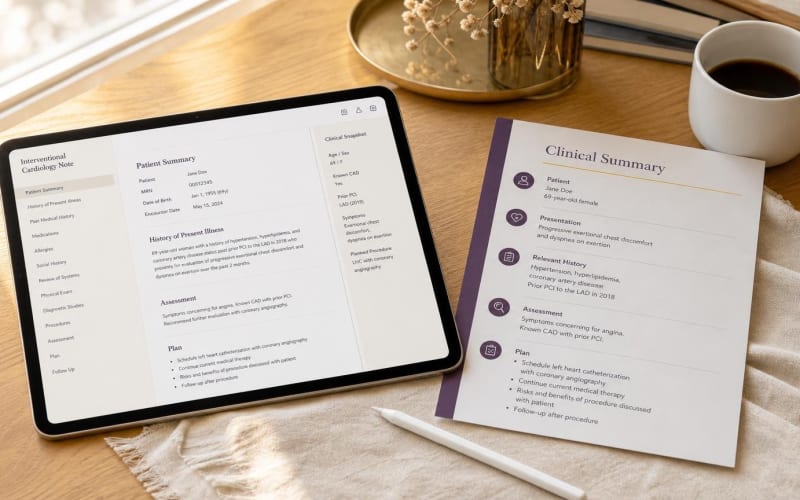
Discrete LVEF, stent date, and DAPT capture, with G2211 gated on modifier 25. Book your audit at https://cal.com/merryai/demo.

Separate Mohs stage maps from distinct E/M problems so modifier 25 holds under review. Book your audit at https://cal.com/merryai/demo.

Discrete LVEF, stent date, and DAPT capture, with G2211 gated on modifier 25. Book your audit at https://cal.com/merryai/demo.