CLINICAL MEMORY
Longitudinal Glycemic Memory
Track time in range, GMI, and hypoglycemia trends across visits. Find CGM prompt packs at Access Specialty Prompts at templates.scribing.io to draft notes in 5 seconds.
Specialty Clinical Playbook
Document TIR, GMI, and hypoglycemia with rationale for defensible 95251 reports. Book your audit at https://cal.com/merryai/demo.
 Dr. Sarah Chen, MD
Specialty Architecture
Engineered to mirror the pacing, CGM interpretation frameworks, and documentation requirements of Pediatric Endocrinology.
CLINICAL MEMORY
Track time in range, GMI, and hypoglycemia trends across visits. Find CGM prompt packs at Access Specialty Prompts at templates.scribing.io to draft notes in 5 seconds.
CONTEXT RETRIEVAL
Retrieve prior time in range, A1c and GMI comparisons, and basal or ratio changes without tab bouncing.
COMPLEXITY CAPTURE
Capture longitudinal diabetes management complexity where payer rules permit. Schedule a 15-Minute Specialty Workflow Audit today.

SPEAKER ROUTING
Separate parent, child, and educator voices and map each finding into the specialty-approved note section where it belongs.
Point-of-Care Flow
Zero IT friction, zero complex API setup, and human-verified attestation on every note.
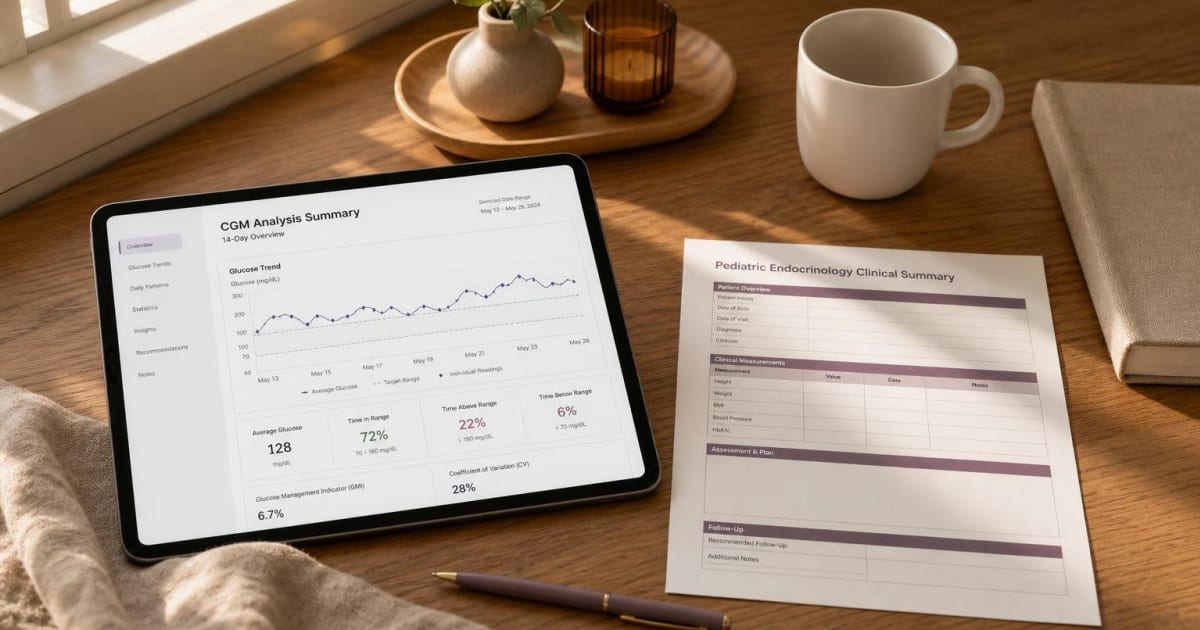
A CGM download is not an interpretation. CPT 95251 describes the professional analysis, interpretation, and report of continuous glucose monitoring data, and payers increasingly read it that way. In pediatric endocrinology, a single clinic hour may hold a newly diagnosed toddler, a pump-using adolescent, and a school nurse on speakerphone. The interpretation is often spoken aloud and then lost to a hurried summary line that reads "CGM reviewed."
That phrase rarely survives review. When a prior authorization reviewer or a 95251 auditor opens the chart, they look for quantified metrics, named patterns, and a plan that follows from them. Merry listens as you narrate the review and places each element where it belongs, so the report reflects the way you reasoned through the data.
A defensible interpretation typically states the dates or duration reviewed, confirming at least 72 hours of data. It also states time in range; time below range at both the 70 mg/dL and 54 mg/dL thresholds; time above range; glycemic variability as coefficient of variation; and the glucose management indicator where available. It then correlates patterns with meals, insulin timing, activity, sleep, or illness and records your assessment. It closes with treatment changes, education, and follow-up, authenticated by your signature. Many payers limit the service to once per month per patient, so the reviewed window should be explicit.
Each metric you speak aloud maps to a documentation field and to the evidence a reviewer will seek. The matrix below is the framework Merry uses to organize the CGM review section.
| Specialty Diagnostic Metric | Required Clinical Data Points | Billing Evidence |
|---|---|---|
| Data sufficiency | Device, sensor dates, wear time, days of data (≥72 hours) | Establishes 95251 eligibility and review window |
| Time in range (70–180 mg/dL) | Percentage, individualized target, change since last visit | Quantified control supporting interpretation |
| Time below range | % <70 mg/dL, % <54 mg/dL, nocturnal or exercise timing | Hypoglycemia risk; supports device necessity |
| Time above range | % >180 mg/dL, % >250 mg/dL, post-prandial pattern | Pattern recognition beyond raw data |
| Variability and GMI | Coefficient of variation, GMI, comparison with A1c | Cognitive analysis and longitudinal trend |
| Treatment response | Insulin dose changes, ratio or basal adjustments, rationale | Medical decision making; G2211 complexity |
Notice that the final row carries the most weight. Numbers alone describe the data. The stated rationale for a dose change demonstrates the clinical judgment that distinguishes interpretation from transcription.
Pediatric endocrinologists speak in compressed clinical shorthand, such as "TIR 64, four under 54, mostly overnight, CV 39, GMI 7.6." Merry normalizes that phrasing into discrete percentages and units. It recognizes caregiver-reported events, such as a soccer-practice low or a missed lunch bolus, and keeps them attributed to the parent rather than the clinician. Targets remain yours. If you set an individualized range for a young child, the note reflects it.
Begin with the chart open. Open your endocrine visit template in the EHR, start the Merry overlay from the Chrome Extension, and select the CGM review section. From that point, Merry routes spoken metrics into that section while the broader conversation feeds the history, assessment, and plan. There is no API configuration and no separate window to manage.
The overlay respects field boundaries. It writes into CGM documentation fields and note text, dispatching standard input events so your EHR's autosave and audit trail capture each entry. Orders, diagnoses, and billing codes stay under your direct control. When an expected element is missing, such as time below 54 mg/dL or the review window, Merry offers a quiet prompt before you sign.
Every insulin adjustment needs a reason in the record. You might say, "Reducing overnight basal by ten percent because of recurrent lows between two and four a.m." Merry records the change, the magnitude, and the pattern that justified it as one linked statement. Carbohydrate ratio changes, correction factor updates, and pump setting revisions are captured the same way, giving reviewers a clear line from data to decision.
Approvals move faster when documentation answers the reviewer's questions in advance. Sensor and pump renewals, coverage appeals, and 95251 claims all depend on the same evidence: quantified hypoglycemia, the current insulin regimen, and an explicit clinician assessment. California SB 1120 requires that medical necessity determinations rest on licensed clinician judgment. Merry structures your words and makes no determinations of its own.
For Medicare-covered patients, G2211 may apply when you serve as the continuing focal point for a serious or complex condition such as type 1 diabetes. It is generally not payable when the E/M carries modifier 25 for a same-day procedure, apart from the preventive-service exception in effect since January 2025. Modifier 59 should be reserved for genuinely distinct services the record clearly supports. Confirm current code definitions at https://www.ama-assn.org/practice-management/cpt.
Audio never outlives the encounter. Merry processes sound in volatile memory and shreds it at session end, with zero-day retention and no model training on pediatric PHI. A business associate agreement is executed before go-live. Specialty prompt packs for CGM review, new-onset diabetes education, and transition-of-care visits are available at https://templates.scribing.io.
Discrete LVEF, stent date, and DAPT capture, with G2211 gated on modifier 25. Book your audit at https://cal.com/merryai/demo.
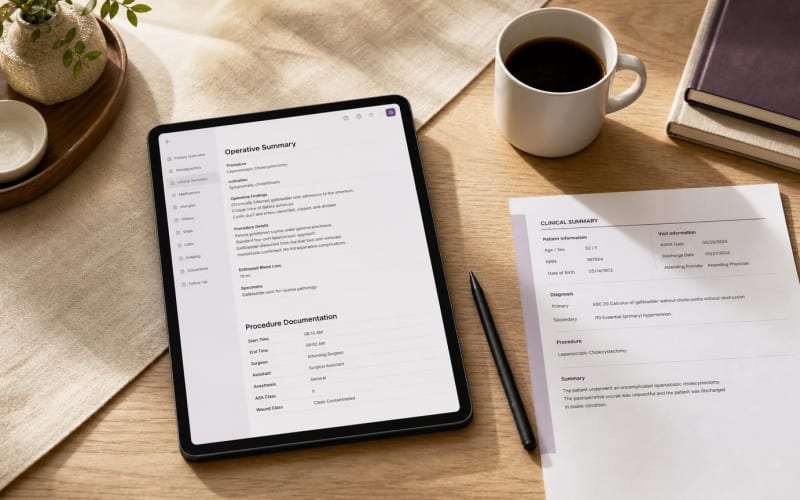
Separate Mohs stage maps from distinct E/M problems so modifier 25 holds under review. Book your audit at https://cal.com/merryai/demo.
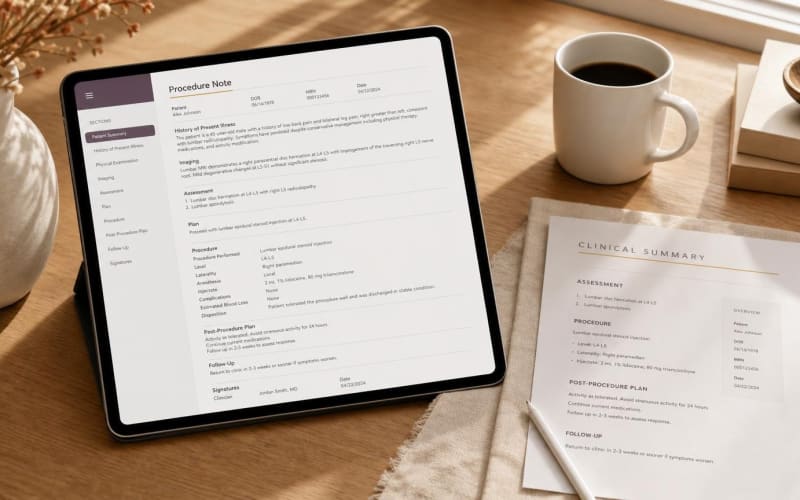
Discrete LVEF, stent date, and DAPT capture, with G2211 gated on modifier 25. Book your audit at https://cal.com/merryai/demo.