
CLINICAL MEMORY
Longitudinal Diagnostic Memory
Carry A1c trajectories, growth velocity, and regimen history across visits. Access Specialty Prompts at templates.scribing.io to generate notes in 5 seconds.
Specialty Clinical Playbook
Document A1c trends, insulin titration, and ongoing complex care for G2211 defense. Book your audit at https://cal.com/merryai/demo.
 Dr. Sarah Chen, MD
Specialty Architecture
Engineered to mirror the pacing, diagnostic frameworks, and documentation requirements of Pediatric Endocrinology.
CLINICAL MEMORY
Carry A1c trajectories, growth velocity, and regimen history across visits. Access Specialty Prompts at templates.scribing.io to generate notes in 5 seconds.

CONTEXT RETRIEVAL
Retrieve A1c trends, CGM time-in-range, IGF-1 results, and growth percentiles without tab bouncing.
COMPLEXITY CAPTURE
Capture longitudinal complexity add-on revenue with modifier 25 conflict checks. Schedule a 15-Minute Specialty Workflow Audit today.

SPEAKER ROUTING
Separate parent, patient, and educator voices and map clinical findings directly into specialty-approved note sections.
Point-of-Care Flow
Zero IT friction, zero complex API setup, and human-verified attestation on every note.
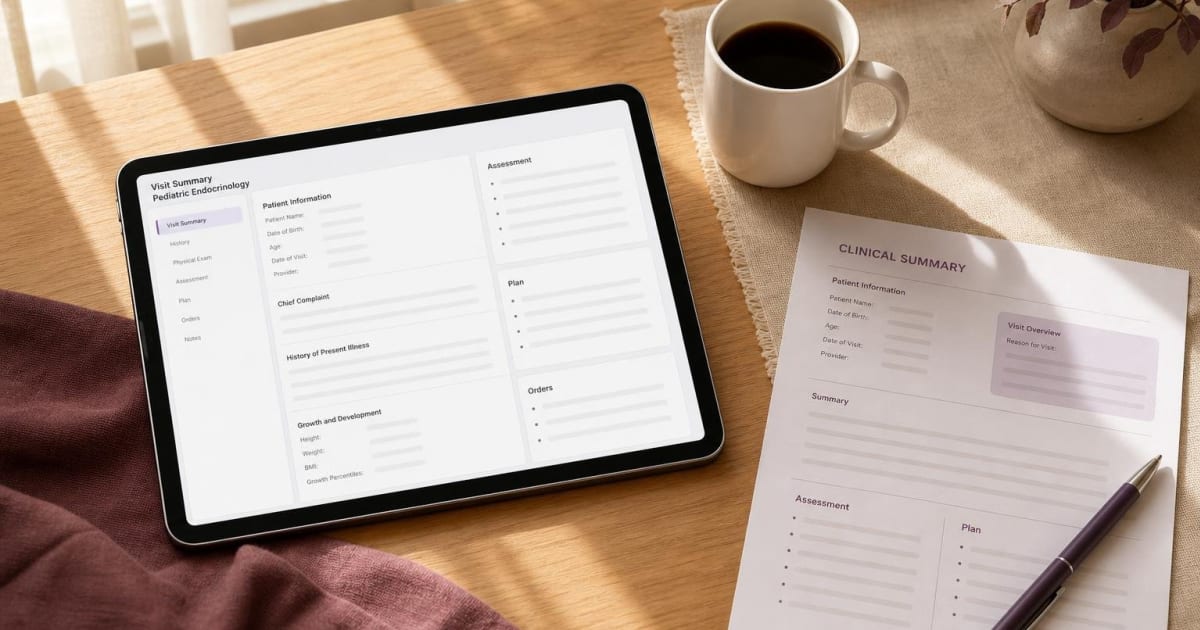
Children with Type 1 diabetes return every three months for years, often from diagnosis in early childhood through transfer to adult care. That cadence is precisely the relationship HCPCS G2211 was written to recognize: visit complexity inherent to medical care that is part of ongoing management of a single, serious condition or a complex condition. CMS added no documentation elements unique to the add-on. Reviewers read the base office visit note, the problem list, and the pattern of visits to judge whether the longitudinal relationship is real.
The practical consequence is simple. If the Assessment and Plan does not show ongoing management, the claim rests on inference. A note that reads 'T1DM, stable, continue current regimen' tells an auditor almost nothing about the work of titrating a hybrid closed-loop system for a twelve-year-old entering puberty. Merry AI drafts the plan so that the clinical reasoning already spoken in the room becomes visible on the page.
Pediatric endocrinology carries a dense set of conditions that meet the single serious or complex standard: Type 1 diabetes on pump and CGM, Type 2 diabetes with obesity and dyslipidemia, congenital adrenal hyperplasia requiring hydrocortisone and fludrocortisone, panhypopituitarism with multiple hormone replacements, and growth hormone deficiency under active dosing. Merry AI reads the existing problem list to shape the ongoing-condition statement but never writes diagnoses on its own. Diagnostic labels remain the endocrinologist's decision.
Our Chrome Extension identifies the active note editor inside your EHR browser window, including iframe-wrapped and framework-rendered editors, and locates the Assessment/Plan region by its labels. Content is appended, never overwritten, using input events the EHR recognizes so nothing is lost on save. Three elements are placed there for every qualifying follow-up visit.
First, the A1c trend line summarizes the last several values with dates and direction, for example 8.9% to 8.2% to 7.8% over twelve months, alongside CGM time-in-range and time-below-range when discussed. Second, insulin dose changes are itemized: basal rate adjustments for overnight lows, revised carbohydrate ratios at breakfast, new correction factors, or long-acting dose changes for patients on multiple daily injections. Third, a short editable statement records that the visit is ongoing management of a chronic complex condition for which you serve as the continuing endocrine focal point.
Growth is the second vital sign in this specialty. When the clinician reviews height velocity, weight, BMI percentile, mid-parental target height, Tanner stage, or a bone age reading, Merry AI drafts those observations into the growth or endocrine plan fields where your template provides them. For children on growth hormone, the note captures weight-based dose adjustments, IGF-1 results, and adherence. For thyroid patients, it records TSH and free T4 alongside levothyroxine changes.
Each row below maps a specialty metric to the data an auditor expects and the billing evidence it supports. Prompt packs that implement these mappings are available at https://templates.scribing.io. For base E/M leveling under medical decision making, refer to the AMA guidance at https://www.ama-assn.org/practice-management/cpt.
| Specialty Diagnostic Metric | Required Clinical Data Points | Billing Evidence |
|---|---|---|
| A1c trajectory | Last three to four values with dates, direction, individualized target | Chronic illness monitoring supporting MDM and G2211 ongoing management |
| CGM metrics | Time in range, time below 70 mg/dL, glycemic variability | Data review element for MDM; therapy efficacy monitoring |
| Insulin regimen changes | Basal rates, carbohydrate ratios, correction factors, MDI doses | Prescription drug management; longitudinal titration evidence |
| Growth velocity | Height and weight percentiles, velocity in cm/yr, Tanner stage, bone age | Ongoing complex condition evidence for growth disorders |
| Hormone replacement | GH dose with IGF-1, hydrocortisone stress dosing, levothyroxine with TSH and free T4 | Drug management requiring intensive monitoring |
| Acute risk history | DKA episodes, severe hypoglycemia, sick-day plan | Risk documentation supporting visit complexity |
Drug management with intensive monitoring is the strongest common thread. Insulin titration based on CGM data, documented visit after visit, establishes both the medical decision making for the base code and the longitudinal pattern that G2211 describes.
Nothing is billed without review. Every injected line appears in the editor where the clinician can see, edit, or delete it before signing. Merry AI does not sign notes, select codes, or submit claims. The physician's judgment remains the authoritative record, and the scaffold simply keeps that judgment legible.
CMS edits deny G2211 when the base office visit carries modifier 25. On days when a procedure is performed and a separate E/M is billed, such as an in-office device procedure reported with its own code, Merry AI suppresses the G2211 prompt and flags the conflict. The add-on also applies only to office visit codes 99202-99215 and home visit codes 99341-99350.
Payer policy deserves a word. G2211 is a Medicare construct, and many pediatric patients are covered by Medicaid or commercial plans whose adoption varies. Confirm local payer rules before reporting; the documentation pattern remains clinically sound regardless, because it describes care you already provide.
Visit audio is shredded from RAM once the note is drafted and accepted. No recording is written to disk by default. Encryption in transit and an executed Business Associate Agreement cover processing, and the finalized note in your EHR satisfies record retention. Practices in California and Texas should have counsel review state disclosure requirements for AI-assisted documentation.
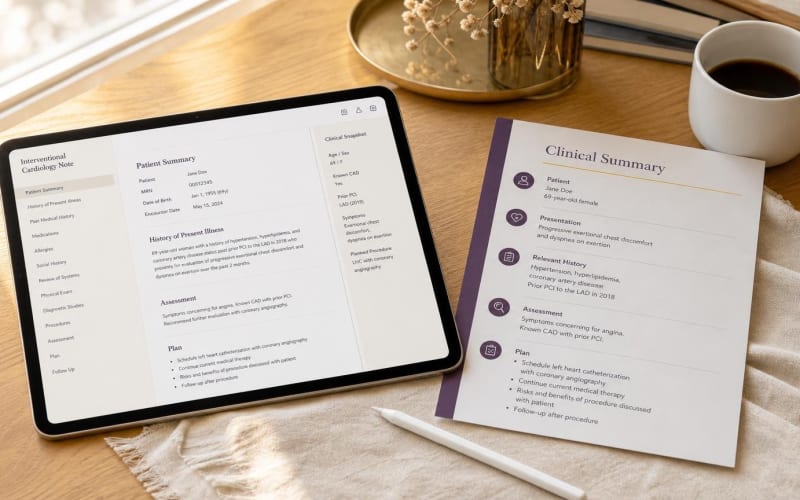
Discrete LVEF, stent date, and DAPT capture, with G2211 gated on modifier 25. Book your audit at https://cal.com/merryai/demo.

Separate Mohs stage maps from distinct E/M problems so modifier 25 holds under review. Book your audit at https://cal.com/merryai/demo.

Discrete LVEF, stent date, and DAPT capture, with G2211 gated on modifier 25. Book your audit at https://cal.com/merryai/demo.