Why Spine Notes Fail Audit Review
Most spine documentation denials begin with one vague sentence: 'decreased lumbar range of motion.' A reviewer cannot tell from that line whether flexion stopped at 30 degrees or 55. The reviewer also cannot tell whether pain or guarding limited the arc, or whether anything changed since the last visit. Prior authorization for an epidural, facet block, or decompression depends on measurable deficits, and adjectives are not measurements.
In a busy spine clinic, the surgeon dictates findings while moving between Spurling's maneuver, straight-leg raise, and a myotomal strength survey. The findings are spoken accurately but often charted loosely, because the attending is already heading to the next room. Merry AI listens to the encounter and separates the clinician's measurements from the patient's account of pain. It then prepares structured values for review, so the numbers are not buried in a narrative paragraph.
Degrees Per Plane, Not Adjectives
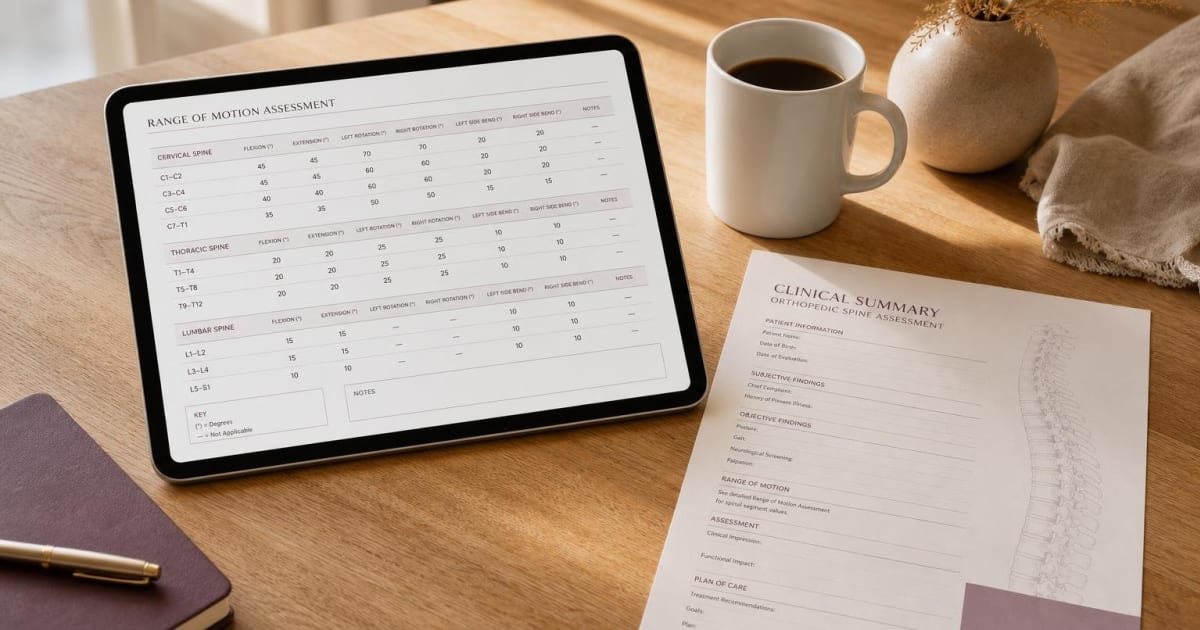
Every recorded range of motion has a plane, a side, and a degree value. For the cervical spine, the planes are flexion, extension, left and right lateral flexion, and left and right rotation. The lumbar spine uses the same six planes. When a surgeon says 'cervical rotation left sixty, right forty-five, limited by pain,' the draft records 60 and 45 degrees. It also marks the right side as pain-limited and flags the asymmetry.
Measured values sit alongside context that reviewers look for: inclinometer or visual estimate, pain-limited or mechanically limited motion, and the practice's reference arc. Neurologic findings follow the same approach. Motor strength is graded 0 to 5 by myotome from L4 through S1, and dermatomal sensory changes and reflexes are recorded as discrete entries. Oswestry and Neck Disability Index scores are stored with the encounter date so the trend over time is visible.
Dated Conservative Therapy Timelines
Payers rarely deny surgery for lack of imaging. They deny it because the chart cannot prove that conservative care was tried, for how long, and with what result. Merry AI builds a dated record of each treatment. It covers supervised physical therapy with start and end dates and total weeks. It also covers NSAID trials with agent, duration, and response, and prior epidural or medial branch blocks with the date and reported relief.
The word 'failed' is reserved for the clinician. The system drafts the timeline and response data. The conclusion that conservative management has failed, and any surgical recommendation that follows, require explicit input from the attending. This separation matters under audit. A template that always writes 'greater than six weeks of PT' regardless of history is exactly the pattern reviewers treat as record inflation.
Binding the Overlay to Exam Fields
Our Chrome Extension reads chart context from the active encounter and confirms the encounter identifier. It then maps each value to an approved field in the musculoskeletal exam section. Lumbar flexion goes to the lumbar flexion field, PT duration to the weeks field, and NSAID response to the coded dropdown. Injection pauses for clinician confirmation in two cases: when more than one chart is open, or when the page layout has changed and fields no longer match their labels.
Nothing writes to the chart without a review step. Values first appear in an in-page panel, where the surgeon edits, locks, or accepts each field before selecting Apply to Chart. Values entered manually stay locked and cannot be overwritten. Specialty exam prompts for cervical and lumbar workflows are available at https://templates.scribing.io.
Clinical Logic Matrix
The matrix below links each spine indicator to the data points a reviewer expects and the billing evidence it supports.
| Specialty Diagnostic Metric | Required Clinical Data Points | Billing Evidence |
|---|
| Cervical ROM | Six planes in degrees; pain-limited flag | Objective deficit supporting injection necessity |
| Lumbar ROM | Six planes in degrees; extension provocation | Serial change supporting G2211 management |
| Conservative Therapy | PT dates and weeks; NSAID agent, duration, response | Dated evidence for prior authorization |
| Neurologic Exam | L4 to S1 myotomes, dermatomes, reflexes, SLR | Radiculopathy specificity for ICD-10 |
| Procedure Laterality | Level, side, approach per injection | Distinct-site support for modifier 59 |
Diagnosis specificity should match the exam. Lumbar radiculopathy (M54.16), lumbar stenosis with neurogenic claudication (M48.062), and cervical disc disorder with radiculopathy (M50.1-) each require different supporting documentation. Current code descriptors are maintained at https://www.cms.gov/medicare/coding-billing/icd-10-codes.
Billing Integrity: G2211, Modifier 25, and Modifier 59
G2211 recognizes the longitudinal relationship a spine practice maintains with patients who have a single serious or complex condition. CMS has added no documentation requirements beyond those for the base E/M visit. However, reviewers read the assessment and plan to confirm that ongoing, complex management is real. Serial ROM values, dated therapy responses, and evolving surgical decisions make that relationship visible without boilerplate.
Modifier 25 requires a significant, separately identifiable E/M on the same day as a procedure. Suppose a patient receives a transforaminal epidural and is also evaluated for new symptoms. The note should then show distinct work beyond the procedure decision. G2211 is generally not payable when the base E/M carries modifier 25, apart from defined preventive-service exceptions. Modifier 59 applies only to distinct non-E/M procedures, so level and laterality must be charted as separate entries.
Provenance, Retention, and State Overlay
Each injected field carries provenance data showing whether it was suggested, edited, or entered manually, so an auditor can reconstruct how the record was built. Encounter audio is streamed for transcription and cleared from memory at zero-day retention. Because the text then becomes the only record of the encounter, clinician review is the safeguard. Practices in California and Texas should confirm their AI disclosure obligations with counsel. Merry AI supports a note footer stating that documentation was AI-assisted.