CLINICAL MEMORY
Longitudinal Skin Cancer Memory
Carry prior SCC and BCC histology, sites, and failed field therapy dates forward into every visit. Access Specialty Prompts at templates.scribing.io for Mohs consult and AK destruction packs.
Specialty Clinical Playbook
Separate E/M evaluation from 17000 destruction notes inside ModMed EMA. Book your audit at https://cal.com/merryai/demo.
 Dr. Sarah Chen, MD
Specialty Architecture
Engineered to mirror the pacing, diagnostic frameworks, and documentation requirements of Mohs Dermatology.
CLINICAL MEMORY
Carry prior SCC and BCC histology, sites, and failed field therapy dates forward into every visit. Access Specialty Prompts at templates.scribing.io for Mohs consult and AK destruction packs.

CONTEXT RETRIEVAL
Retrieve prior biopsy results, margin status, and 5-FU response at the exact body-map site without tab bouncing.
COMPLEXITY CAPTURE
Document separately identifiable E/M work and withhold G2211 on modifier 25 destruction days. Schedule a 15-Minute Specialty Workflow Audit today.
SPEAKER ROUTING
Separate surgeon, patient, caregiver, and medical assistant voices, then route findings into evaluation or procedure sections.
Point-of-Care Flow
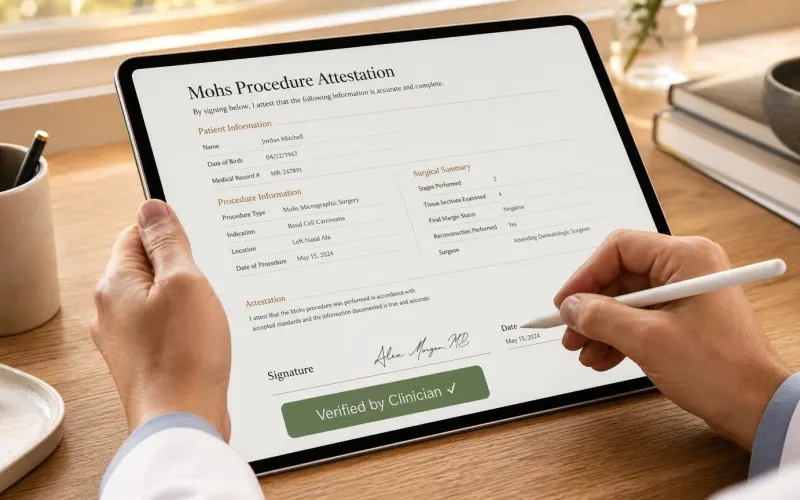
Zero IT friction, zero complex API setup, and human-verified attestation on every note.
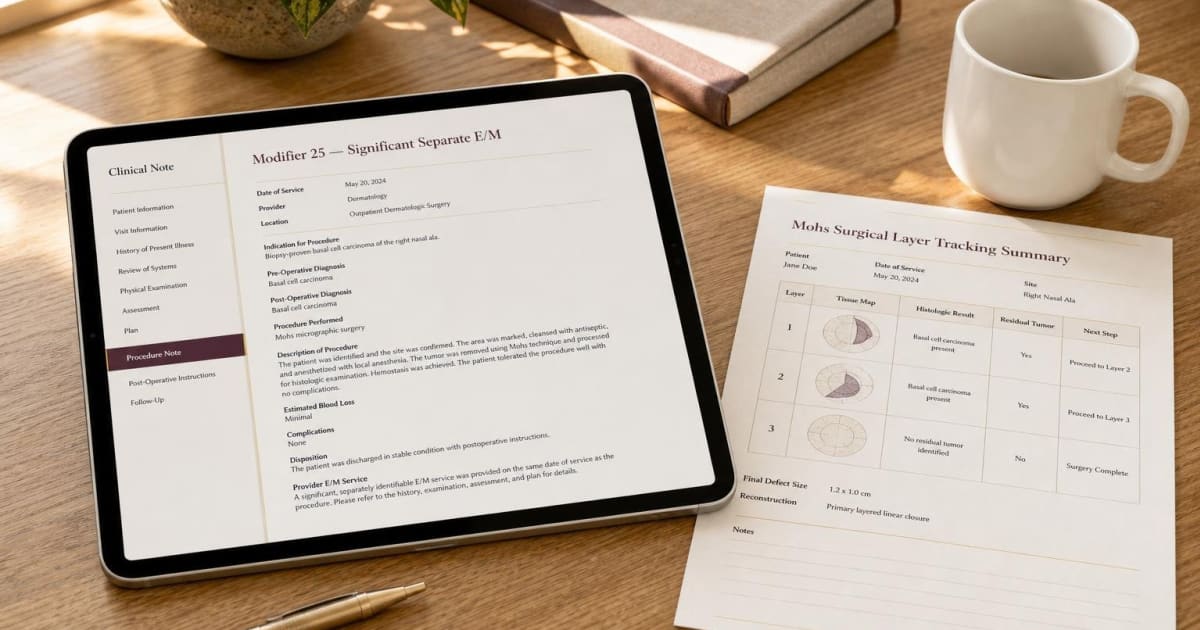
Most denied modifier 25 claims in Mohs and general dermatology clinics share a single flaw: the evaluation and the procedure read as one undifferentiated paragraph. When a patient presents for a scheduled Mohs consult and the surgeon also treats a field of actinic keratoses with liquid nitrogen, the chart must show that the evaluation reached well beyond the pre-service work bundled into CPT 17000. Under the 2026 NCCI integumentary chapter, consent, site marking, and a brief look at the target lesion belong to the procedure. They do not justify a separate E/M line.
Auditors look for distinct cognitive work. That means a new or changing lesion, a full-body skin examination in a high-risk patient, a management decision such as stopping field therapy, or a discussion of Mohs appropriateness for a recurrent tumor. When those elements are buried inside the destruction narrative, the E/M appears redundant even when the clinical work was genuinely separate.
Merry AI listens to the encounter and separates findings into two lanes. Evaluation content flows into history, exam, and assessment. Technical content flows into the procedure note. Neither lane borrows from the other.
Every destruction note begins with an exact count. CPT 17000 covers the first premalignant lesion, 17003 each of lesions two through fourteen, and 17004 a single unit for fifteen or more. Merry AI records the count, the anatomic site of each lesion, and the treatment method. Separately, the evaluation lane records prior skin cancers with histology and date, for example invasive SCC of the left helix excised in January 2024, and nodular BCC of the nasal ala treated with Mohs in 2022. High-risk sites in the H-zone, ears, hands, and genitalia are tagged so the reasoning for Mohs rather than standard excision is visible.
Failed field therapy is the clearest evidence of an escalating management decision. Merry AI documents the agent, concentration, start and stop dates, and response: 5-fluorouracil 5% cream twice daily, 09/2025 to 11/2025, incomplete clearance with progression to SCC in situ at the right dorsal hand. Imiquimod courses and photodynamic therapy sessions are logged the same way. This history supports medical necessity and anchors the decision-making that makes the E/M separately identifiable.
The procedure lane stays narrow. It holds method, freeze-thaw cycles, number of lesions treated today, anesthesia where used, immediate tolerance, and aftercare given. The evaluation lane holds the skin survey, the reasoning behind biopsy or Mohs referral, risk counseling, and the plan. When the chart is read side by side, a reviewer can see two services, not one service described twice.
The table below maps each Mohs diagnostic indicator to the data points Merry AI captures and the billing evidence that results.
| Specialty Diagnostic Metric | Required Clinical Data Points | Billing Evidence |
|---|---|---|
| Premalignant lesion count | Exact number, per-site location, method, freeze-thaw cycles | 17000, 17003 x units, or 17004 |
| Anatomic risk zone | H-zone, ear, hand, or genital designation; lesion size in mm | Mohs appropriateness for 17311–17315 |
| Prior skin cancer history | Histology, site, date, margin status, recurrence interval | MDM complexity; ICD-10 C44 and Z85.828 specificity |
| Failed field therapy | Agent, dates, adherence, clearance response | Modifier 25 decision-making support |
| Full skin examination | Regions examined, new findings, biopsy decisions | Separately identifiable E/M |
| Same-day procedure flag | Procedure performed alongside E/M | G2211 withheld when modifier 25 applies |
Coding definitions should always be confirmed against the current AMA descriptors at https://www.ama-assn.org/practice-management/cpt.
Our Chrome Extension works inside the EMA browser window without an API contract. It targets the dermatology exam fields, the body-map reference, the impression and plan, and the procedure detail fields where lesion counts and sizes live. Because EMA suggests ICD-10, CPT, and modifier codes from those structured inputs, accurate placement matters more than eloquent prose. Lesion counts land in procedure fields; prior SCC history lands in history and assessment.
Before any text is written, the extension confirms the active patient and encounter, which protects clinicians who keep several charts open. Every injected section remains editable and is attributed to the signing clinician after review. Nothing is committed without attestation.
On G2211, the logic is deliberate. CMS does not pay G2211 when the base office E/M carries modifier 25, except alongside an annual wellness visit, vaccine administration, or a Part B preventive service. Merry AI therefore withholds G2211 on destruction days and surfaces the longitudinal evidence on surveillance visits where no procedure is performed.
Specialty prompt packs for Mohs consults, AK destruction, and post-operative checks are available at https://templates.scribing.io. Patient-facing aftercare drafted by Merry AI carries a generative AI disclosure and human-contact instructions, consistent with California AB 3030.
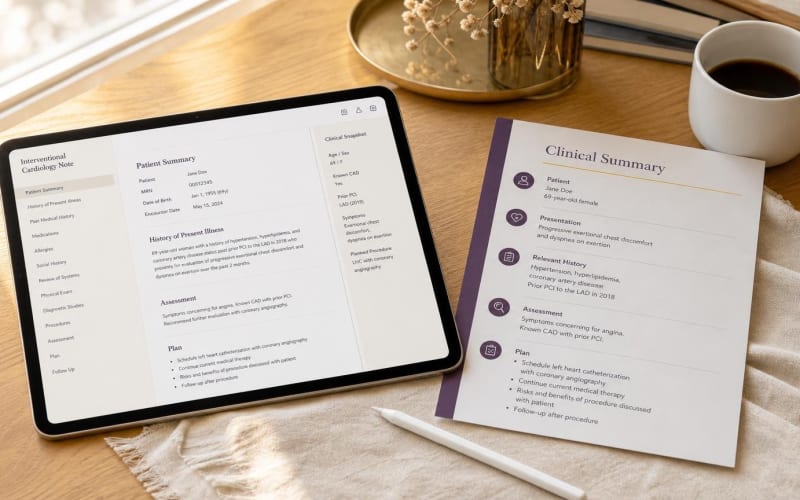
Discrete LVEF, stent date, and DAPT capture, with G2211 gated on modifier 25. Book your audit at https://cal.com/merryai/demo.
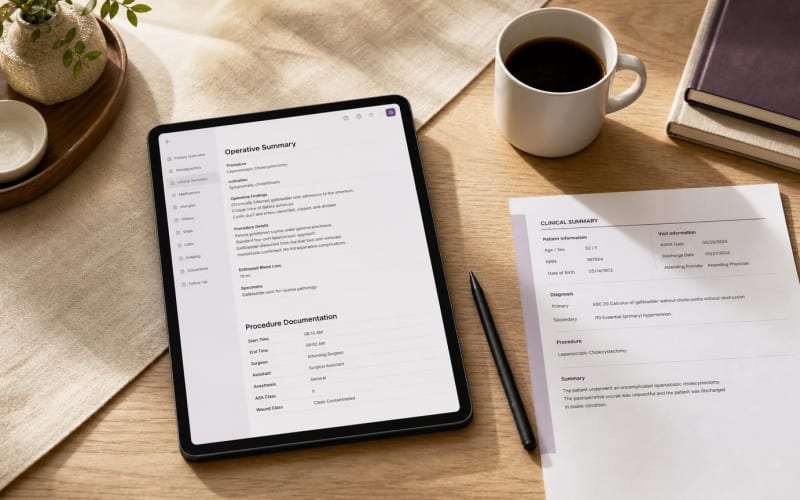
Separate Mohs stage maps from distinct E/M problems so modifier 25 holds under review. Book your audit at https://cal.com/merryai/demo.

Discrete LVEF, stent date, and DAPT capture, with G2211 gated on modifier 25. Book your audit at https://cal.com/merryai/demo.