CLINICAL MEMORY
Longitudinal Diagnostic Memory
Hold every lesion's stage sequence, block map, and margin history in one record. Find Mohs prompt packs at Access Specialty Prompts at templates.scribing.io to generate notes in 5 seconds.
Specialty Clinical Playbook
Stage, block count, anatomic site, and margin status written into your Mohs fields. Book your audit at https://cal.com/merryai/demo.
 Dr. Sarah Chen, MD
Specialty Architecture
Engineered to mirror the pacing, diagnostic frameworks, and documentation requirements of Mohs Dermatology.
CLINICAL MEMORY
Hold every lesion's stage sequence, block map, and margin history in one record. Find Mohs prompt packs at Access Specialty Prompts at templates.scribing.io to generate notes in 5 seconds.
CONTEXT RETRIEVAL
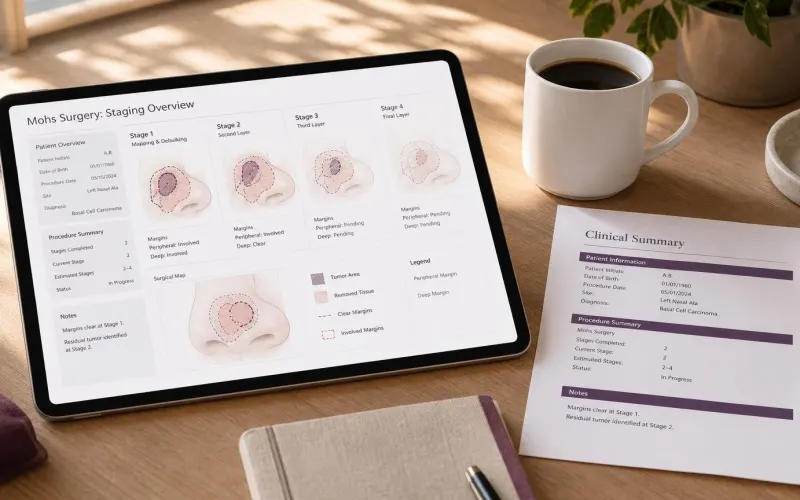
Retrieve prior Mohs maps, stage counts, and pathology history for recurrent tumors without tab bouncing.
COMPLEXITY CAPTURE
Keep separately identifiable E/M content distinct from Mohs stage documentation so G2211 is suggested only when eligible. Schedule a 15-Minute Specialty Workflow Audit today.
SPEAKER ROUTING
Separate surgeon, histotechnician, patient, and family voices, then map findings into history, stage, margin, and repair sections.
Point-of-Care Flow
Zero IT friction, zero complex API setup, and human-verified attestation on every note.
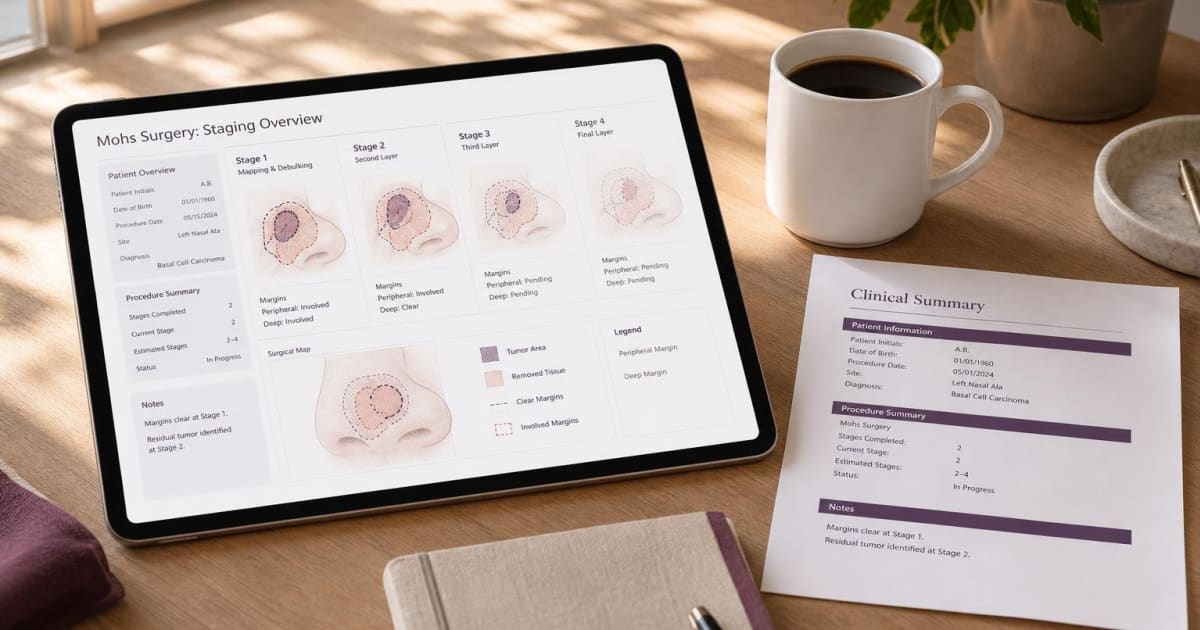
Clinical documentation in Mohs surgery is a ledger of decisions made in sequence. The surgeon excises a layer, maps it, sections it, reads the slides, and decides whether to return to the patient. Each cycle is billable under CPT 17311 or 17313 for the first stage and 17312 or 17314 for each additional stage. Each one must stand on its own when a reviewer asks how many units were justified.
Recovery auditors already know where to look. CMS approved RAC topic 0150 to verify that the Mohs surgeon acted as both surgeon and pathologist and that additional-stage units were neither excessive nor insufficient. A narrative note that says 'two stages, clear' rarely survives that review. A stage record that names blocks, margins, and the anatomic site almost always does.
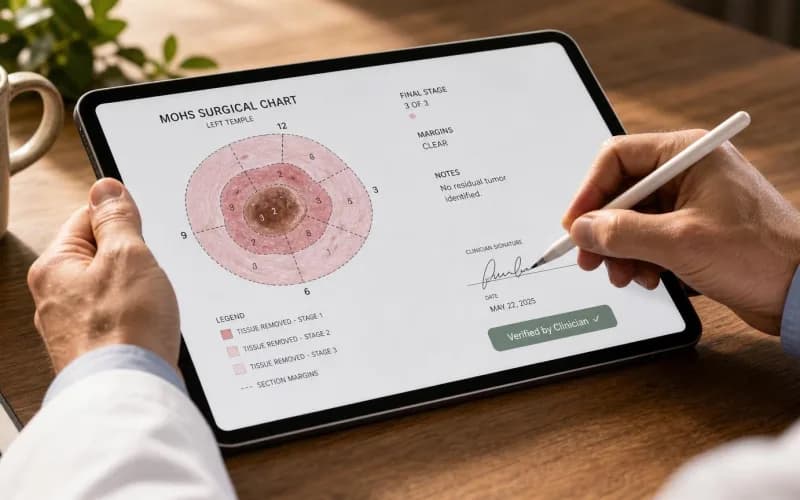
Merry AI listens for four anchors in every stage: stage number, tissue block count, anatomic site, and margin status. As you dictate at the microscope, a phrase such as 'Stage 2, three blocks, residual nodular BCC at the deep margin, 9 o'clock' is parsed into discrete values rather than left as prose. Block counts are checked against the CPT convention of up to five blocks per stage. The draft flags any stage that exceeds it so you can confirm before signing.
Anatomic site is captured with the precision 17311 requires: head, neck, hands, feet, genitalia, or any location involving muscle, cartilage, bone, tendon, major nerves, or vessels. 'Right nasal ala' or 'left helical rim' is preserved verbatim. The draft also captures the histologic diagnosis, pre-operative size, recurrence history, and the rationale for choosing Mohs over standard excision.
The matrix below shows how we translate the Mohs map into evidence that a coder and an auditor can follow without reopening the slides.
| Specialty Diagnostic Metric | Required Clinical Data Points | Billing Evidence |
|---|---|---|
| Stage number | Sequential stage per lesion, linked to its first stage | 17311 or 17313 once per lesion; 17312 or 17314 units equal additional stages |
| Tissue block count | One to five blocks per stage, block identifiers, H&E or toluidine blue staining | Supports each stage unit; blocks beyond five reviewed under 17315 |
| Anatomic site | Precise site, laterality, involvement of critical structures | Determines the 17311 versus 17313 code family |
| Margin status | Peripheral and deep status per block, clock-face orientation, residual tumor subtype | Demonstrates 100% margin evaluation and true Mohs |
| Surgeon-pathologist attestation | Personal slide interpretation, CLIA number | Bundles 88300–88309; prevents separate pathology claims |
| Repair | Final defect size, repair type, layered or flap closure | Repair codes separately reportable under NCCI |
Code descriptors should always be confirmed against the current CPT code set at https://www.ama-assn.org/practice-management/cpt. Check your local MAC article as well, such as Noridian's A56514, before configuring charge rules. Merry drafts the evidence, and the surgeon signs the attestation.
Most web-based dermatology EHRs expose a dedicated Mohs procedure template with structured fields for stage, blocks, and margins, often rendered inside a nested iframe. The Merry Chrome Extension waits until that template has loaded. It then writes each confirmed value into its own field rather than pasting a block of free text into the note body.
Each Mohs stage table cell is mapped to a stable selector. Examples include an input carrying a stage-number data attribute, a block-count input, an anatomic-site select, and a margin-status grid. After writing, the overlay dispatches the input and change events your EHR expects. Its own validation, autosave, and charge-capture logic then run exactly as they would if you had typed the values yourself.
When you move between the procedure, pathology, and charges tabs, the overlay re-reads the visible fields and reconciles them with its internal stage record before writing again. If a histotechnician has already entered block three, the overlay leaves that entry in place and surfaces the discrepancy for your review.
Separate lesions on one date are tracked under independent lesion indices, each with its own site, stage sequence, and block counts. That structure supports reporting each first stage on its own claim line with modifier 59, with additional stages linked to the correct parent code. This is the linkage reviewers check.
The 2026 NCCI manual is explicit that 17311 through 17315 include biopsy and excision codes 11102–11107, 11600–11646, and 17260–17286, along with surgical pathology codes 88300–88309 and 88329–88332. Merry never proposes those codes against Mohs tissue. Specimens from unrelated sites are labeled as distinct so they cannot be confused with margin evaluation.
Same-day evaluation and management deserves equal care. The decision to perform Mohs is generally part of the procedure. When a significant, separately identifiable problem is addressed with modifier 25, that content lives in its own E/M section. The draft does not suggest G2211 alongside it except under the narrow exceptions CMS has defined.
Audio is held in RAM only for the length of active recognition. It is never written to disk or cloud storage, and it is released at the close of each stage, so retention is zero days. The chart remains the single designated record, which is what your compliance officer and your patients would both prefer.
Mohs-specific prompt packs, including stage dictation phrasing and rationale templates, are available at https://templates.scribing.io. Most surgeons adjust one or two to match their own map conventions, and that small effort pays back on the first busy morning.
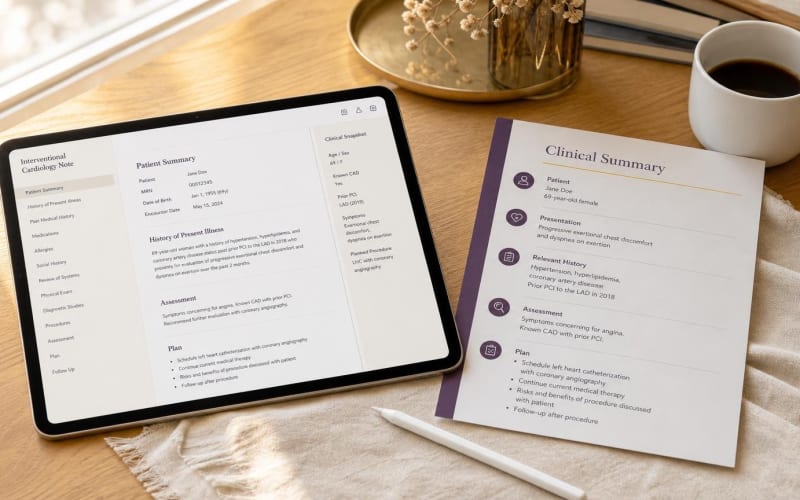
Discrete LVEF, stent date, and DAPT capture, with G2211 gated on modifier 25. Book your audit at https://cal.com/merryai/demo.
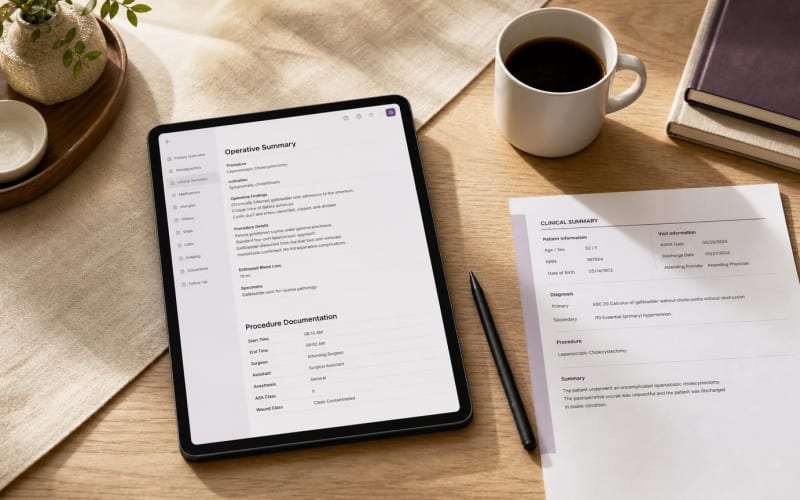
Separate Mohs stage maps from distinct E/M problems so modifier 25 holds under review. Book your audit at https://cal.com/merryai/demo.
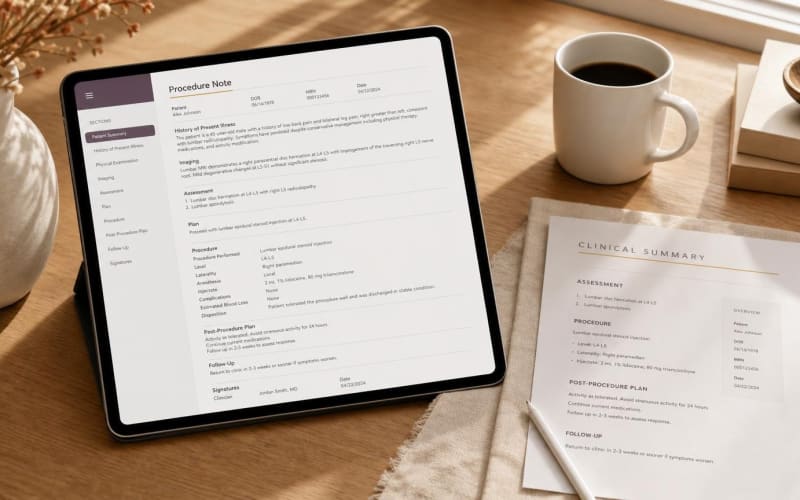
Discrete LVEF, stent date, and DAPT capture, with G2211 gated on modifier 25. Book your audit at https://cal.com/merryai/demo.