
CLINICAL MEMORY
Longitudinal LVEF and Stent Memory
Carry LVEF trend, index PCI date, vessel, and stent type forward across visits. Access Specialty Prompts at templates.scribing.io for post-PCI templates.
Specialty Clinical Playbook
LVEF, stent dates, and DAPT duration captured in every cardiology follow-up. Book your audit at https://cal.com/merryai/demo.
 Dr. Sarah Chen, MD
Specialty Architecture
Built to follow the pacing, diagnostic frameworks, and documentation requirements of post-PCI and heart failure follow-up.
CLINICAL MEMORY
Carry LVEF trend, index PCI date, vessel, and stent type forward across visits. Access Specialty Prompts at templates.scribing.io for post-PCI templates.

CONTEXT RETRIEVAL
Retrieve DAPT start date, named P2Y12 inhibitor, planned duration, and calculated stop date without leaving the note.
COMPLEXITY CAPTURE
Document ischemic versus bleeding risk reasoning that supports G2211 and Modifier 25. Schedule a 15-Minute Specialty Workflow Audit today.

SPEAKER ROUTING
Separate cardiologist, patient, caregiver, and fellow voices, then place findings into the assessment and plan sections where they belong.
Point-of-Care Flow
No IT friction, no API setup, and clinician-verified attestation on every note.
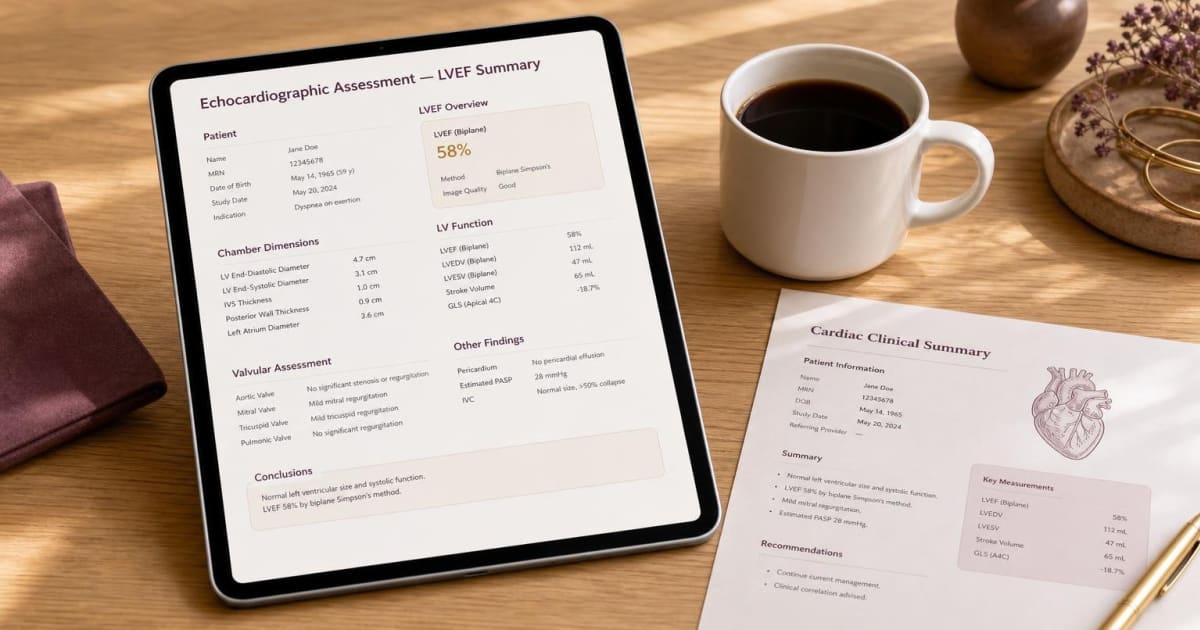
A post-PCI follow-up visit carries more quantitative weight than most ambulatory encounters. Within fifteen minutes, the clinician reviews the latest echocardiogram, confirms the index procedure, asks about bleeding, reconciles antiplatelet agents, and listens for change in exertional tolerance. Most of this is spoken aloud, and much of it never reaches the chart in a form a coder or covering partner can find quickly.
Merry AI was built around a simple observation from clinic floors: the numbers that guide decisions are the ones most often lost in narrative. 'EF is about 35 percent, down from 45 on the March echo' becomes 'reduced EF' in a rushed note. A drug-eluting stent in the proximal LAD placed on a specific date becomes 'prior PCI.' The engine listens for those quantities and keeps them intact.
Every longitudinal cardiology assessment should state three things plainly: the current LVEF percentage with its source and date, the stent date with vessel and stent type, and the DAPT duration with its planned end. Merry AI treats these as required elements. When one is missing from the conversation, the draft flags the gap before signature, while the patient is still in the room.
The LVEF value is classified against familiar thresholds: reduced at 40 percent or below, mildly reduced between 41 and 49 percent, and preserved at 50 percent or above. NYHA functional class, when stated or clearly described, is recorded alongside it, giving the reader an immediate sense of heart failure severity and the medical necessity behind device referral or a staged intervention.
The matrix below reflects how the engine reasons about each metric and how that evidence supports the claim.
| Specialty Diagnostic Metric | Required Clinical Data Points | Billing Evidence |
|---|---|---|
| LVEF percentage | Numeric value, modality (TTE, ventriculogram, cardiac MRI), study date, prior value | MDM data review; serious-condition profile for G2211 |
| Stent history | Index PCI date, vessel and segment, DES vs BMS, stent count, staged lesions | Longitudinal relationship; distinct sites for Modifier 59 or XS |
| DAPT duration | Aspirin plus named P2Y12 inhibitor, dose, start date, planned months, stop date | Prescription drug management; high-risk decisions |
| Bleeding vs ischemic risk | Bleeding history, anticoagulant use, PRECISE-DAPT or DAPT score, rationale | Risk weighing supporting moderate or high MDM |
| NYHA class | Class I to IV, exertional dyspnea, angina pattern, edema | Separately identifiable evaluation for Modifier 25 |
Each row maps to language a reviewer can verify without replaying the visit, which matters because the audio itself is never retained.
The Chrome Extension runs inside the same browser tab as your EHR. It identifies the cardiology assessment and plan editors through page structure, using accessible labels and textbox roles, and writes the reviewed content directly into them. There is no interface build, no API contract, and no tab switching. Where practices use discrete fields, such as a latest LVEF box or a planned DAPT end date, mapping can be configured per template.
Cath lab systems and enterprise EHRs often nest modules inside iframes. Rather than driving several panes at once, Merry AI commits to one active documentation pane per sync. The clinician confirms the target, the overlay places LVEF, stent chronology, and DAPT plan into their sections, and the note is ready for attestation.
Audio is processed in memory and shredded at session close. Only the signed note persists, inside your EHR, under your existing retention policy. A Business Associate Agreement is executed before go-live. Where drafts become patient-facing summaries, such as instructions on when to stop clopidogrel, the system can append disclosure language consistent with California AB 3030, including how to reach a human member of the care team.
Longitudinal complexity is easier to defend when the record shows it rather than implies it. A patient with HFrEF, three prior stents, and an active DAPT plan fits the single serious or complex condition CMS describes for the G2211 add-on to office and outpatient E/M codes. When LVEF trend, stent chronology, and DAPT reasoning appear explicitly in the assessment, the coder does not need to infer the relationship.
Same-day evaluation followed by a procedure requires a significant, separately identifiable E/M service for Modifier 25. Merry AI labels evaluative segments distinctly, for example 'Separate evaluation for new NYHA class III symptoms,' apart from procedural narrative. When interventions involve separate vessels or sessions, the note records anatomy and timing so Modifier 59 or XS rests on documented facts. Modifier 59 is never suggested for E/M lines.
For clinicians who want ready-made structures, interventional cardiology prompt packs at https://templates.scribing.io include post-PCI follow-up, HFrEF titration, and DAPT de-escalation templates. For the literature behind LVEF thresholds and antiplatelet duration, the peer-reviewed archive at https://www.ncbi.nlm.nih.gov/pmc/ remains a reliable starting point, including the ACC/ASE/ASNC/HRS/SCAI policy statement on integrating the healthcare enterprise.

Discrete LVEF, stent date, and DAPT capture, with G2211 gated on modifier 25. Book your audit at https://cal.com/merryai/demo.

Separate Mohs stage maps from distinct E/M problems so modifier 25 holds under review. Book your audit at https://cal.com/merryai/demo.

Discrete LVEF, stent date, and DAPT capture, with G2211 gated on modifier 25. Book your audit at https://cal.com/merryai/demo.