
CLINICAL MEMORY
Longitudinal Diagnostic Memory
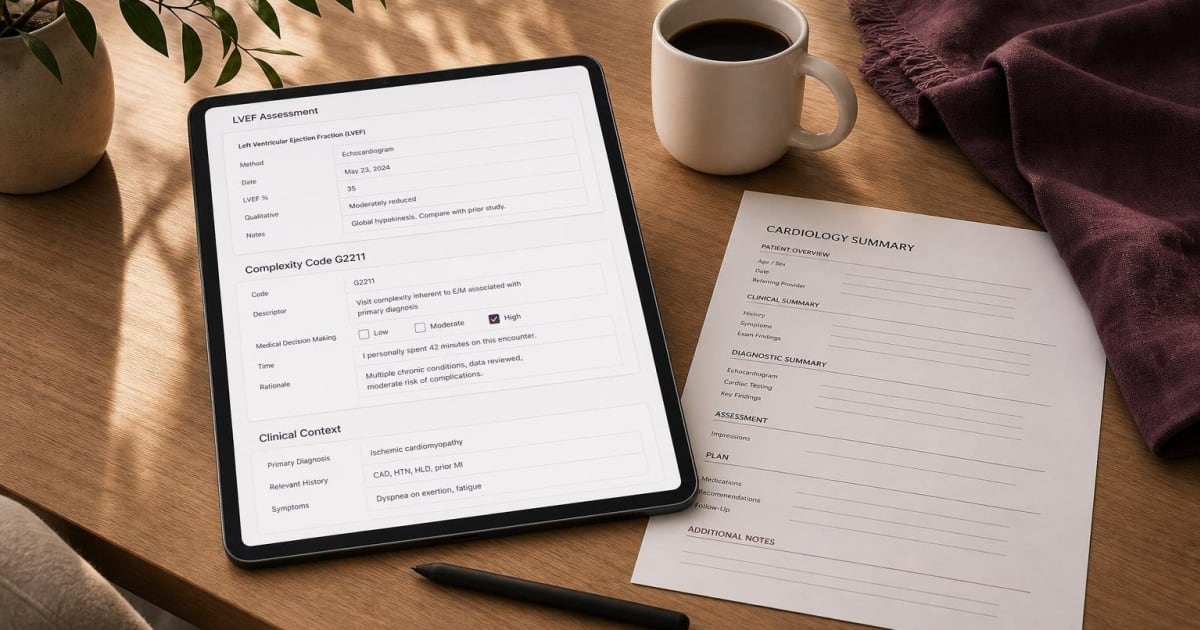
Carry serial LVEF, NYHA class, and GDMT doses forward from visit to visit. Access Specialty Prompts at templates.scribing.io to draft heart failure notes in about 5 seconds.
Specialty Clinical Playbook
Serial LVEF, GDMT titration, and G2211 attestation, drafted quietly into NextGen. Book your audit at https://cal.com/merryai/demo.
 Dr. Sarah Chen, MD
Specialty Architecture
Built to follow the pacing, diagnostic frameworks, and documentation requirements of Cardiology.
CLINICAL MEMORY
Carry serial LVEF, NYHA class, and GDMT doses forward from visit to visit. Access Specialty Prompts at templates.scribing.io to draft heart failure notes in about 5 seconds.

CONTEXT RETRIEVAL
Retrieve echo-derived ejection fraction trends, eGFR, and potassium history without moving between tabs.
COMPLEXITY CAPTURE
Capture longitudinal complexity add-on revenue with attestations tied to real disease trajectory. Schedule a 15-Minute Specialty Workflow Audit today.

SPEAKER ROUTING
Separate the patient, caregiver, nurse, and cardiologist, then route each finding into the correct section of the cardiology note.
Point-of-Care Flow
No IT friction, no complex API setup, and clinician attestation on every note.
A heart failure follow-up is rarely a single conversation. In fifteen minutes, a cardiologist reconciles last month's echocardiogram, a basic metabolic panel drawn three days ago, a patient's account of orthopnea, and a spouse's quieter observation that the ankles have been swelling again by evening. Each of these threads carries diagnostic weight. Each tends to dissolve into a generic narrative when documentation is rushed at the end of clinic.
Merry AI listens to the whole encounter and separates speakers before drafting anything. The patient's symptom report, the caregiver's observations, and the clinician's reasoning are attributed independently, so the note reflects who said what. That attribution matters when NYHA class shifts from II to III, because the evidence for that shift often comes from the person sitting beside the patient rather than the patient alone.
Every heart failure visit should carry three anchors: the serial LVEF percentage with modality and date, the specific GDMT change made today, and the next titration date. Merry AI drafts a compact trend line, for example TTE 28% in March, 34% in June, and 41% today, and binds it to the current classification of HFrEF, HFmrEF, or HFpEF. When ejection fraction recovers above 40%, the draft suggests HFimpEF language. This keeps the record from quietly reclassifying a patient whose therapy must continue.
Cardiorenal constraints belong in the same paragraph. When eGFR has fallen below 30 or potassium sits above 5.0 mEq/L, the note states the reason for holding a mineralocorticoid receptor antagonist or deferring ARNI uptitration. That deferral rationale is clinically honest. It is also the material reviewers look for when chronic kidney disease complicates cardiac management.
The matrix below describes how each cardiology indicator moves from conversation to defensible chart evidence. Our specialty prompt packs follow the same logic and are available at https://templates.scribing.io.
| Specialty Diagnostic Metric | Required Clinical Data Points | Billing Evidence |
|---|---|---|
| Serial LVEF | Study date, modality (TTE, TEE, CMR), percentage, change from prior | Supports serious condition status and data review in MDM |
| NYHA Functional Class | Exertional symptoms, limitation of ordinary activity, caregiver corroboration | Documents trajectory supporting G2211 longitudinal care |
| GDMT Titration | ARNI/ACEi/ARB, beta-blocker, MRA, and SGLT2 inhibitor doses versus target, next titration date | Prescription drug management for moderate or high MDM |
| Cardiorenal Status | eGFR, creatinine trend, potassium, diuretic response | Risk documentation and rationale for deferred therapy |
| CHA2DS2-VASc | Age, sex, hypertension, diabetes, prior stroke, vascular disease, heart failure | Anticoagulation decision-making with drug-monitoring risk |
| Device Parameters | ICD or CRT interrogation, pacing percentage, arrhythmia burden | Independent interpretation and ongoing management |
Code definitions remain the province of the AMA, and we encourage teams to verify current descriptors through https://www.ama-assn.org/practice-management/cpt. Merry AI drafts the evidence. The clinician and NextGen's own E/M logic select the code.
NextGen Enterprise cardiology content moves through ACE templates in a fixed order: Intake, Histories, SOAP, Finalize, and Checkout. Our Chrome Extension respects that sequence. It does not touch Intake vitals entered by nursing staff, and it never writes a G2211 statement into a template where it does not belong. There is no API contract to negotiate and no interface engine to configure.
The extension targets the SOAP – Cardiology assessment and plan editors specifically. These rich-text surfaces often render inside nested frames. The extension locates the active editor, confirms caret position, and inserts text through the editor's supported input methods rather than raw DOM mutation. That approach preserves NextGen's autosave, validation, and audit logging, which keeps the chart as the single source of truth.
Inserted content arrives under labeled headings: LVEF Trend, NYHA Class and Functional Status, GDMT Titration Schedule, and Longitudinal Complexity Attestation. Nothing is written until the clinician accepts it. Problem list changes, such as reclassifying HFrEF to HFimpEF in Histories – Cardiology, are offered as suggestions only. The Finalize E/M panel is left entirely to the provider.
CMS evaluates G2211 by the totality of the record. A single boilerplate sentence does not establish that a cardiologist is the continuing focal point for a serious or complex condition. Merry AI builds the attestation from three connected parts. The first is current disease status with LVEF and NYHA trend. The second is the longitudinal plan, including titration and surveillance imaging. The third is an explicit statement of ongoing responsibility and coordination with primary care and nephrology.
Same-day procedures require careful boundaries. When a cardioversion or transesophageal echo shares a date with an office visit, the longitudinal heart failure narrative stays in the E/M assessment under its own heading, and procedural documentation stays separate. That separation protects Modifier 25 claims and avoids language that reads as routine pre-procedure evaluation. Modifier 59 distinctness is preserved the same way.
Audio never outlives the note. Visit audio is buffered in volatile memory during the encounter and shredded when the clinician signs. What remains is the attested text inside NextGen, along with a log noting that ambient assistance was used. For California practices, any patient-facing summary derived from the note carries the AB 3030 generative AI disclaimer.
The result is a chart that reads the way a careful cardiologist thinks. It is built in the quiet minutes after the patient leaves rather than late in the evening.
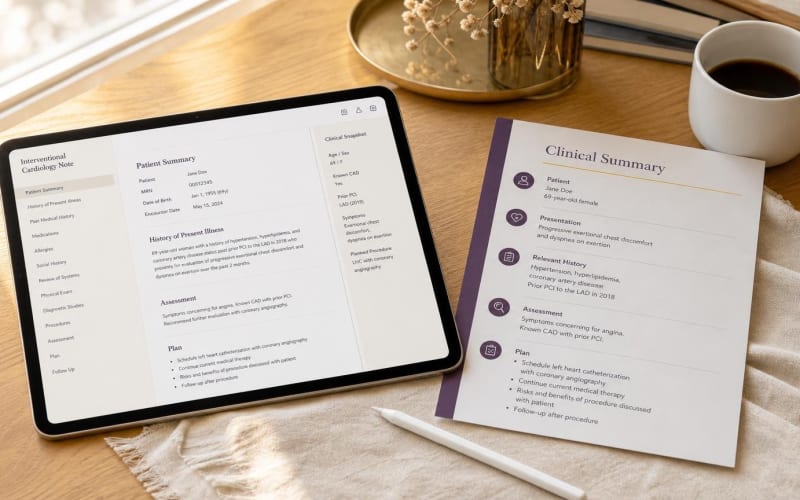
Discrete LVEF, stent date, and DAPT capture, with G2211 gated on modifier 25. Book your audit at https://cal.com/merryai/demo.

Separate Mohs stage maps from distinct E/M problems so modifier 25 holds under review. Book your audit at https://cal.com/merryai/demo.

Discrete LVEF, stent date, and DAPT capture, with G2211 gated on modifier 25. Book your audit at https://cal.com/merryai/demo.