
CLINICAL MEMORY
Longitudinal Diagnostic Memory
Carries prior LVEF percentages, NYHA classes, HF stage, and GDMT doses forward into each heart failure visit. Access Specialty Prompts at templates.scribing.io for cardiology note structures.
Specialty Clinical Playbook
Document dated LVEF and NYHA trends that support G2211 on every heart failure follow-up. Book your audit at https://cal.com/merryai/demo.
 Dr. Sarah Chen, MD
Specialty Architecture
Engineered to mirror the pacing, diagnostic frameworks, and documentation requirements of Cardiology.
CLINICAL MEMORY
Carries prior LVEF percentages, NYHA classes, HF stage, and GDMT doses forward into each heart failure visit. Access Specialty Prompts at templates.scribing.io for cardiology note structures.

CONTEXT RETRIEVAL
Surfaces echo-derived ejection fraction, device interrogation summaries, and potassium and creatinine trends without moving between tabs.
COMPLEXITY CAPTURE
States ongoing management of a single serious condition with a dated LVEF and NYHA trend in the Assessment. Schedule a 15-Minute Specialty Workflow Audit to review your HF notes.

SPEAKER ROUTING
Separates cardiologist, patient, and caregiver voices and places symptom anchors, medication adherence, and exam findings into the correct progress note sections.
Point-of-Care Flow
Zero IT friction, zero complex API setup, and human-verified attestation on every note.

Every heart failure follow-up carries a quiet question for the auditor. Is this cardiologist the continuing focal point for a single, serious condition, or simply the clinician who happened to see the patient today? HCPCS G2211 pays for the former. CMS describes the code as reflecting the inherent complexity of ongoing care. Medicare contractors look for four things: medical necessity, a longitudinal plan, evidence of the focal-point relationship, and cognitive effort that reaches beyond an episodic visit.
Most cardiology notes already contain that evidence, but it is scattered across echo reports, device interrogations, and medication histories. It rarely appears where reviewers read first. Merry AI was built around one observation from clinic: the Assessment and Plan is where complexity must be stated plainly, in the clinician's own reviewed words, with numbers attached.
A defensible Assessment names the condition, its phenotype, its stage, and its trajectory in one sentence. For example: Chronic HFrEF, Stage C, under my ongoing management; LVEF 30% (June 2023), 35% (March 2024), 42% (September 2026); NYHA class III improved to class II on ARNI, beta-blocker, MRA, and SGLT2 inhibitor at maximally tolerated doses. That single line establishes the serious condition, the longitudinal relationship, and the titration work that justifies the add-on. Merry AI drafts this sentence from the encounter and prior data. The cardiologist confirms or edits it before signing.
Heart failure documentation follows a grammar most cardiologists learned in fellowship. It includes the LVEF phenotype (HFrEF at 40% or below, HFmrEF at 41 to 49%, HFpEF at 50% or above), ACC/AHA stage A through D, NYHA functional class I through IV, and the four pillars of guideline-directed medical therapy. The engine maps each visit to these elements so the trend is visible rather than inferred.
| Specialty Diagnostic Metric | Required Clinical Data Points | Billing Evidence |
|---|---|---|
| LVEF percent (echo or cardiac MRI) | Dated value, modality, phenotype (HFrEF, HFmrEF, HFpEF) | Establishes the single serious condition and ICD-10 specificity |
| NYHA functional class | Class I to IV with a symptom anchor, such as dyspnea after one flight of stairs | Shows functional trajectory across visits for G2211 |
| ACC/AHA HF stage | Stage A to D with supporting structural findings | Confirms a chronic, progressive condition under ongoing management |
| GDMT pillars | ARNI/ACEI/ARB, beta-blocker, MRA, and SGLT2i doses; intolerances; duration at maximally tolerated dose | Documents titration as cognitive work beyond episodic care |
| Device and rhythm milestones | ICD or CRT candidacy, AF burden, interrogation summary | Demonstrates coordination and longitudinal planning |
Diagnosis coding should match the narrative. Chronic systolic, chronic diastolic, and chronic combined heart failure carry distinct ICD-10-CM codes (I50.22, I50.32, I50.42). The official code sets are maintained at https://www.cms.gov/medicare/coding-billing/icd-10-codes. If the phenotype in the Assessment and the code on the claim disagree, the G2211 argument weakens, however complete the rest of the note may be.
The engine pulls prior LVEF percentages and NYHA classes from echo interpretations and earlier heart failure clinic notes, then presents them as a dated series inside the draft. A patient whose ejection fraction recovered from 25% to 45% over three years is managed differently from one whose ejection fraction declined from 50% to 38%. Both stories support G2211, but only if the trajectory is written down. When a value is missing or ambiguous, the draft flags it for the clinician rather than guessing.
Ambient capture is only useful if the note lands in the right place. Merry AI runs as a Chrome Extension inside the clinician's existing EHR session, so no interface engine or API contract is required. After review, the structured Assessment and Plan is delivered directly into the cardiology progress note, alongside the HPI, interval history, and device findings.
Each supported note layout is mapped to specific Assessment and Plan textarea selectors, as well as to the contenteditable rich-text editors that many browser-based EHRs use. On insertion, the extension sets the field value and triggers the input and change events the EHR expects, so the chart registers the edit as the clinician's own. Each draft is tied to the active patient and encounter, which prevents it from landing in the wrong chart when a cardiologist switches tabs between visits. If a cross-origin iframe or strict content security policy blocks insertion, the note is copied to the clipboard for a single paste, and the clinician is told why.
G2211 is an add-on, not a standalone claim. It attaches to office or outpatient E/M codes 99202 to 99205 and 99211 to 99215. Beginning in 2026, it also attaches to home or residence visits 99341, 99342, 99344, 99345, and 99347 to 99350. When the E/M carries modifier 25, G2211 is payable only if the same-day service is an annual wellness visit, vaccine administration, or a qualifying Part B preventive service. Merry AI surfaces these conditions as prompts. It does not code on the clinician's behalf.
Audio is held in memory only while it is transcribed and is then discarded. No recording is written to disk or kept after the session. The resulting text is still protected health information, so it is governed under a signed Business Associate Agreement, with encryption in transit and at rest. Clinicians who want a starting point can review the cardiology prompt packs at https://templates.scribing.io. These include heart failure follow-up, atrial fibrillation rate control, and post-PCI templates.
The aim is modest and durable. Every note should read the way a careful cardiologist would write it with time to spare, and every Assessment should answer the auditor's question before it is asked.
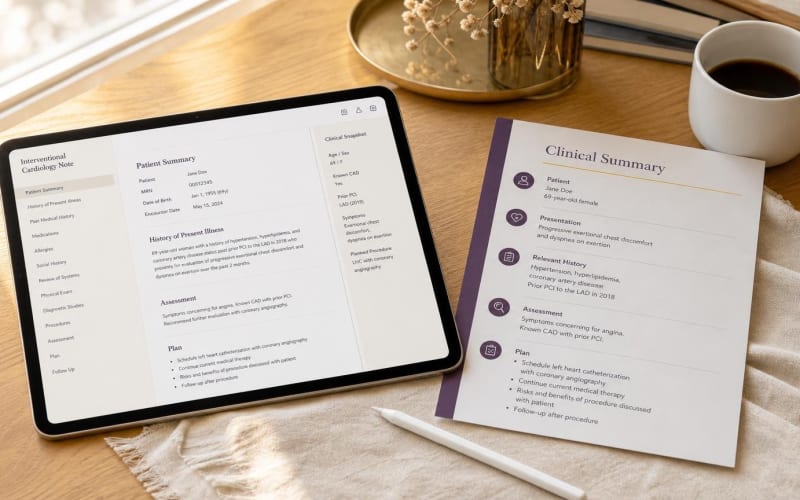
Discrete LVEF, stent date, and DAPT capture, with G2211 gated on modifier 25. Book your audit at https://cal.com/merryai/demo.

Separate Mohs stage maps from distinct E/M problems so modifier 25 holds under review. Book your audit at https://cal.com/merryai/demo.

Discrete LVEF, stent date, and DAPT capture, with G2211 gated on modifier 25. Book your audit at https://cal.com/merryai/demo.