A Documentation Workflow Built for SimplePractice
Clinical documentation inside SimplePractice rarely fails because clinicians lack dedication. It fails because the psychiatric encounter demands full presence while the record demands full precision, and the two compete for the same finite attention. SimplePractice is a HIPAA-aligned, HITRUST-certified EHR that supports SOAP, DAP, and BIRP documentation for psychiatry and psychotherapy, but the platform does not expose a public write-API for third-party note automation. That single architectural fact shapes everything about how a scribe should connect to it.
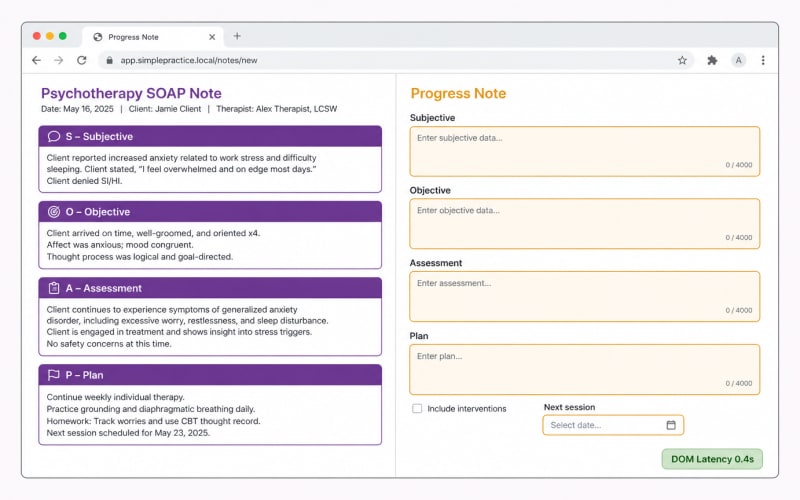
Merry AI approaches this constraint not by fighting it but by respecting it. Rather than requesting marketplace approval that SimplePractice does not offer for arbitrary note injection, our engine operates where the clinician already works: inside the browser DOM of the appointment page itself. The result is a documentation assistant that writes structured notes into the exact fields you already own and control, without touching account configuration, API keys, or IT infrastructure.
This distinction matters enormously for psychiatry and psychotherapy practices, where the record splits into progress notes that live inside the legal medical record and psychotherapy notes that HIPAA keeps deliberately separate and more private. A tool that ignores this segregation is a liability. A tool that honors it becomes infrastructure. Merry AI was engineered around that boundary from the first line of code.
Comparing Integration Architectures
Three fundamentally different paths exist for getting an AI-generated note from a transcript into a SimplePractice chart. Each carries distinct overhead, latency, and cost profiles, and the differences compound daily across a full psychiatric panel. The table below lays out the tradeoffs with the candor a systems architect owes a clinician making a durable decision.
| Architecture | Deployment Overhead | Latency | Annual Fee | SimplePractice Support |
|---|---|---|---|---|
| Traditional API Marketplace | Vendor provisioning, admin approval, API key management | 2-6s sync lag plus rate throttling | $1,200-$4,800 in marketplace + seat fees | No public write-API exists |
| Manual Copy-Paste | None, but fully human | 90-180s per note of manual transfer | Hidden cost in clinician hours | Universal but error-prone |
| Merry AI DOM Injection | User-level Chrome install, ~2 minutes | 0.4s field mapping | No API or marketplace fees | Works natively in browser |
The marketplace approach collapses immediately for SimplePractice because there is no third-party note-write endpoint to integrate against. Even where such APIs exist on other platforms, they impose synchronization lag, rate limits, and recurring per-seat licensing that scales punishingly with panel size. You pay for the privilege of waiting.
Manual copy-paste remains the default for most clinicians precisely because it requires nothing, yet it silently taxes ninety to one hundred eighty seconds per encounter in transcription drudgery and introduces transposition errors into the record. Across twenty-five patients a day, that is nearly an hour reclaimed by automation that behaves correctly.
DOM Injection Mechanics Explained
Our content script activates only on recognized SimplePractice appointment pages, confirmed through URL pattern matching and the presence of appointment metadata such as client name, provider, date, and CPT code. This narrow scoping means the extension never observes other browser tabs and never performs background collection beyond the single note field it is asked to populate.
Field targeting uses semantic anchors instead of fragile positional selectors. We locate the note text area by its label text, ARIA roles, and durable structural identifiers, then insert content by setting the field value and dispatching a native input event. Because SimplePractice's own autosave and validation logic listens for exactly those events, the injected note is treated identically to text you typed by hand, preserving the platform's integrity guarantees.
Progress Notes Versus Psychotherapy Notes
HIPAA and SimplePractice both treat psychotherapy notes as a protected category held apart from the shareable medical record, while progress notes flow into audits, coordination of care, and payer review. Our engine detects which note type you are editing and applies the appropriate template family, ensuring sensitive process reflections never leak into a record designed for external disclosure. Clinical documentation guidance from peer-reviewed literature indexed at https://www.ncbi.nlm.nih.gov/pmc/ consistently reinforces this separation as a cornerstone of psychotherapeutic privacy.
Structured Notes for the Psychiatric Encounter
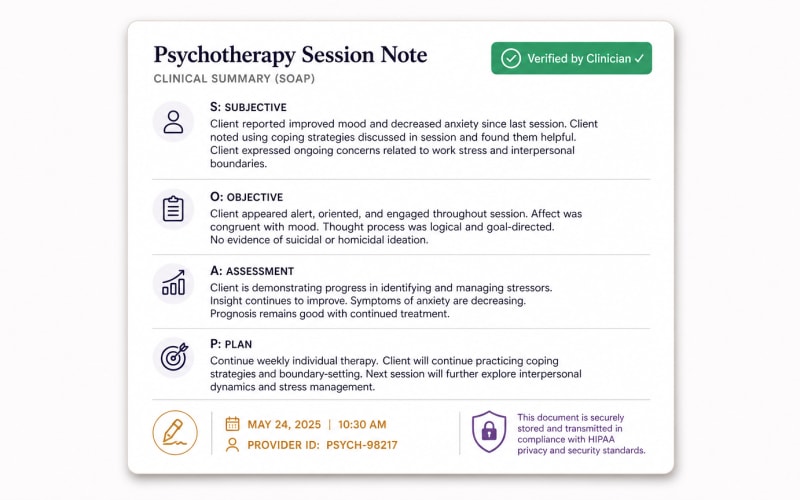
Psychiatry and psychotherapy documentation carries clinical weight that generic scribing tools underestimate. A complete note must capture the subjective presentation, an objective mental status examination, an assessment with ICD-10 diagnoses and differential reasoning, and a plan encompassing medication changes, therapeutic interventions, safety planning, and follow-up cadence. Merry AI's templates are tuned to this structure rather than bolted on afterward.
You can browse and generate from over one thousand specialty templates at Access 1,000+ EHR Clinical Templates, including psychiatry medication management SOAP, CBT session notes, psychotherapy intake DAP, and crisis-visit BIRP formats. Each maps cleanly into the SimplePractice note field and includes placeholders for the structured clinical detail that longitudinal psychiatric care requires.
CPT G2211 Complexity Capture
The CMS complexity add-on HCPCS code G2211 recognizes the inherent complexity of E/M visits that serve as the continuing focal point of a patient's care or address a single serious or complex condition, which describes a large share of ongoing psychiatric relationships. Per CMS guidance, G2211 may be reported alongside office and outpatient E/M codes 99202-99215 but is blocked when modifier 25 is appended to the associated visit. Merry AI surfaces G2211 capture cues within the note draft so eligible longitudinal encounters are documented to support the claim, without ever auto-submitting anything on your behalf.
Compliance, Data Handling, and the Author of Record
SimplePractice signs a BAA with its subscribers and maintains HITRUST certification, and Merry AI extends that chain of trust rather than weakening it. When you choose to send audio or transcript content to our processing pipeline, we act as your HIPAA Business Associate under an executed BAA that specifies permitted uses, encryption in transit and at rest, breach notification, subprocessor oversight, and secure data destruction. Our zero-retention posture means no audio or transcript persists after your note is generated.
Using our extension does not by itself certify your practice as HIPAA compliant, and we state that plainly. It supports a compliant workflow, but your practice retains responsibility for its own risk analysis, access controls, and multi-factor authentication. We provide the security documentation and enterprise deployment paths larger psychiatric groups need to satisfy their own review processes.
Crucially, you remain the author of record for every chart. Merry AI generates a draft, presents it for your review inside the appointment page, and writes nothing until you explicitly confirm insertion and apply your signature. Non-destructive behavior is enforced at the DOM level with content rollback, so a mis-click can never overwrite work you have already begun. To see this workflow mapped against your actual panel, Schedule a 15-Minute Workflow Audit.
Getting Started Without a Marketplace
Adoption follows the same logic as the architecture: minimal ceremony, maximum control. You install the Chrome Extension at the user level, open a SimplePractice appointment page, dictate or upload your session, review the structured draft, and inject it into the correct progress or psychotherapy note field. There is no vendor provisioning, no API contract, and no waiting on integration engineering.
For solo psychiatrists and group practices weighing the total cost of documentation, the arithmetic is unambiguous once you account for reclaimed clinical hours and eliminated marketplace fees. To review deployment options and pricing tuned to your practice size, Explore Merry AI Practice Partner Plans and bring your questions to a workflow audit where we walk the injection path live inside your own SimplePractice environment.